You're running two businesses and pretending they're one.
Sales and property management operate on different rhythms, different clients, different processes. Most real estate agencies try to run both with the same approach. That's why growth feels like it's breaking things instead of building them. I've helped real estate agencies untangle this. The ones that get it right don't just grow. They replicate.
The two-business problem
Here's something most real estate content won't tell you: your agency doesn't have one operational engine. It has two.
Sales is event-driven and relationship-heavy. Listings, appraisals, auctions, negotiations, settlements. Every deal is a performance. The best agents run on instinct, relationships, and competitive energy. The rhythm is lumpy: a big commission one month, quiet the next.
Property management is process-driven and volume-heavy. Tenant placement, inspections, maintenance requests, lease renewals, owner reports. Every day is a rhythm. Revenue is predictable. The work is repetitive. And the margin depends entirely on how efficiently you can manage each door.
These two machines share a team, a brand, and a database. But the operational DNA is completely different. Trying to systemise them the same way is like using the same playbook for a sprint and a marathon.
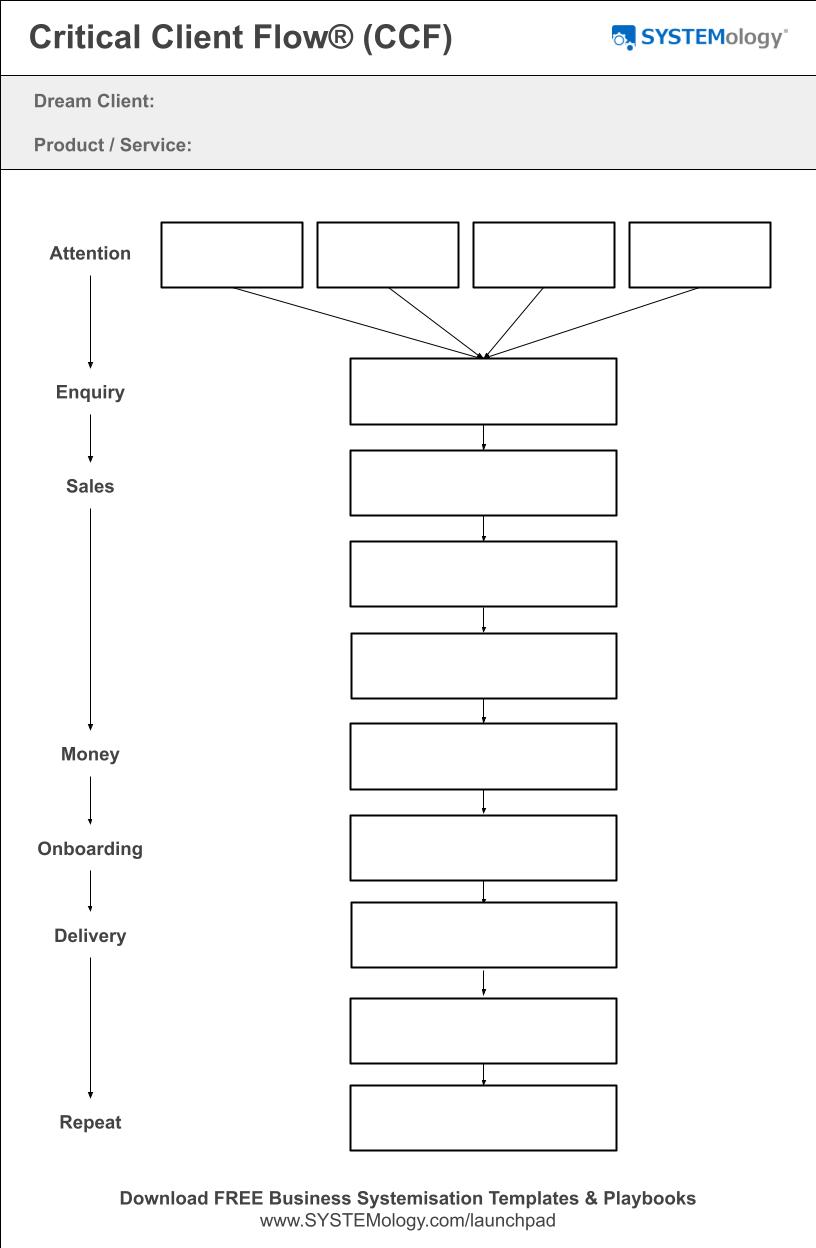
Dan Schubert, a real estate agency owner in Australia, figured this out. He built two separate Critical Client Flows. One for sales. One for property management. That decision changed how he ran his agency because he stopped treating it as one business with lots of moving parts and started treating it as two businesses that happen to share a roof.
Most agencies try to systemise everything at once. The smarter move is to recognise you have two machines, and they need different playbooks.
The sales machine
Your best agent already runs this flow instinctively. Watch them work and you'll see a pattern:
They prospect and generate leads. They win the appraisal or listing presentation. They manage the marketing campaign. They run open homes and handle buyer interest. They negotiate (or run the auction). They manage exchange through to settlement. Then they follow up for referrals and the next listing.
That's the sales Critical Client Flow. Every agent in your office follows a version of it. The difference between your top performer and your newest hire isn't talent alone. It's that the top performer has refined this flow over years of repetition. They know what to say in a listing presentation. They know how to handle a buyer objection at an open home. They know when to call and when to text.
The problem is that their instinct isn't teachable. When you hire agent number 8 or 15 or 30, they don't have that instinct. They need the playbook.
Systemising the sales machine means capturing how your best agent runs each stage: the listing presentation structure, the follow-up cadence after an appraisal, the marketing launch sequence, the auction day checklist, the post-settlement referral process. Not to make every agent a clone. To give every agent a starting point that's better than "figure it out."
The property management machine
The PM flow looks nothing like sales:
A new landlord comes on (often from a sale: "We just bought an investment, can you manage it?"). You onboard them: management agreement, property condition report, rent appraisal, marketing for tenants. You place a tenant: applications, screening, lease execution, move-in. Then the ongoing cycle starts: routine inspections every 3-6 months, maintenance management, lease renewals, monthly owner statements. Eventually a tenant exits and you re-let.
This is a completely different operational rhythm. It's not about winning deals. It's about managing volume consistently. The agency with 200 doors and tight systems makes more profit per door than the agency with 500 doors and chaos.
The metrics are different too. Sales measures listings won and commissions earned. Property management measures doors under management, vacancy rates, maintenance response times, and landlord retention. A lost landlord doesn't just mean one lost fee. It means losing that door's management fee every month for years.
Systemising the property management machine means documenting the tenant placement process, the inspection procedure, how maintenance requests get triaged, how owner reports get generated, and how lease renewals are handled. These are high-volume, repetitive processes. They're exactly the kind of work that falls apart when it lives in one person's head and breaks when that person goes on leave.
Where they connect and where they conflict
The two machines aren't independent. They intersect at critical moments.
The investor handover. An agent sells a property to an investor. That investor needs property management. This is either a seamless handover (the client feels looked after by the same agency) or a dropped ball (the PM team doesn't know the client exists until they call a month later asking why nobody's found them a tenant). A documented handover system between sales and PM is one of the highest-value processes in a real estate agency.
Shared resources. Your admin team, your CRM, your brand reputation. When the sales team is in campaign mode and the PM team needs admin support for end-of-month owner statements, who wins? Without documented priorities and workflows, the squeakiest wheel gets the grease.
Conflicting rhythms. Sales wants speed. PM wants thoroughness. An agent wants a tenant placed fast so the landlord is happy. The PM team wants proper screening so they don't end up with a problem tenant. Both are right. Systems resolve this tension by defining the standard: "Here's our screening process. It takes 5 business days. Non-negotiable."
The 30-hires-a-year problem
Maddie Todd works in property management for an agency growing at a rapid rate. Her biggest challenge isn't processes or technology. It's training.

"Imagine hiring 30 new people every year, and having a chatbot that new hires could ask questions about processes and procedures. I see the use case being nothing short of incredible."
She's describing the real estate training bottleneck. Every fast-growing agency hits it. You bring on new agents and new property managers, and they take months to become productive. Not because they're not smart. Because nobody has written down how things work.
Time-to-productivity is the metric that matters most for a growing agency. If a new agent takes 6 months to close their first deal, that's 6 months of salary, desk fees, and management attention before any return. If a new property manager takes 3 months to manage a portfolio independently, you're bottlenecking your rent roll growth at whatever rate your existing PMs can absorb.
Documented systems compress this timeline. Not by cutting corners. By giving new people a clear playbook instead of having them piece it together from watching and asking.
What to systemise first
Here's where this article diverges from generic advice. The answer depends on which machine is breaking.
If you're losing landlords or your PM team is drowning: Start with property management. Document the tenant placement process (from marketing to move-in), the routine inspection procedure, and the maintenance triage workflow. These three systems handle the highest volume of work and create the most consistency for landlords.
If new agents are floundering or you can't replicate your top performer: Start with sales onboarding. Document the listing presentation framework, the buyer follow-up cadence, and the new agent's first-90-days training plan. Capture how your best agent works and make it teachable.
If both are breaking: Start with whichever generates more predictable revenue. For most agencies, that's the rent roll. Management fees are recurring. Commissions are not. A stable rent roll gives you the financial base to invest in sales training.
Whatever you start with, find your Systems Champion. Not your best agent (they're too busy selling). Not the principal (they're too close to it). Your office manager, your operations coordinator, or your most organised PM. Someone who can interview the best performers, watch how they work, and document it.
Put the systems in one central place your team can access from anywhere. Not buried in the CRM. Not in a shared drive nobody opens. systemHUB is built for this, but whatever you use, your team needs one place to check before they ask the principal.
AI in real estate
This is where real estate has an advantage over most industries. Property management is 80% routine communication. And routine communication is exactly what AI handles best.
Inspection reminders and reports. Maintenance request triage and follow-up. Lease renewal notices. Monthly owner statements. Tenant inquiries about parking, pets, and bond refunds.
This isn't aspirational AI. This is practical, right-now AI. Agencies using documented systems can layer AI on top today: automated inspection scheduling, AI-drafted maintenance updates to owners, chatbots that answer common tenant questions from your documented procedures.
Maddie Todd's vision of a chatbot that new hires could ask about processes? That's possible right now. But only if the procedures are documented in a central system first. AI can't answer questions about processes that live in someone's head.
Process first, then AI. The agencies getting the most from AI are the ones who documented their property management procedures first, then used AI to accelerate them.
The numbers that matter
Real estate agencies run on specific metrics. If you're not tracking these, you're managing by feel.
| Metric | Why it matters |
|---|---|
| Doors under management | Your recurring revenue engine. More doors with tight systems = more profit per door. |
| Agent time-to-first-listing | How fast new hires become productive. Shorter = better ROI on every hire. |
| Listings per agent per month | Individual productivity. Systems create consistency across the team. |
| Vacancy rate | PM operational efficiency. Every vacant week is lost revenue for your landlord and your agency. |
| Maintenance response time | Tenant satisfaction and retention. Fast response = fewer escalations. |
| Landlord retention rate | Rent roll stability. Losing a landlord costs years of management fees. |
| Days listing to settlement | Sales cycle efficiency. |
The agencies with the best numbers aren't the ones with the most talented people. They're the ones where the systems create a floor of performance that everyone operates above.
Scaling to multiple offices
The ultimate test of a systemised real estate agency: can you open a second office?
If your first office runs on the principal's instinct and the office manager's memory, the second office will struggle from day one. You can't clone people. You can clone systems.
The agencies that successfully open second and third offices do it by documenting their two machines (sales and PM), training new staff on documented playbooks, and measuring performance against consistent benchmarks. The systems become the franchise model, whether you're franchising or not.
If you're thinking about this, read our guide on how to prepare your business for sale. The same principles apply: a business that runs on systems is worth more than a business that runs on one person.
Learn more →
And the framework works the same way across industries. The same approach has been used in construction, plumbing, accounting, allied health, law firms, and digital agencies.
The agencies that scale to multiple offices don't do it by finding more talented agents. They do it by building two machines that run without the principal on every call, at every auction, and in every inspection. One machine for sales. One for management. Both documented. Both teachable. Both scalable.
If you're ready to see what that looks like for your agency, book a free Good Fit call and we'll map it out together.
Not ready for a call? Start with the full SYSTEMology framework and see how the method works.