Systemising a construction business means documenting the critical steps your company follows, from first inquiry to final handover, so your team delivers consistent results without you on every job site. I've helped hundreds of trades businesses do exactly this. And the construction owners who get it right don't just build better businesses. They get their lives back.
If you're a builder, contractor, or construction business owner working 60-hour weeks and wondering how to step back without everything falling apart, this guide is for you. It's based on real case studies from construction businesses in Australia and New Zealand that made the shift.
Why do construction business owners get stuck?
You started your construction business because you were good at the work. Maybe the best. You could build things other people couldn't. You could solve problems on site that stumped everyone else.
And that's exactly the trap.
Because now you're the one answering every question. You're quoting jobs, managing sites, chasing suppliers, handling client complaints, and somehow still trying to grow the business. The team can't make a decision without you. If you take a week off, things go sideways.
This is what I call the "owner's trap." You've built a successful company, but it can't run without you.
Here's the paradox: the behaviours that made you successful are the same ones keeping you stuck. Working harder, being across every detail, personally managing quality. Those traits got you to where you are. But they stop working at scale. You can't be on every site. You can't quote every job. You can't train every apprentice by having them shadow you.
The problem isn't effort. It's leverage.
Every construction business hits the same bottlenecks:
- Quoting is inconsistent. One estimate looks completely different from the next because it's all in someone's head.
- Site handovers fall through the cracks. When one crew finishes and another starts, information gets lost. Mistakes happen.
- Quality varies between crews. Your best work happens when you're on site. When you're not? It's a coin flip.
- The phone never stops ringing. Everyone needs you for everything, all day, every day.
- New staff take forever to get up to speed. Because the "training" is just following you around and hoping they pick it up.
Sound familiar? You're not alone. (If you want to see how dependent your business is on you right now, try the Owner Dependency Score. It takes two minutes.) And there is a way out.
What does a systemised construction business actually look like?
Before I explain the method, let me show you the result.
Ryan Stannard owns Stannard Family Homes in Adelaide. Custom home building. The kind of complex, high-stakes construction where every project is different and there are a thousand things that can go wrong.
A few years ago, Ryan was stuck in the classic owner's trap. He was the expert everyone depended on. Every decision went through him. He couldn't step away for a week, let alone a month.
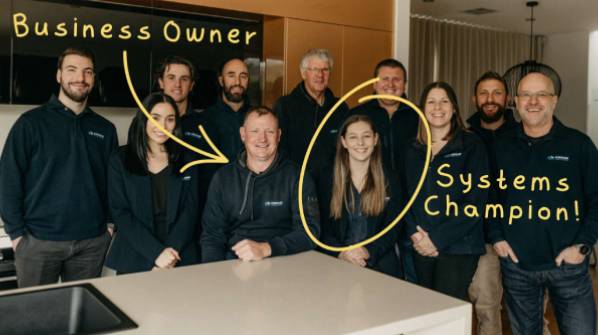
Today? Ryan takes 7-week holidays. The business has grown to $15 million in revenue. And here's the part that surprises people: his daughter Eryn, who started with zero construction experience, is now the assistant manager running operations. She was 21 when she stepped into that role.
How? Ryan appointed Eryn as his Systems Champion. She documented every process in the business. When the interior designer quit, Eryn stepped in, rewrote the systems for that role, and was managing it within months. She progressively took on HR, accounts, and more.
The business now runs on its systems, not on Ryan.
They're even planning to launch a new business arm by copying and pasting their existing systems into a new entity. That's the power of a systemised construction business. It becomes an asset you can replicate, not a job you're trapped in. You can read Ryan's full case study here.
What is a Critical Client Flow for construction?
The Critical Client Flow (CCF) is the backbone of systemising any business. It's the visual map of every step your client goes through, from the moment they contact you to the moment the project is complete and they're referring you to someone else.
For a construction business, it typically looks like this:
- Lead comes in (phone call, website, referral)
- Initial consultation (site visit, scope discussion)
- Quote or estimate (pricing, inclusions, timeline)
- Contract signed (terms, deposit, start date)
- Pre-construction planning (permits, materials, scheduling)
- Build phase (site management, progress updates, quality checks)
- Handover (walkthrough, defects list, final sign-off)
- Follow-up (warranty, review request, referral)
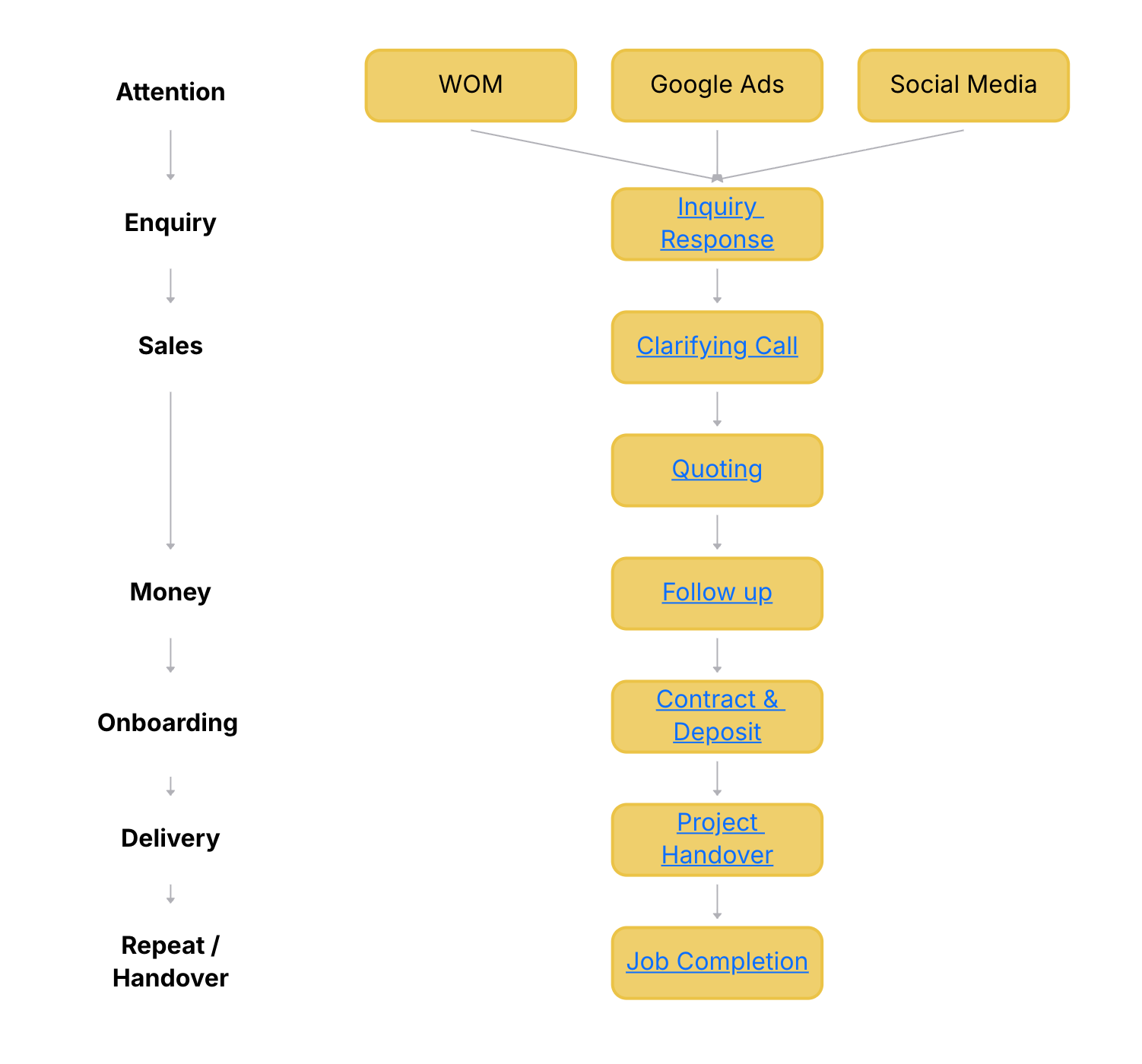
Every construction business will have its own variation. Zak Johnson from ZJ Building, a design-and-construct firm in Australia, discovered he actually needed two separate operations flows. The design phase and the build phase operate so differently that they required their own department structures and systems.
That insight is important. You don't need to force your business into a generic template. Map your own flow. But having it mapped at all? That's the shift.
Once you can see the whole journey on one page, the bottlenecks become obvious. You'll spot the steps where things break down, where clients get frustrated, and where your team gets stuck waiting for you.
How do you start systemising a construction company?
Here's the practical, step-by-step process. This isn't theory. It's what the construction businesses I've worked with actually did.
Step 1: Map your Critical Client Flow
Grab a whiteboard or a sheet of paper. List every step a client goes through, from first contact to project completion. Don't overthink it. Get it down.
For most construction businesses, this is 10 to 15 steps. The goal isn't perfection. It's visibility. You need to see the whole picture before you can improve any part of it.
Step 2: Appoint a Systems Champion
This is the person who will drive the documentation process. And here's the thing most construction owners get wrong: it doesn't need to be your most experienced builder.
Remember Eryn Stannard? She was 18 with no construction experience when she started. But she had the right mindset. She asked questions. She challenged the way things had always been done. She documented processes that Ryan had never put on paper.
Your Systems Champion doesn't need to know how to read blueprints. They need to know how to extract knowledge from the people who do.
Look for someone on your team who is organised, curious, and not afraid to ask "why do we do it this way?" That's your person.
Step 3: Document the top three bottleneck systems first
You don't need to document everything. Start with the three processes that cause the most pain, waste the most time, or create the most inconsistency.
From working with hundreds of trades businesses, I've found there are three systems that are most commonly missed and have the highest ROI when you fix them. Construction is no different:
- The quoting and follow-up process. How a quote gets built, what's included, how it's presented, and critically, how follow-ups work. Most builders quote a job, email it, and hope for the best. A structured follow-up (Day 1: confirm receipt. Day 3-5: check in. Day 7-10: closing question. Day 14: final follow-up) can lift your quote conversion rate from 20% to 40-50%.
- The project handover meeting. This is the biggest cause of job failures in construction: the person who quoted the job isn't the same person delivering it. A mandatory handover meeting between your estimator, operations manager, lead tradesperson, and the client's project manager before work starts prevents scope misunderstandings, rework, and margin erosion.
- Defects and snag list management. How defects get reported, tracked, and resolved. This is often the most chaotic part of a construction business, and the one that damages client relationships fastest.
Document these three first. Get your team using them. Then move to the next three.
For context, a fully systemised construction business typically has around 30 systems across six departments: marketing, sales, operations, finance, HR, and management. We've built complete template packs for trades businesses that map all of these out. But you don't start with 30. You start with three.
Step 4: Put it all in one central place
Your systems need to live somewhere your whole team can access. Not in a filing cabinet. Not in a shared drive nobody checks. Not in your foreman's head.
Construction teams work on site, on the road, on their phones. Your systems need to be accessible from a tablet or a phone, anywhere, anytime.
This is exactly why I built systemHUB. It's designed for businesses like yours, where the team needs to find the right process fast, follow it consistently, and get back to work.
But the tool matters less than the habit. Whatever platform you choose, the key is: one central source of truth that everyone uses.
Learn more →
Real results from systemised construction businesses
Ryan Stannard isn't an isolated case. Here are three more construction and trades businesses that made the same shift.
Davies Construction, New Zealand
Luke Davies builds custom homes in New Zealand. Like Ryan, he was trapped managing every detail of every project. Long hours. Immense stress. No capacity to grow because he was the capacity.
After reading SYSTEMology, Luke documented every stage of his design-and-build workflow. From the initial client meeting through to handing over the keys, every step is now in a central playbook his team follows.
The result? Luke extracted himself from day-to-day project management. He now focuses on sales and growth while his team delivers projects consistently. The business is more scalable, more profitable, and Luke has his passion for the work back.
Titan Electrical, Australia
Dimitri Markakis runs Titan Electrical. Electrical contracting involves high safety standards, strict compliance, and complex project coordination. Dimitri was caught in the "tradie trap": master technician, salesperson, and manager all at once.
He documented his core processes: how to quote a job, safety procedures for being on-site, installation processes, and how to complete and bill for work. Everything went into systemHUB as a central playbook for his team.
Now, new apprentices and electricians get trained faster. The quality of work stays consistent across every crew. And Dimitri has a foundation to scale without hiring beyond what the quality can support.
Dr. Drip Plumbing, Sydney
Andy and Angela Smith run Dr. Drip Plumbing in Sydney. Emergency call-outs, scheduled jobs, quoting, invoicing, and a team of plumbers on the road. Without systems, it was chaos. Andy and Angela were tied to the phone around the clock.
They documented everything: how the phone gets answered, how jobs are dispatched, the on-site procedure for plumbers, and how invoices are issued. New plumbers can now be trained quickly. The business runs more smoothly. And Andy and Angela have stepped back from the daily grind.
Three different trades. Three different countries. Same result: the owners got their time back.
What about AI and automation in construction?
AI is changing how fast you can systemise a business. But here's the critical point: process first, then AI.
If you try to automate chaos, you just get faster chaos.
Once your processes are documented, AI can accelerate everything:
- Draft SOPs from verbal descriptions. Record yourself explaining how a process works, and AI turns it into a documented system.
- Create dynamic checklists that adapt based on project type, site conditions, or trade stage.
- Speed up onboarding. New team members can ask an AI assistant about company procedures and get instant, accurate answers based on your documented systems.
The construction businesses getting the best results with AI are the ones who mapped their processes first. AI is the accelerant. Systems are the foundation.
The bottom line
Systemising a construction business isn't about creating bureaucracy. It's about building a business that works without you being on every site, answering every call, and making every decision.
Here's what it takes:
- Map your Critical Client Flow.
- Appoint a Systems Champion.
- Document your top three bottleneck systems.
- Put it all in one central place your team can access.
Ryan Stannard did it and now takes 7-week holidays while his $15 million business runs without him. Luke Davies did it and got out of daily project management. Andy and Angela Smith did it and got their plumbing business off their backs.
As Tony Fraser Jones from The Profitable Tradie puts it: "You don't rise to the level of your goals. You fall to the level of your systems."
The construction businesses that win aren't the ones with the best builders. They're the ones with the best systems.
If you're ready to see what that looks like for your business, book a free Good Fit call and we'll map it out together.
Not ready for a call? Start with the full SYSTEMology framework and see how the method works.