Systemising a plumbing business means documenting how every job flows from the first phone call to the final invoice, so your team delivers consistent, professional service without you dispatching every job and answering every question. I've helped hundreds of trades businesses do this. And the plumbing business owners who get it right stop working 60-hour weeks and start building a business that's worth something beyond their own two hands.
If you're a plumber who's built a successful business but can't take a week off without everything falling apart, this guide is for you. It's based on a real case study, a proven 9-stage framework, and the specific systems that make the biggest difference for plumbing companies.
Why do plumbing business owners get stuck?
You started your plumbing business because you were good at the work. Probably the best plumber in your area. Clients loved you. Builders kept calling back. The business grew.
And that growth is exactly what's trapping you now.
As Tony Fraser Jones from The Profitable Tradie puts it: "Tradies are good at something, but that creates the success that then leads to the downfall because of the growth that comes when you're good at something."
Here's what happens. You hire a couple of plumbers. Then an apprentice. Then someone for the office. Suddenly you're managing emergency call-outs, scheduled jobs, quoting, invoicing, and a team of people on the road. You're the dispatcher, the salesperson, the quality inspector, and the problem solver. All at once.
The behaviours that made you successful, being across every detail, personally checking every job, answering every call, stop working when you have 10 or 15 people. You can't be on every site. You can't quote every job. You can't answer every phone call.
But without documented systems, your team doesn't know how you want things done. So they either guess (and get it wrong) or they call you (and you're back to being the bottleneck).
Every plumbing business hits the same pain points:
- You're tied to the phone 24/7. Emergency call-outs don't care that it's Sunday morning. And your team won't make decisions without checking with you first.
- Quoting is slow and inconsistent. Every quote gets built from scratch because there are no templates. It takes days instead of hours.
- You send quotes and hope. No structured follow-up. You price the job, email it, and wait. Half the time you don't even know if the builder opened it.
- New plumbers take months to get productive. The "training" is shadowing a senior plumber and figuring it out. There's no playbook.
- Quality varies from crew to crew. When you're on site, the work is excellent. When you're not, it's a coin flip.
Sound familiar? You're not alone. (Want to see how dependent your business is on you? Try the Owner Dependency Score. Takes two minutes.) The fix isn't working harder. It's building systems.
What does a systemised plumbing business actually look like?
Before I explain the method, let me show you the result.
Andy and Angela Smith run Dr. Drip Plumbing in Sydney. Like most plumbing business owners, they were stuck in the daily grind. Managing emergency call-outs, dispatching jobs, chasing invoices, and being tied to the phone around the clock. The business couldn't function without them in the middle of everything.
After reading SYSTEMology, they committed to documenting their critical processes. They started with the basics: how the phone gets answered, how jobs are dispatched, what happens on site, and how invoices are issued. They built it all into systemHUB as a central operations manual for their entire team.
The result? New plumbers and admin staff can now be trained quickly and efficiently. The business runs more smoothly and professionally. Customers get a consistent experience regardless of which plumber shows up. And Andy and Angela have been able to step back from the day-to-day operations.
That's what systemising a plumbing business looks like. Not a binder of rules nobody reads. A living playbook that your team actually uses, every day, on every job.
And Dr. Drip isn't the only trades business to make this shift. Ryan Stannard from Stannard Family Homes did the same thing in construction and now takes 7-week holidays while his $15 million business runs without him.
What is the Critical Client Flow for a plumbing business?
The Critical Client Flow (CCF) is the backbone of systemising any business. It maps the journey your client goes through, from the moment they contact you to the moment they're referring you to someone else.
For a plumbing business working with builders and quality-focused clients, the CCF has nine stages:
- Attract attention. Word of mouth, referrals, social media, and for the proactive businesses, direct outreach to target builders.
- Inquiry. The builder sends plans to price, or a homeowner calls with an issue.
- Clarify and quote. Call the builder to understand the scope before quoting. Review plans together. Then prepare and send a professional quote.
- Follow-up. Structured follow-up on Day 1 (confirm receipt), Day 3-5 (check in), Day 7-10 (closing question), and Day 14 (final follow-up).
- Accept and contract. Get a signed contract before starting work. Collect a deposit to cover materials.
- Project handover. The critical meeting where the estimator, operations manager, lead plumber, and builder's PM align on scope, timeline, and expectations.
- Deliver. Site setup, rough-in, fix-out, quality checks, daily communication with the builder.
- Complete and collect. Final inspection, builder walkthrough, sign-off, invoice, and payment collection.
- Repeat. Follow-up call, request testimonial, ask for referral, stay top of mind.
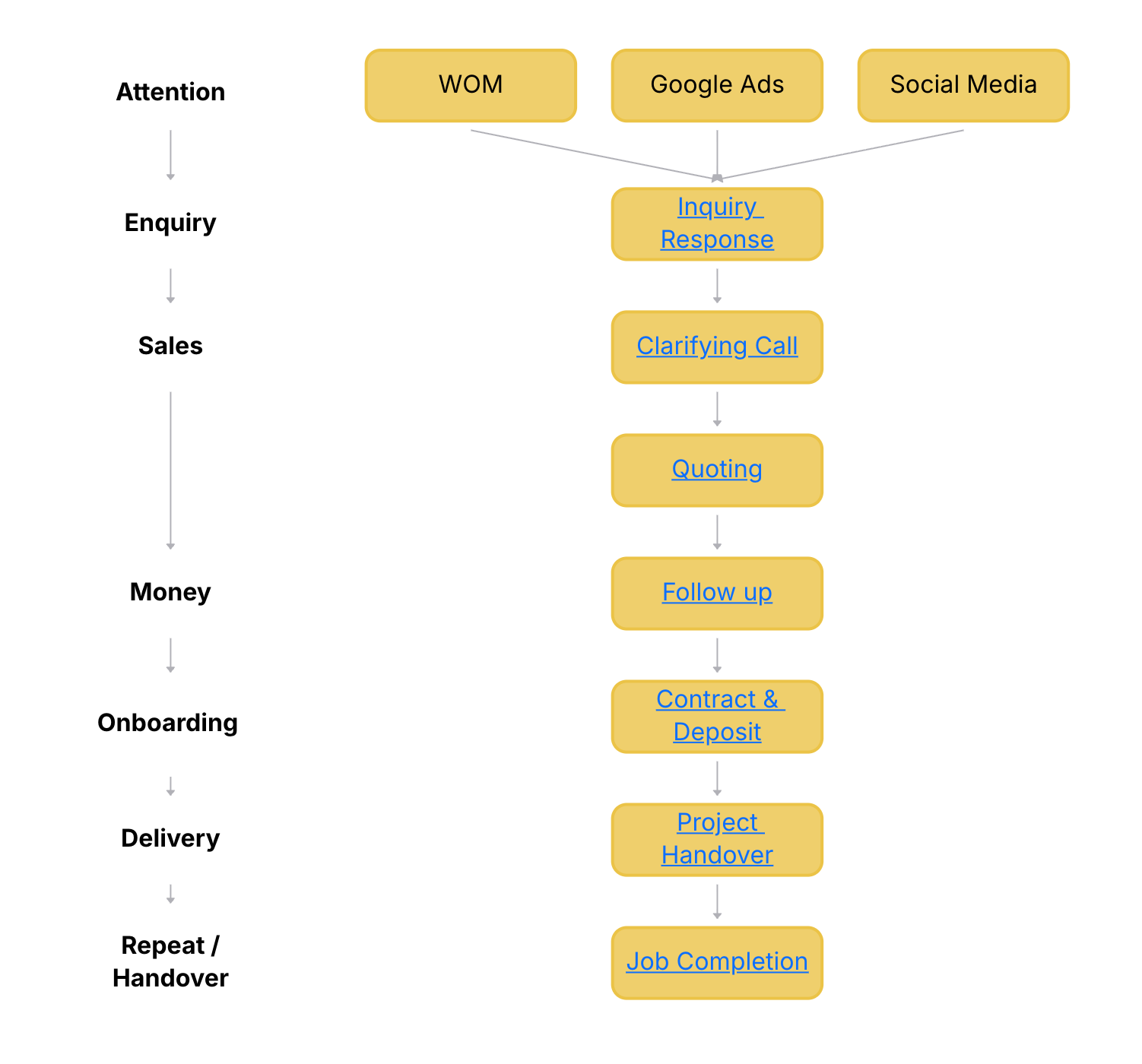
Most plumbing businesses are strong at stages 7 and 8 (doing the work and getting paid). Where they fall apart is stages 3, 4, and 6. These are the three most commonly missed systems in plumbing, and they're where the biggest ROI sits.
What are the core plumbing business systems?
When plumbers search for "plumbing business systems" they usually mean one of two things: the software that runs the office, or the repeatable processes the team follows. The software helps, but the processes are the system. Here are the core plumbing business systems, grouped by where they sit in the flow above.
Front end (winning the work): phone and inquiry intake, the clarifying call before you quote, quoting, and quote follow-up.
Delivery (doing the work): job scheduling and dispatch, the project handover meeting, site setup and daily builder updates, and a quality check before you leave site.
Back end (getting paid and getting the next job): invoicing and payment collection, the review and referral request, and the follow-up call that keeps you top of mind.
Support systems: onboarding a new plumber, vehicle and tool checks, and safety and compliance paperwork.
That's thirteen systems, and you don't need all of them on day one. The three most plumbing businesses are missing, and the ones worth documenting first, are the clarifying call, quote follow-up and the project handover meeting. The rest of this guide shows you how.
How do you start systemising a plumbing company?
Here's the practical, step-by-step process. This is what works.
Step 1: Map your Critical Client Flow
List the nine stages above on a whiteboard. Then walk through each one and ask: "What actually happens here? Who does it? Is it consistent?"
You'll quickly see where things break down. Maybe your quoting is solid but your follow-up is non-existent. Maybe your on-site work is excellent but your invoicing takes a week. The CCF makes the gaps visible.
Step 2: Appoint a Systems Champion
This is the person who drives the documentation process. And here's the important part: it doesn't need to be your best plumber.
Ryan Stannard's daughter Eryn was 18 with zero construction experience when she became Systems Champion for their building company. She's now assistant manager of a $15 million business at age 21. Your Systems Champion might be your office manager, your estimator's assistant, or anyone on the team who is organised, curious, and not afraid to ask questions.
They don't need to know how to solder a pipe. They need to know how to get the process out of your head and onto paper.
Step 3: Document the three systems that cost you the most money
You don't need to document all 30+ systems in your business at once. Start with the three that most plumbing businesses get wrong.
The clarifying call. Most plumbers receive plans, price them up, email the quote, and hope for the best. They skip the most important step: calling the builder before quoting to understand the scope, add value, and build the relationship. This single system differentiates you from every competitor who just emails a number.
Quote follow-up. A structured follow-up process can lift your quote conversion rate from 20% to 40-50%. That's not a typo. Most plumbers don't follow up at all. A simple cadence (Day 1: confirm receipt. Day 3-5: check in. Day 7-10: closing question. Day 14: final follow-up) is the difference between winning the job and wondering why you never heard back.
The project handover meeting. This is the biggest cause of job failures in any trades business. The estimator quotes the job and makes promises. The lead plumber turns up on site and doesn't know what was promised. The builder expects one thing, your team delivers another. A mandatory 30-60 minute handover meeting before every job, where the estimator walks the delivery team through the scope, prevents rework, margin erosion, and damaged relationships.
Most plumbers skip this entirely. It's the highest-ROI system you can document.
- Understand the builder's end client. What's their style? Modern, traditional, high-end, budget-conscious? Any specific concerns?
- Walk through the plans together. Clarify ambiguous specs, identify incomplete details, flag potential issues.
- Add value through expertise. "I noticed the plumbing design for the ensuite. Have you considered a different configuration? It would save the client $2,000 and give them better water pressure."
- Confirm scope boundaries. What's included, what's excluded, what are you assuming?
- Set timeline expectations. When do they need the quote? When does the project start?
Step 4: Put it in one central place
Your systems need to live somewhere your whole team can access. Not in a filing cabinet at the office. Not in a shared drive nobody checks. Your plumbers are on the road, on site, in their vans.
This is exactly why I built systemHUB. It's designed for businesses like yours, where the team needs to find the right process on their phone or tablet, follow it, and get back to work.
But the platform matters less than the habit. One central source of truth that everyone knows to check. That's the goal.
For context, a fully systemised plumbing business typically runs around 31 systems across six departments: marketing, sales, operations, finance, HR, and management. But you don't start with 31. You start with three.
Learn more →
The numbers that matter
One thing that sets systemised plumbing businesses apart: they know their numbers. If you're not tracking these metrics, you're flying blind.
| Metric | Target | Why it matters |
|---|---|---|
| Quote-to-job conversion | 40-50% | Below 30% means your follow-up or pricing is broken |
| Average time to quote | 2-3 days | Faster quotes win more jobs |
| Gross margin per job | 40-50% | Below 35% and you're underpricing or overspending |
| Net profit margin | 15-20% | The real measure of business health |
| Debtor days | Under 14 | Cash flow is king in trades |
| Repeat client revenue | 60%+ | If builders keep coming back, your systems are working |
These aren't aspirational numbers. They're what well-run plumbing businesses consistently achieve. The system that has the single biggest impact on these metrics? Quote follow-up. Most plumbing businesses are leaving 20-30% of their revenue on the table simply because nobody picks up the phone after sending a quote.
What about AI and automation?
AI is changing how fast you can systemise a plumbing business. But the principle hasn't changed: process first, then AI.
Once your processes are documented, AI can help with:
- Turning voice recordings into written SOPs. Record yourself explaining how you quote a bathroom job. AI turns it into a step-by-step system your team can follow.
- Smarter dispatch and scheduling. AI-powered routing that groups jobs by location and minimises drive time between sites.
- Faster onboarding. New plumbers can ask an AI assistant about company procedures and get instant, accurate answers based on your documented systems.
The plumbing businesses getting the best results with AI are the ones who mapped their processes first. AI without documented systems is just faster chaos.
Can systemising help you sell your plumbing business?
This is worth addressing directly, because a lot of plumbing business owners are thinking about it. The data shows that "sell a plumbing business" and "plumbing business exit strategy" are among the most-searched terms in this industry.
Here's the reality: a plumbing business that depends entirely on the owner is worth very little to a buyer. But a plumbing business with documented systems, trained staff who can operate independently, and consistent financial metrics? That's an asset someone will pay a premium for.
Andy and Angela Smith at Dr. Drip didn't systemise because they wanted to sell. They systemised because they wanted their lives back. But the side effect is that they've built a business that could be sold, because it doesn't depend on them being there every day.
If exit planning is on your mind, read our guide on how to prepare your business for sale.
The bottom line
Tony Fraser Jones says it best: "You don't rise to the level of your goals. You fall to the level of your systems."
Systemising a plumbing business isn't about creating paperwork. It's about building a business that delivers consistent, professional service whether you're on site or on holiday. Here's what it takes:
- Map your Critical Client Flow (the nine stages).
- Appoint a Systems Champion.
- Document the three systems costing you the most money.
- Put it all in one place your team can access from anywhere.
Andy and Angela Smith did it at Dr. Drip and got their lives back. Ryan Stannard did it in construction and now takes 7-week holidays. Dimitri Markakis did it at Titan Electrical and can scale without quality dropping.
The plumbing businesses that win aren't the ones with the best plumbers. They're the ones with the best systems.
If you're ready to see what that looks like for your business, book a free Good Fit call and we'll map it out together.
Not ready for a call? Start with the full SYSTEMology framework and see how the method works.