You help your clients build valuable, sellable businesses every day. You advise them on asset protection, succession planning, and operational efficiency. But here's the uncomfortable question: could your own firm survive without you for three months?
Systemising an accounting firm means documenting how your practice delivers value, from the first client inquiry through to ongoing advisory, so your team can handle compliance, client conversations, and strategic advice without everything running through the senior partner. I've helped accounting firms make this shift. The ones who get it right stop trading hours for expertise and start building a practice that's worth something beyond their personal client relationships.
Why do accounting firm owners get stuck?
If you're an accountant reading this, you probably think you already have systems. You use Xero or MYOB. You have Karbon or XPM for workflow. You have checklists for BAS and year-end closings.
But that's not what's trapping you.
Your compliance systems work. Your practice management software tracks tasks. What you don't have documented is everything else: how you run a client meeting, how you scope an advisory engagement, how you onboard a new client in the first 30 days, how a graduate accountant learns to have the conversations you have instinctively after 20 years.
That knowledge lives in your head. And as long as it stays there, your firm has a ceiling.
Here's the pattern. You started because you were technically excellent. Clients trust your judgment. Referrals keep coming. You hire a few accountants. Then a few more. Now you're managing compliance deadlines, reviewing every return, sitting in every important client meeting, and somehow trying to find time for the advisory work that actually grows the firm.
The behaviours that built your reputation, personally knowing every client's situation, reviewing everything before it goes out, being the trusted advisor, stop working at scale. You can't be in every meeting. You can't review every lodgement. And every tax season, the bottleneck gets worse at the worst possible time.
Every accounting firm owner hits the same pain points:
- Client onboarding is reinvented every time. Gathering documents, setting up software, establishing communication rhythms. No two clients get the same experience because the process isn't written down.
- Compliance work is inconsistent. One team member prepares a BAS one way, another does it differently. You end up reviewing everything because you can't trust the consistency.
- Advisory conversations stay with the partner. Your team can do the technical work, but they can't have the strategic conversations that clients value most. That knowledge is locked in your head.
- When someone leaves, knowledge walks out the door. Client relationships, institutional knowledge, the nuances of how you handle complex situations. None of it is documented.
- Your revenue is capped by your personal capacity. The firm can't grow beyond the number of hours you can personally bill and review.
And here's the irony that makes this harder for accountants than anyone else: you spend your days advising clients on how to build businesses that don't depend on one person. But your own firm does. (Curious how dependent your practice is on you? Take the Owner Dependency Score. It takes two minutes.)
"My work is too specialised to systemise"
This is the objection I hear from every professional services firm. Lawyers say it. Consultants say it. And accountants, especially specialists, say it loudest.
Shannon Smit runs SMART Business Solutions in Melbourne. Her firm isn't a general practice. They specialise in transfer pricing, one of the most complex, technical, and regulation-heavy niches in accounting. International tax. Cross-border compliance. The kind of work where a single mistake can cost a client millions.
If anyone had a reason to say "my work is too specialised to systemise," it was Shannon.
A few years ago, she was working 70-hour weeks. The business was entirely dependent on her. Critical knowledge was stuck in her head. She was burning out, and the highly specialised nature of her work made it feel impossible to delegate.
After enrolling in the Systems Champion Academy, Shannon appointed a Systems Champion within her team. They mapped the Critical Client Flow for their core services, identified the 10-20% of key systems that deliver the most value, and documented everything in systemHUB as their single source of truth.
The result? Shannon removed herself from day-to-day operations. She took her first long holiday in years. Her team now runs the business using the documented systems. The firm continued to grow. And the documented intellectual property significantly increased the tangible value of the business.
Shannon didn't systemise because her work was simple. She systemised because it was too complex to keep in one person's head.
And she's not alone. Whether it's a construction business or a plumbing company, the framework is the same. The industry changes. The result doesn't.
What is the Critical Client Flow for an accounting firm?
The Critical Client Flow (CCF) maps the journey your client goes through, from first contact to ongoing relationship. For an accounting firm, it typically follows eight stages:
- Lead or referral comes in. Word of mouth, professional network, or website inquiry.
- Discovery meeting. Understand their situation, pain points, goals, and current setup.
- Proposal and engagement. Scope of services, pricing (fixed-fee or value-based), engagement terms.
- Client onboarding. Gather documents, set up software access, establish communication rhythms, introduce the team.
- Compliance delivery. BAS, tax returns, year-end accounts, payroll. The recurring engine.
- Advisory delivery. Management reporting, cash flow forecasting, strategic planning sessions.
- Regular check-ins. Monthly or quarterly reviews, proactive communication, relationship nurture.
- Annual review and re-engagement. Review scope, adjust pricing, plan for next year.
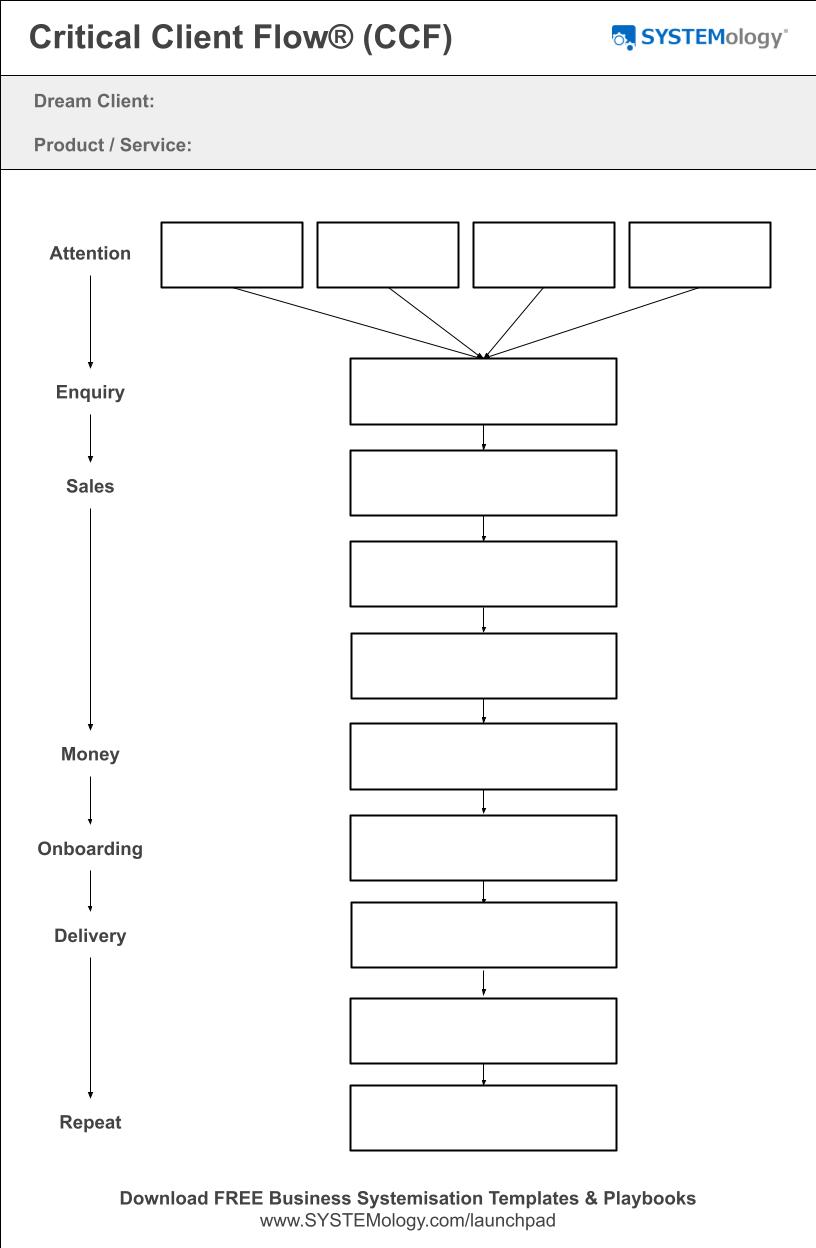
One key difference from other industries: your CCF is cyclical, not linear. Unlike a construction project with a clear start and end, accounting clients go through stages 5-7 repeatedly (monthly, quarterly, annually). Your systems need to handle this recurring rhythm without someone manually managing every deadline.
Jordan Smith, a CPA from Montana, adapted the CCF into a spreadsheet format. As an accountant, he naturally thought in rows and columns rather than the typical visual flow diagram. That flexibility is the point. The format doesn't matter. Having the flow mapped at all is what creates the shift.
How do you start systemising an accounting practice?
Here's the practical, step-by-step process. This is what works.
Step 1: Map your Critical Client Flow
Write out the eight stages above. Walk through each one and ask: "Is this consistent? Does every client get the same experience? Or does it depend on which accountant they're assigned to?"
Most firms discover that their compliance delivery is reasonably consistent (because regulations force structure). But their onboarding, advisory conversations, and client communication are completely ad hoc. That's where the bottleneck lives.
Step 2: Appoint a Systems Champion
Your Systems Champion doesn't need to be your most experienced accountant. In fact, it's often better if they're not. You need someone who will ask "why do we do it this way?" rather than someone who already knows and does it automatically.
Shannon's Systems Champion drove the documentation process while Shannon continued to focus on client work. Look for an organised team member: your office manager, a graduate accountant, or an operations coordinator. They don't need to understand transfer pricing. They need to know how to get the process out of your head and onto paper.
Step 3: Document the three systems costing you the most
Don't try to document everything. Start with the three processes that cause the most pain.
For accounting firms, the top three are almost always:
Client onboarding (first 30 days). The first month of a new client relationship sets the tone for everything. How documents are gathered, how software is set up, how expectations are communicated, how the team is introduced. When this is inconsistent, clients start with a poor experience and the team wastes hours chasing missing information for the rest of the year.
Compliance workflow management. How a tax return or BAS moves from assigned to reviewed to lodged. Who does what, in what order, by when. When this lives in someone's head, deadlines get missed, work gets duplicated, and the senior partner becomes the review bottleneck.
Client review meetings. How you prepare for, conduct, and follow up on a client meeting. Most firms have no system for this. The partner wings it based on their personal knowledge of the client. Document the preparation checklist, the agenda template, and the follow-up process, and any qualified team member can run these meetings to a consistent standard.
When onboarding is inconsistent, you spend the rest of the year chasing missing documents and fixing setup errors.
- Week 1: Setup
- Send welcome pack: document checklist, software access instructions, key contacts.
- Set up client in practice management software (XPM, Karbon, FYI).
- Request ATO portal authorisation (or equivalent tax authority access).
- Schedule the onboarding call with the assigned accountant.
- Week 2: Data gathering
- Onboarding call: walk through current setup, pain points, and goals.
- Collect prior year financials, tax returns, and outstanding lodgements.
- Set up or connect accounting software (Xero, MYOB, QBO).
- Identify and reconcile any backlog or catch-up work needed.
- Week 3-4: Rhythm established
- First monthly check-in scheduled.
- Recurring compliance calendar set (BAS dates, tax dates, payroll dates).
- Introduce the client to their full team (not just the partner).
- Confirm communication preferences (email, phone, portal).
Step 4: Put it in one central place
This is where accounting firms need to understand an important distinction. Practice management software (Karbon, XPM, FYI) manages tasks. It tracks what's due and who's doing it. That's workflow management.
What it doesn't capture is how your firm thinks. How you scope an advisory engagement. How you handle a complex restructure. How you run a client review meeting that turns a compliance client into an advisory client. That's institutional knowledge, and it needs to live somewhere accessible.
systemHUB is purpose-built for this. It's where you document the "how" and "why" behind your firm's processes, not just the "what" and "when." Hundreds of professional services firms use it as their single source of truth.
For context, a fully systemised accounting firm typically runs around 30 systems across six departments. But you don't start with 30. You start with three.
Learn more →
The numbers that matter
You understand metrics better than anyone. So here are the benchmarks that well-run, systemised accounting firms consistently hit:
| Metric | Target | Why it matters |
|---|---|---|
| Client onboarding time | Under 14 days | Faster setup means faster value delivery and fewer errors |
| Lodgements on time | 98%+ | Late lodgements damage trust and create penalties |
| Lockup days (WIP) | Under 30 | Work sitting unbilled is cash you can't use |
| Debtor days | Under 21 | Consistent invoicing and follow-up keeps cash flowing |
| Client retention rate | 90%+ | Systems create the consistency that keeps clients loyal |
| Revenue per employee | Track monthly | The real measure of practice efficiency |
If you're below these benchmarks, it's rarely a people problem. It's a systems problem. The team wants to perform. They just don't have the documented processes to perform consistently.
More firms making the shift
Shannon's story is the most dramatic, but she's not alone.
Silvan Ridge Business Advisers took a different angle. They realised that systemising their own firm was only half the opportunity. They started offering process improvement as a core advisory service, using systemHUB to help clients document their business processes. The result: a new revenue stream, deeper client relationships, and a shift from compliance-focused accounting to strategic advisory. They didn't just systemise their practice. They turned systemisation into a product.
Johnson Accounting made a similar move. By adopting systemHUB as a value-add tool for their SME clients, they repositioned from "accountant" to "strategic advisor." Clients who used to call once a year for tax now engage quarterly for business improvement conversations.
Trina Dando, a bookkeeper, created a video walkthrough of her Critical Client Flow, showing that this approach works at every firm size. You don't need a 50-person practice to benefit from documented systems. Even a solo bookkeeper with a couple of contractors can systemise their client delivery and reclaim their weekends.
What about AI in accounting?
AI is transforming accounting faster than almost any other profession. Automated bank feeds, AI-powered categorisation, machine learning for anomaly detection. The technology is moving fast.
But the principle holds: process first, then AI.
AI can accelerate your documented processes. It can auto-categorise transactions, generate draft management reports, and automate routine client communications. But it can only do these things well if you've first documented what "good" looks like.
AI without documented processes produces faster errors. AI built on top of well-documented processes produces leverage. If you want to see what that looks like for accounting specifically, read about the AI-first accountant approach.
Shannon Smit's firm, SMART Business Solutions, documented their processes first, then layered AI and automation on top.
The result: 998 hours of repetitive work eliminated annually. That's the equivalent of half a full-time employee, freed up to focus on higher-value advisory work. Not by hiring more staff. Not by working harder. By systemising first, then automating.
This is what becomes possible when your processes are documented. AI can't improve a process that lives in someone's head. But once it's on paper, the leverage is enormous.
Can systemising help you sell your accounting practice?
Let's talk about this directly, because you understand business valuation better than most.
A practice where every client relationship runs through the founding partner is worth a small multiple of recurring fees. Buyers know the risk: when the partner leaves, clients leave too.
A practice with documented systems, a trained team that handles clients independently, and consistent financial metrics? That's a different asset entirely. The documented IP, the institutional knowledge captured in systemHUB, the client relationships that belong to the firm rather than the founder: that's what buyers pay a premium for.
Shannon Smit's documented intellectual property significantly increased the tangible value of SMART Business Solutions. She didn't systemise to sell. She systemised to get her life back. But the exit optionality is a powerful side effect.
If you're thinking about this, read our guide on how to prepare your business for sale.
The cost of doing nothing
You're an accountant. You understand opportunity cost. So let's be honest about what the next 10 years look like if nothing changes.
Another decade of 70-hour weeks during tax season. A practice that's worth very little without you in it. A team that's capable but can't operate independently because the knowledge never left your head. The slow erosion of the passion that made you start this firm in the first place.
The accounting firms that thrive aren't the ones with the smartest partners. They're the ones that captured what makes them smart and made it accessible to their whole team.
The bottom line
You spend your career helping clients build valuable, transferable businesses. It's time to build one yourself.
Here's what it takes:
- Map your Critical Client Flow (the eight stages).
- Appoint a Systems Champion.
- Document the three systems costing you the most time.
- Put it all in one place your team can access instantly.
Shannon Smit did it with one of the most complex specialisations in accounting. Silvan Ridge turned it into a new revenue stream. Johnson Accounting used it to reposition from compliance to advisory.
If you're ready to see what that looks like for your firm, book a free Good Fit call and we'll map it out together.
Not ready for a call? Start with the full SYSTEMology framework and see how the method works.