Systemising a law firm means documenting how your practice delivers legal services, from client intake to matter completion, so your team can handle cases consistently without every decision running through the senior partner. I've helped law firms do this. The firms that get it right stop being trapped by their own expertise and start building a practice that's scalable, sellable, and doesn't depend on one person knowing everything.
If you're a lawyer, managing partner, or firm owner who can't take a week off without client matters stalling, this guide is for you.
Why law firm owners get stuck
You became a lawyer because you're smart, analytical, and good at solving complex problems. Those same qualities made you successful enough to start your own firm. And those same qualities are now keeping you trapped.
Here's why: legal work feels inherently unsystemisable. Every matter is different. Every client's situation is unique. The law itself changes constantly. So lawyers default to the belief that their work is too complex, too nuanced, too high-stakes to put in a process.
But think about what actually fills your day. Yes, there's legal strategy and complex problem-solving. That's maybe 30% of the work. The other 70% is intake calls, document gathering, file management, scheduling, billing, trust account reconciliation, court deadline tracking, and client communication. All repeatable. All documentable. All stealing time from the work that actually requires your legal mind.
Every law firm owner hits the same pain points:
- Client intake is reinvented every time. One lawyer does a thorough conflict check and engagement letter. Another starts work before the paperwork is done. Risk and inconsistency from day one.
- Matter management depends on who's handling it. File notes in different formats. Different approaches to deadlines. Different communication styles with clients. The client experience depends on the lawyer, not the firm.
- Knowledge lives in the senior partner's head. Precedents, approaches, client preferences, the nuances of how the firm handles particular types of matters. None of it is written down.
- New lawyers take years to become independent. Because the "training" is watching the partner and absorbing knowledge by osmosis. There's no playbook.
- The firm can't grow beyond the founding partner's capacity. Revenue is capped by how many matters you can personally supervise.
And here's the uncomfortable truth that makes this harder for lawyers than most: you advise your clients on risk management, governance, and proper documentation every day. But your own firm runs on tribal knowledge and the hope that nothing falls through the cracks.
"Every matter is different"
This is the objection I hear from every law firm. And it's true. Every matter has unique facts, unique parties, unique legal issues.
But the process of handling a matter follows a pattern. The intake. The conflict check. The engagement letter. The document gathering. The file setup. The court deadline tracking. The billing. The trust account management. The client update cadence. The file closing procedure.
Those steps happen on every single matter. The legal strategy inside the matter is unique. The process around the matter is repeatable.
John Crow understood this. He runs Crow Estate Planning and Probate, a boutique law firm across three locations in the Southeast US. Estate planning is procedural but highly variable. Probate work involves 95 different counties, each with different rules, different forms, different procedures.
If anyone had a reason to say "my work is too complex to systemise," it was John.
He enrolled in the Systems Champion Academy and appointed Callie Saulsburry as his Systems Champion. Callie's background was in education, not law. She didn't need to know the law. She needed to know how to extract the process from the people who did.
They started by documenting the Critical Client Flow for their most common service: estate planning. Once that was working, they tackled the more complex probate process, documenting it county by county.
The result: a "single source of truth" that new hires can follow from day one. The team now proactively requests new systems to be built. And John is on a clear path to scaling across the Southeast US, something that would have been impossible when every matter depended on his personal involvement.
The Critical Client Flow for a law firm
The Critical Client Flow maps the journey every client takes through your firm. For a law firm, it typically follows these stages:
- Inquiry or referral. Phone call, website form, referral from another lawyer or accountant.
- Conflict check and intake. Verify no conflicts. Gather preliminary information. Assess whether the matter is a good fit.
- Initial consultation. Understand the client's situation, goals, and expectations. Assess the legal issues.
- Engagement. Engagement letter, fee agreement, retainer. File setup.
- Matter execution. Research, drafting, negotiation, court appearances, correspondence. The legal work.
- Billing and trust accounting. Time recording, invoicing, trust account management, payment follow-up.
- Matter completion. Final deliverables, file closing, archiving, compliance.
- Follow-up and relationship. Post-matter check-in, referral request, cross-selling other services, ongoing relationship nurture.
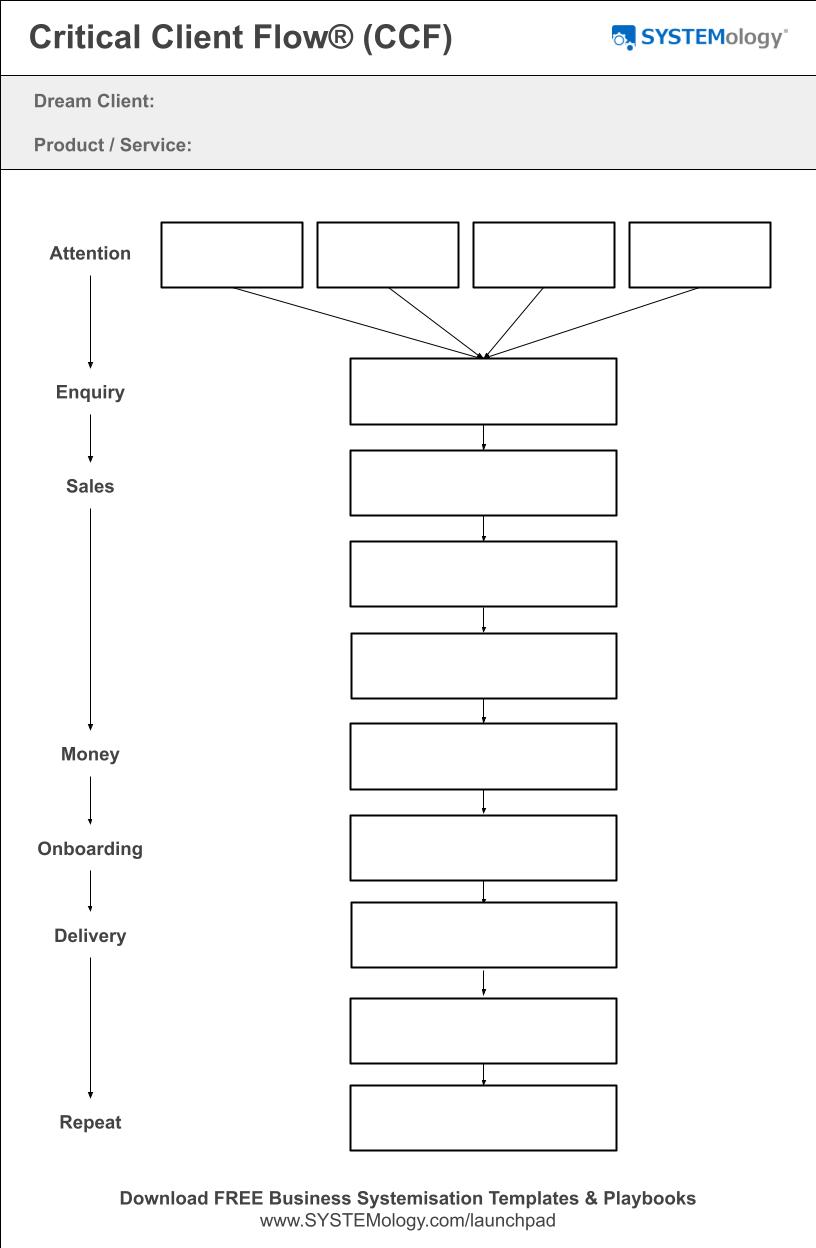
The legal work in stage 5 is where each matter is genuinely unique. But stages 1-4 and 6-8 are almost identical every time. And even within stage 5, there are repeatable sub-processes: how you open a file, how you track deadlines, how you manage documents, how you communicate progress to clients.
How to start systemising your law firm
Step 1: Map your Critical Client Flow
Write out the eight stages for your most common matter type. If you do family law, map the family law client journey. If you do commercial, map that. Start with one practice area and get it right before expanding.
Walk through each stage and ask: is this consistent? Does every client get the same experience? Or does it depend on which lawyer they're assigned to?
Step 2: Appoint a Systems Champion
Callie Saulsburry at Crow Estate Planning was an educator, not a lawyer. That was an advantage. She could ask the obvious questions that nobody inside the firm was asking because they were too close to the work.
Your Systems Champion could be your practice manager, your legal secretary, or a paralegal. They need to be organised and willing to interview lawyers about how they do things. They don't need a law degree.
Step 3: Document the three systems costing you the most
For law firms, the top three are almost always:
Client intake and file opening. How a new matter goes from first contact to fully set up in your practice management system. Conflict check, engagement letter, file creation, document gathering, initial communication. When this is inconsistent, matters start badly and risk compounds from day one.
Matter milestone tracking. How you track deadlines, court dates, limitation periods, and key milestones for every open matter. When this lives in a lawyer's head or a personal calendar, things get missed. When it's in a documented system, the whole team has visibility.
Client communication cadence. How often clients hear from you, what updates look like, and who's responsible for keeping clients informed. The number one complaint about lawyers is lack of communication. A documented communication rhythm (e.g., fortnightly update email, monthly phone call, immediate notification of key events) solves this systematically.
Inconsistent intake creates risk from day one. A missed conflict check, an unsigned engagement letter, a file without proper setup: these are the problems that become expensive later.
- Run conflict check against all parties (use practice management system search).
- Confirm no conflicts. If conflict identified, escalate to supervising partner immediately.
- Send engagement letter and fee agreement for signing (template by matter type).
- Receive signed engagement letter and retainer payment.
- Create matter file in practice management system (matter type, parties, key dates, responsible lawyer).
- Request and gather initial documents from client (use standard checklist by matter type).
- Set up court deadline and limitation period tracking.
- Send welcome communication to client: what to expect, key contacts, communication rhythm.
- Schedule first working meeting between assigned lawyer and client.
Step 4: Put it in one central place
Practice management software (LEAP, Actionstep, Smokeball, Clio) manages matters and billing. That's workflow. What it doesn't capture is how your firm does things: how you run an intake, how you conduct a client meeting, how you handle a complaint, how you onboard a new lawyer.
systemHUB is purpose-built for that second layer. It's where your "how we do things here" documentation lives. Hundreds of professional services firms use it as their single source of truth.
Learn more →
The business value of a systemised law firm
Joanna Oakey runs Aspect Legal, a commercial law firm specialising in business acquisitions and exits. She also hosts the Buy, Grow, Exit podcast, where she advises business owners on building sellable businesses.
Her perspective on law firm systemisation is blunt: buyers don't pay a premium for a practice that depends on the founding partner. They pay a premium for documented systems, trained staff, and client relationships that belong to the firm rather than one person.
"Systemisation is one of the most impactful things you can do to increase the value of your business," she says. That applies to law firms as much as any other business.
If exit planning is on your mind, read our guide on preparing your business for sale.
More firms making the shift
Boss Advisors is a multi-disciplinary firm offering both legal and accounting services. Michael Payne, the founder, documented core processes across both sides of the business. The result: new advisors onboard faster, clients receive consistent service regardless of who they work with, and the firm has become a valuable asset rather than a job.
Absolute Immigration handles visa applications where a single error can derail someone's future. Jamie Lingham mapped the entire client journey from initial consultation to visa approval, creating a standardised workflow that reduces risk, speeds up onboarding of new agents, and lets him focus on strategic direction instead of casework.
These firms span estate planning, commercial law, multi-disciplinary advisory, and immigration. Different practice areas. Same framework. Same result: the founding partner got their time back without quality or compliance dropping.
See how the same framework works for accounting firms, allied health practices, construction businesses, and digital agencies.
What about AI in legal practice?
AI is transforming legal work. Document review, contract analysis, legal research, even first-draft document generation. The technology is moving fast.
But the principle holds: process first, then AI.
AI can draft a standard letter of engagement. It can summarise case notes. It can flag deadline risks across your matter list. But it can only do these things well if you've first documented what "good" looks like for your firm.
The law firms getting the most from AI are the ones who documented their processes first, then layered AI on top. AI without documented processes produces faster errors in a profession where errors have consequences.
The bottom line
Systemising a law firm isn't about turning legal work into a factory. It's about building a practice where the repeatable work, the 70% that isn't unique legal strategy, runs consistently without the senior partner in the middle of everything.
Here's what it takes:
- Map your Critical Client Flow (the eight stages).
- Appoint a Systems Champion (they don't need a law degree).
- Document the three systems costing you the most time and risk.
- Put it all in one place your team can access instantly.
John Crow is scaling across the Southeast US because his firm runs on systems, not on him. Callie Saulsburry, an educator with no legal background, drove the transformation. The team now asks for new systems to be built.
If you're ready to see what that looks like for your firm, book a free Good Fit call and we'll map it out together.
Not ready for a call? Start with the full SYSTEMology framework and see how the method works.