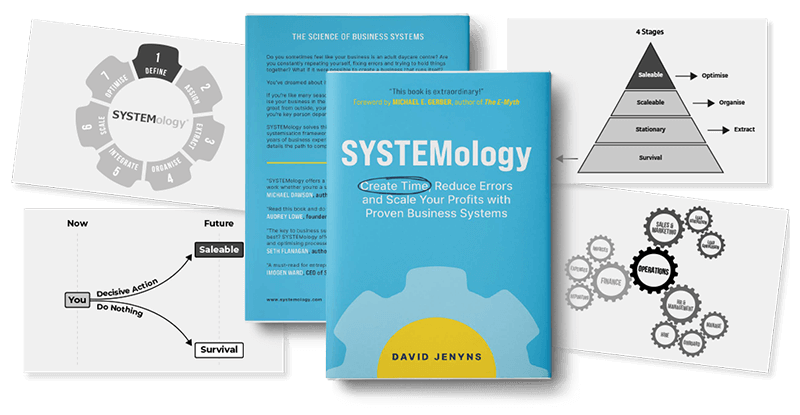
SYSTEMology is a seven-stage framework for systemising any business and removing key person dependency. Written by David Jenyns, with a foreword by Michael E. Gerber (author of The E-Myth), the book provides a step-by-step process for getting your business to run without you. Here is the complete framework, explained by the author.
Learn more →
What Is SYSTEMology?
SYSTEMology is a methodology for building business systems that free the owner from daily operations. It answers the question that most business books leave unanswered: how do you actually extract the knowledge from your best people and turn it into repeatable, documented processes?
The framework came from my own experience. I founded Melbourne SEO Services, a digital agency, and spent years trapped in the daily grind. Every decision ran through me. I was working 60-plus hours a week and the business couldn't function without me.
In 2016, I systemised myself out of that business. I hired a CEO, stepped back from daily operations, and the business kept growing. The process I used became SYSTEMology.
How do I know it works? When Michael E. Gerber's wife called me out of the blue and asked me to help launch Gerber's final E-Myth book, I was able to say yes immediately. I walked away from my business for three months, unpaid, because my systems were running everything. Two years earlier, I would have had to say no. That's the difference SYSTEMology makes.
Why Do Most Businesses Fail at Systemisation?
If you've read The E-Myth Revisited, Traction, or Scaling Up, you already know you should systemise your business. So why haven't you?
Because most business owners fall for what I call the seven myths of business systems. Here are the three that do the most damage.
Myth 1: You need to document hundreds of systems. You don't. You need 10 to 15. The Critical Client Flow identifies the systems that matter most, the ones that directly touch your client journey. Start there. Everything else can wait.
Myth 2: The business owner should do the documenting. This is the assumption that kills most systemisation attempts. The owner is usually the worst person to document processes. They're too close to the work, too busy, and too likely to overcomplicate things. The person who should document a system is the person already doing it well. I call them the knowledgeable worker.
Myth 3: Everything needs to be perfect before you start. It doesn't. A minimum viable system, a rough but usable process document, is infinitely better than a perfect system that never gets written. You can always improve it later.
These myths explain why 5 million people read The E-Myth and most of them never systemised anything. They were trying to do it the wrong way.
The SYSTEMology 7-Stage Framework
Here is the complete framework, stage by stage. This is what the book walks you through in detail, with templates, examples, and exercises at each step.
Stage 1: Define. Map your Critical Client Flow (CCF). This is the sequence of 10 to 15 core systems that drive your business, from the moment a prospect finds you through to delivery, follow-up, and repeat business. Don't try to document everything. The CCF tells you exactly what to work on first. A plumber's CCF might start with "answer the phone" and end with "send the invoice and request a review." Every business has one. Yours probably has between 10 and 15 steps.
Stage 2: Assign. For each system in your CCF, identify the knowledgeable worker. This is the team member who already does that task well. Assign them as the system owner. Also identify your Systems Champion, the detail-oriented team member who will drive the whole project forward.
Stage 3: Extract. This is where the magic happens. The knowledgeable worker records themselves doing the task. Screen recording, video, or audio. No writing required at this stage. Your Systems Champion then watches the recording and turns it into a simple, step-by-step written procedure. The person doing the work captures it. Someone else writes it up. The owner stays out of it entirely.
Stage 4: Organise. Take your raw documentation and format it consistently. Every system should follow the same structure: title, overview, steps, and any relevant links. Store everything in one central location. This is where a tool like systemHUB becomes valuable, but the methodology works with any tool.
Stage 5: Integrate. A system that sits in a folder and never gets used is worthless. Integration means embedding your systems into daily operations. Link them to onboarding checklists. Reference them in team meetings. Make following the system the path of least resistance.
Stage 6: Scale. Once your core CCF systems are running, expand. Use the same methodology to systemise the next layer of your business: marketing, finance, HR, management. You've already proven the process works. Now replicate it.
Stage 7: Optimise. Systems are not set-and-forget. Build in regular review cycles. Track which systems are being followed and which aren't. The businesses that get the best results treat systemisation as an ongoing practice, not a one-time project. AI tools can now accelerate this step dramatically, turning recordings into written SOPs and identifying bottlenecks.
Want to see where your business stands right now? Take the free Systems Strength Test to find out how systemised you already are.
What Makes SYSTEMology Different?
Four concepts set SYSTEMology apart from other business systemisation approaches.
Critical Client Flow (CCF). Most frameworks tell you to "document your systems" without telling you which ones to start with. The CCF is a prioritisation tool. It maps your client journey and identifies the 10 to 15 systems that have the biggest impact. Start with these. Ignore everything else until they're running.
The Knowledgeable Worker. The traditional approach says the business owner should document everything. SYSTEMology flips this. Your best people already know how to do the work. Have them record it. The owner's job is to step back and let others lead.
Minimum Viable Systems (MVS). Don't aim for perfect documentation. Aim for usable. A rough system that gets followed is better than a polished system that sits in a drawer. You can always improve it on the next cycle.
The Systems Champion. Every systemisation project needs a driver. Not the owner. Not an external consultant. Someone inside the business who is detail-oriented, organised, and committed to making systems stick. I cover this role in depth in my second book, The Systems Champion.
Who Endorses SYSTEMology?
Some of the most influential business thinkers in the world have read this book and put their name behind it.
Michael E. Gerber, author of The E-Myth, wrote the foreword. He said: "David Jenyns has not only DONE it, but he's now written the brilliant book to teach you exactly how to do it, too!"
Gino Wickman, author of Traction: "SYSTEMology is a must for any business owner and their leadership team."
Allan Dib, author of The 1-Page Marketing Plan: "This book is going to be a category killer. I have read many books on business systems and nothing else comes close."
Jack Daly, author of Hyper Sales Growth: "What Michael Gerber started, David Jenyns completed."
When the authors of both The E-Myth and Traction endorse the same book, that tells you something about where SYSTEMology sits in the landscape.
Does SYSTEMology Work in Practice?
Ryan Stannard runs a custom home-building company in Adelaide. Classic tradie-turned-owner. He was working constantly, answering every question, and couldn't step away.
He appointed his daughter Eryn as the Systems Champion. She was 18 at the time, with no construction industry experience, but she had the right mindset: detail-oriented, organised, curious. She began documenting every process in systemHUB.
When the interior designer quit unexpectedly, Eryn stepped in. She rewrote the systems for that role and was running it successfully within months. She progressively took over HR, accounts, and operations.
Today, Ryan takes 7-week holidays knowing the business runs without him. Eryn, now 21, is the assistant manager of a $15 million company. The business is so well-systemised they're planning to launch a new arm by copying and pasting their existing systems into a new entity.
That's what a systemised business looks like.
Resources and Next Steps
The Book. SYSTEMology is available on Amazon in paperback, Kindle, and audiobook. It walks you through every stage with templates, real examples, and exercises.
systemHUB. The software platform built to house your business systems. Not required to use the methodology, but purpose-built for it. Includes 100-plus templates, AI tools, and a guided implementation path.
Free Tools. Start here if you want a taste before committing:
- Systems Strength Test: find out how systemised your business is today
- Cost Calculator: see what unsystemised processes are costing you
- Dependency Score: measure how dependent your business is on you
The Systems Champion (Book 2). The practical sequel, written for the person who drives systemisation forward. Covers documentation, tools, and culture, with AI integration throughout.
SYSTEMologist Certification. For consultants and coaches who want to use the SYSTEMology framework with their own clients.
Related Reading: