By David Jenyns, founder of

Systemising a digital agency means building your business so it can deliver great work to clients without you in every meeting, reviewing every piece of creative, and firefighting every crisis. If you started your agency for freedom and ended up with the most demanding job you've ever had, you're not alone. I built, systemised, and sold a digital agency. This guide is what I learned.
You started this for freedom
Nobody starts an agency because they love project management. You started because you were good at the work. Design, SEO, paid media, content, development. Whatever it was, you were good enough that clients paid you, and eventually enough clients paid you that you hired a team.
That's when the trap closed.
Now you spend 20% of your time on the creative, strategic work you love. The other 80% is chasing access credentials, reviewing reports before they go out, explaining the project management tool to a new hire, following up on invoices, sitting in internal meetings, and putting out fires.
You're not a business owner. You're a freelancer with staff.
I know because that's exactly what happened to me. I ran a digital agency called Melbourne SEO Services. We were good at what we did. Clients stayed. Referrals came. The team grew. And I slowly became the bottleneck in my own business.
The better I got at the work, the more clients we won. The more clients we won, the less time I had for the work. Success was the trap.
What most agency owners get wrong
Here's the lie we all tell ourselves: "Nobody can do it as well as I can."
It's comfortable because it's partly true. Nobody will care about your clients exactly the way you do. But that belief has a cost. It means the business can't grow beyond your personal capacity. Your hours are the ceiling. And you're so busy being the expert that you have no time to build something that could work without one.
When I looked honestly at my agency, the problem wasn't the team. Grace had been with me for over 15 years. MJ for nine. Jillian for five. They were capable and loyal. The problem was that the knowledge of how things should be done lived in my head, not on paper.
They were waiting on me for every decision because I'd never given them anything else to check.
Systems don't kill creativity. They protect it.
This is the objection I hear from every agency owner. "But my work is creative. You can't put creativity in a box."
You're right. You can't systemise the creative thinking. But that's not what's eating your time.
Think about everything around the creative work. Client onboarding. Briefing. Reporting. Invoicing. Project handoffs. Scheduling. Internal communication. None of that is creative. All of it is repeatable. And all of it is stealing hours from the work your clients actually pay for.
When I systemised Melbourne SEO Services, I didn't touch the creative strategy. I systemised everything around it. The result was that the team had more time for the work that mattered. Quality went up, not down.
Stepping back from the daily work isn't abandoning your agency. It's the most creative thing you'll ever do for it. You stop delivering a service and start designing a business.
What I actually did
I started by mapping what I now call the Critical Client Flow. It's the journey every client takes through your agency.
For Melbourne SEO Services, it looked like this: lead comes in, discovery call, proposal, client onboarding, strategy, execution, reporting, retention. Eight stages. Every agency follows a version of this path. The difference was that I'd never written it down. It was all intuition. And intuition doesn't scale.

Once the flow was mapped, the bottlenecks became obvious. Onboarding was different every time. Reporting depended on who was handling the account. Handoffs between team members were verbal, not documented. No wonder I was in the middle of everything.
I picked three systems to document first. The three causing the most pain:
Client onboarding. How a new client goes from signed proposal to fully set up in the first two weeks. Access credentials, brand guidelines, kickoff call, strategy document, first deliverable timeline. I wrote it down once. Every client after that got the same consistent experience.
Monthly reporting. How reports get built, what's included, how they're presented. I'd been personally reviewing every report. Once the process was documented, the team could handle it without me.
Project handoffs. What happens when work moves from one team member to another. The brief, the context, the deadlines, the client preferences. When this was verbal, things got lost. When it was documented, they didn't.
Three systems. Not thirty. Three.
I didn't do the documenting myself. That was a key insight. I found someone on the team who was organised, detail-oriented, and willing to ask the questions nobody else was asking. What I'd now call a Systems Champion. They watched how the work actually got done, then wrote it up. Simple. Clear. Usable.
The systems weren't perfect. They didn't need to be. Done beats perfect. But even the rough first versions made an immediate difference. The team had clarity. They didn't need to check with me. They could check the system.
The proof that it worked
Within months, I wasn't in the middle of everything anymore. I hired Melissa to run day-to-day operations. I drew profit distributions instead of billing hours.
Then the real test came. Michael E. Gerber, author of the E-Myth series, one of the best-selling business books of all time, asked me to help launch his final book. It would take 60-plus hours a week for three months. If that call had come two years earlier, I'd have had to say no. The agency couldn't survive a week without me.
But by then, the systems were in place. I took the project. The agency barely noticed I was gone. If anything, it ran smoother without me looking over everyone's shoulders.
Later, when Melissa had to move overseas and resigned, the business didn't collapse. Because it was built on systems, I had options. I found a new owner. We sold. Grace, MJ, Jillian, the rest of the team: they kept their jobs. The clients kept getting great results. The suppliers kept their relationships.
I didn't write SYSTEMology and then test it. I tested it first, and then wrote the book.
That book opens with a story about the time Michael E. Gerber, author of the E-Myth, asked me to help launch his final publication. It would take 60-plus hours a week for three months. If he'd asked two years earlier, I would have had to say no. But by then, Melbourne SEO ran on systems. I said yes. The agency barely noticed I was gone. Gerber liked the work so much he wrote the foreword to SYSTEMology.
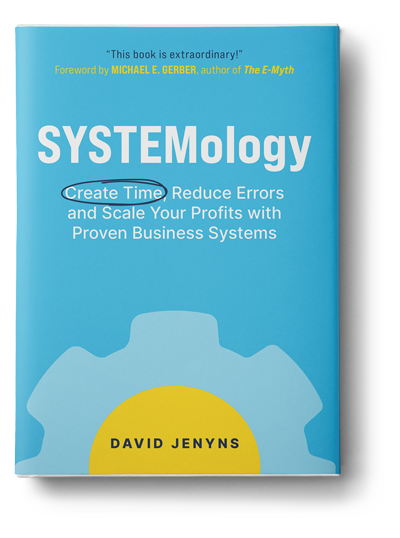
Learn more →
You're not the only one
Mouneeb runs a web design agency. He was working 16-hour days. Lead designer, project manager, and salesperson all at once. He'd tried hiring before, but without documented processes, the new hires failed. He blamed them.
When he finally realised he was the problem, not the hires, everything changed. He documented his entire delivery process. Sales, onboarding, design, development, handover.
He went from 16 hours a day to two.
Not because he stopped caring. Because he stopped doing work that someone else could do if they just had the playbook.
Trevor Henselwood at Websavvy, a Google and Facebook ads agency, made the same shift. So did John Gossage at London Agency, a creative agency specialising in thought leadership. Different types of agencies. Different services. Same framework. Same result.
And it's not just agencies. The framework works the same way for construction businesses, plumbing companies, and accounting firms. The industry changes. The result doesn't.
How to do it for your agency
Here's what I learned, distilled into four moves:
Map your client journey. Write down the stages your clients go through, from first contact to ongoing relationship. Eight stages, give or take. You'll immediately see where things are inconsistent or where everything depends on one person.
Find your Systems Champion. Not your best creative. The person on your team who's organised, curious, and willing to document what everyone else does instinctively. They don't need to be senior. They need to be systematic.
Document three systems. The three causing the most pain. For most agencies: client onboarding, reporting, and project handoffs. Write them down. Get the team using them. Then do the next three.
Put it in one central place. Not scattered across Notion, Google Docs, Slack messages, and someone's head. systemHUB is built for this, but whatever you use, your team needs one place to check before they ask you.
That's it. The same four moves I made at Melbourne SEO Services. The same four that hundreds of agencies have made since.
The question that matters
How many opportunities have already passed you by because you were too swamped to notice them? Not just the ones you turned down. The ones you never even saw because you barely had time to eat lunch, let alone rise above the noise and spot the big breaks in your periphery.
SYSTEMology gives you the freedom to choose. Instead of the business forcing you to conform to its will, you should be able to shape your business to conform to yours. In it. Out of it. Ten hours a week. A hundred. Your call.
The biggest opportunities come when the business owner creates space. You have to learn to engineer that space. Systems hold the key.
If you're ready to see what that looks like for your agency, book a free Good Fit call and we'll map it out together.
Not ready for a call? Start with the full SYSTEMology framework and see how the method works.
Now let's finish with a bit of fun!