Two Subway franchises sat across the street from each other.
Same brand. Same menu. Same suppliers. One of them made consistently better margins than the other.
The difference? How they handled the chicken.
At the first store, the worker scooped chicken by eye. Some days generous. Some days mean. Nobody was trying to rip anyone off. They were just using their judgment.
At the second store, the chicken came in pre-measured trays. Exactly 2.5 ounces per sandwich. Every time. The worker didn't have to think about it.
Guess which owner was smarter? Most business books would tell you the second one. And they'd be right. Mostly. The answer is more interesting than that.
The cost of too much discretion
Ron Carroll flagged this problem years ago. He called it the cost of employee discretion, and he was right about the numbers.
At Walmart, clerks in the fabric department were cutting "just a little extra" to make sure customers got their full yard. Good intention. The cost? Around $2,500 per store per year in shrinkage. Multiply that by thousands of stores and you've got a meaningful line item.
At Subway, the difference between a scoop of chicken and a measured tray was roughly an ounce per sandwich. Multiply by a few hundred sandwiches a day, multiply by 365 days, and you're looking at serious money walking out the door.
The pattern is the same everywhere. Small decisions, made by well-meaning people, compound fast.
Especially in high-volume, low-margin businesses, this kind of drift kills you. Not in one big blow. In a thousand small cuts.
So Ron's advice made sense: eliminate discretion.
But here's what that framing misses
Zero-discretion works beautifully for fast food and retail. It falls apart the moment you apply it to a service business.
Think about your best salesperson.
Are they following a word-for-word script? Probably not. They're reading the room. They're adjusting their tone when the client is nervous. They're pushing harder when the client is interested. They're using judgment.
Now think about your senior consultant or your lead technician. They're not executing a checklist. They're diagnosing a problem no one's seen before. They're making a call.
Kill their discretion and you kill the thing that makes them valuable in the first place.
This is where a lot of business owners get stuck. They read a book, get fired up about systemisation, try to document everything, and run straight into resistance. "You're turning us into robots." "You don't trust us."
Sometimes that resistance is just change aversion. But sometimes the team is right. You've tried to systemise a decision that shouldn't be systemised.
The real question
It's not discretion vs systems. It's this: where does your business need consistency, and where does it need judgment?
That's the line you're trying to draw.
Once you start looking for it, the line shows up in every corner of the business. Some work should be locked down so tight that a new hire can run it in a week. Other work needs space for someone with expertise to actually think. The job is figuring out which.
A simple framework: the 4 types of decisions
Every decision in your business falls into one of four categories. The category tells you how much to systemise and how much to leave to judgment.
Not every decision should be systemised. Some need judgment. Here's how to tell them apart.
- Operational: Consistency matters most. Example: how much product goes in a serving. Systemise tightly. Zero discretion.
- Procedural: Structure matters, execution flexes. Example: running a client call. Systemise the structure. Allow judgment within.
- Strategic: Judgment matters, stakes are high. Example: whether to take a difficult client. Guidelines, not rules. Senior involvement.
- Creative: Insight matters most. Example: solving a novel client problem. Minimal systemisation. High judgment.
Good systems make it obvious which type each decision is, so no one has to guess.
Most business owners try to systemise everything the same way. That's the mistake. Operational work needs rails. Creative work needs room.
How to tell which type a decision is
When you're not sure which category a decision belongs in, ask three questions.
1. Does the outcome depend on consistency or insight? If a customer won't notice any difference between two people doing it the same way, it's operational or procedural. Systemise it. If the outcome depends on someone thinking it through, you're in strategic or creative territory. Leave room.
2. What's the cost of getting it wrong? Wrong amount of chicken on a sandwich costs you cents. Wrong advice to a major client costs you a relationship. The higher the stakes and the more unique the situation, the more judgment matters. The lower the stakes and the more repeatable the situation, the more the system matters.
3. Does the person doing the work have the context to judge? A brand new hire on day one doesn't have the context to make a call on client strategy. They need a clear system to follow. Your senior consultant does have the context. Giving them a rigid script insults their experience and wastes their value.
Run those three questions on any decision and you'll usually know where it sits on the spectrum.
This is also where the characteristics of good business systems come in. Good systems aren't just about eliminating variation. They're about creating clarity on where variation helps.
Systems should enable judgment, not replace it
This is the bit most business books miss. They frame systems as the opposite of judgment.
They're not.
The best systems do two things at once.
They lock down the parts of the work that should be consistent, so your team doesn't waste energy deciding. And they free your team to use their judgment on the parts that actually matter.
Think of it as building guardrails, not a cage.
The guardrails keep the car on the road. They don't tell the driver where to go. A good business system does the same thing. It keeps everyone on the road. It doesn't try to drive the car for them.
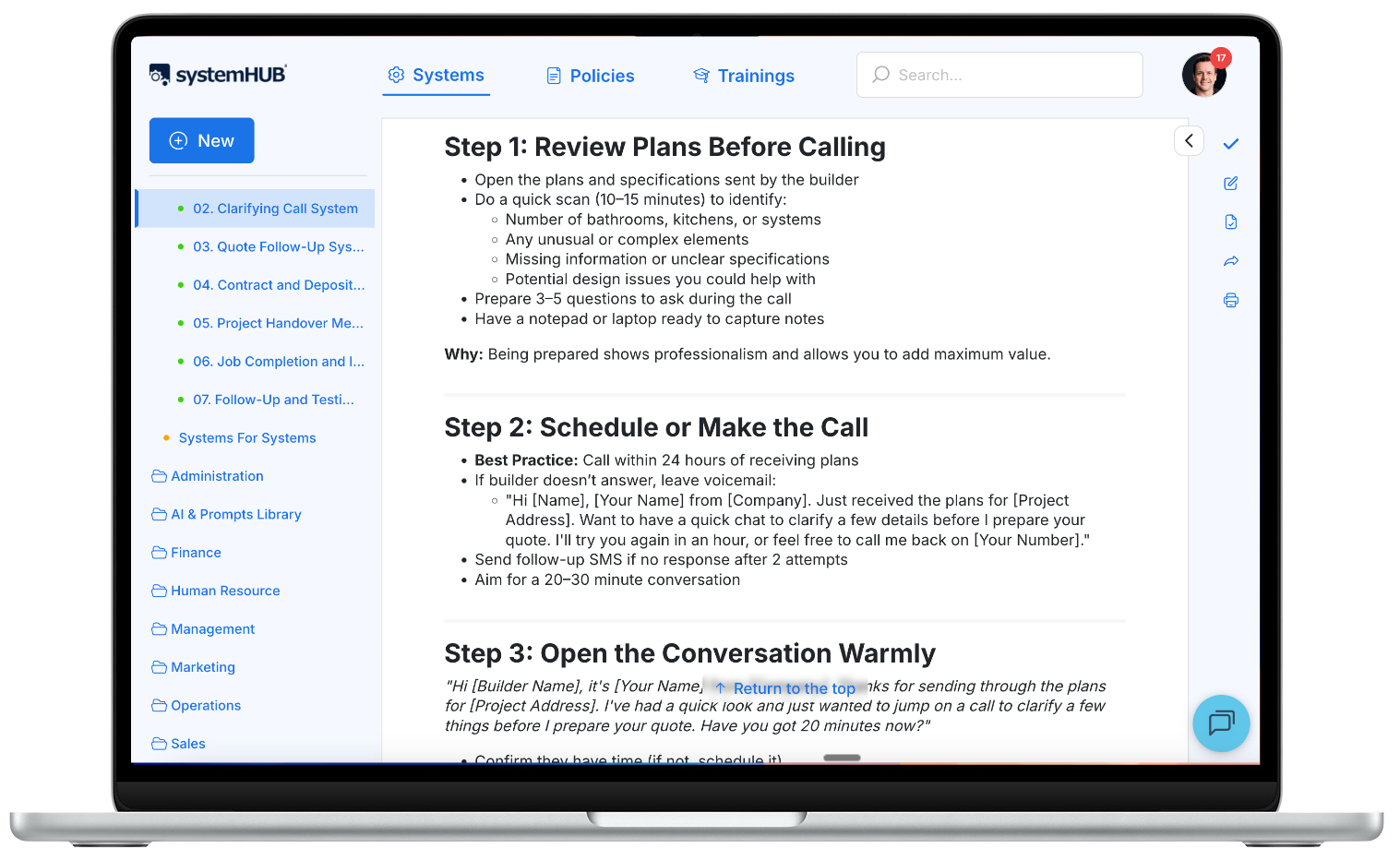
When you design systems this way, something interesting happens. Your team stops resisting. Because the system isn't trying to replace their judgment on the stuff they actually care about. It's just clearing the noise so they can focus their judgment where it counts.
This is why people are your most important business system. The systems exist to serve them, not the other way around.
How this played out at Melbourne SEO Services
When I was running Melbourne SEO Services, the agency I eventually sold, we had this exact tension.
On one hand, we needed consistency. A technical SEO audit had to check the same things in the same order, or we'd miss something. A campaign report had to follow the same format, or the client would get confused.
So we systemised that work tightly. The audit process was a documented checklist. The report template was standardised. The campaign strategists followed it exactly.
Learn more →
On the other hand, the creative angles for a campaign couldn't be systemised. Figuring out which keywords to prioritise for a particular client, which content angle would resonate with their audience, which competitor to target first: that was judgment work. That was the reason clients hired us in the first place.
So we left that part alone.
The result? The technical side got more consistent over time. Fewer mistakes. Faster onboarding for new strategists. And the creative side got sharper, because our best people weren't wasting their brainpower on the rails.
The system didn't replace their expertise. It freed them to use it.
That's what a well-drawn line looks like. It's also why the right results-oriented job descriptions matter: they tell people what outcome they're responsible for, then leave room for judgment on how to get there.
The Gerber quote, updated
Ron Carroll ended his piece by quoting Michael Gerber: "Build systems, let systems run the business, people run the systems."
Ron's reading was: eliminate discretion.
I'd read it a little differently.
Build systems that make it obvious where discretion lives and where it doesn't. Let those systems run the business, so your people aren't stuck reinventing the wheel every day. And let your people run the systems with the judgment, experience, and creativity that make them human.
Because the goal was never a business full of robots. The goal was a business where ordinary people, supported by clear systems, could deliver extraordinary work. That's a very different picture.
The bottom line
The question isn't discretion vs systems.
It's this: what kind of discretion does this decision need, and does our system make that obvious to everyone?
Get that right and your team stops feeling micromanaged. Your work gets more consistent where it needs to be. Your best people get more room where they need it. And you, the owner, stop being the referee every time someone isn't sure what to do.
Start there. Pick one decision your team currently gets wrong, look at which of the four types it falls into, and design the system to match. If you want the foundation, here's what a business system is and where to start.
And if you need someone on your team to actually drive the documentation, look at appointing a Systems Champion. Simple beats perfect. Always.
Ready to draw the line between consistency and judgment in your own business? systemHUB gives you a single place to document the parts that need consistency and leave the rest to your team's judgment. It comes loaded with 100+ templates to help you start. Try it free.