You put up a suggestion box three months ago.
You open it today. Inside: two gum wrappers, one scribbled note that just says "MORE PARKING", and a folded page demanding half-day Fridays, forever, no questions asked.
Your team has better ideas than that. The system you used to capture them was the problem.
Here's the thing. Your employees see things you don't. They talk to clients you never hear from. They use tools you haven't touched in years. They know where the friction is, where the double-handling happens, where the small daily annoyances pile up into real cost.
That knowledge is gold. And most businesses have no working way to mine it.
Why suggestion boxes fail
A suggestion box looks like openness. It's actually the opposite.
The old-school box fails for six reasons:
- Anonymity invites sniping. When people don't sign their name, complaints replace ideas. It becomes a vent, not a plan.
- Problems come without solutions. "The printer sucks" isn't a suggestion. It's a gripe. Boxes don't force people to think one step further.
- Most ideas are infeasible. Without context, people pitch things that sound great but ignore cost, timing, or downstream effects.
- There's no clear owner. Who reads the box? Who decides? Who acts? Usually no one. So nothing moves.
- There's no follow-up. People drop in an idea. Nothing happens. Ever. They stop contributing.
- It's disconnected from the work. A box in the break room has nothing to do with the system that actually runs the process.
A passive box sitting on a wall can't fix any of that.
What you need is a process. Not a box.
What you actually need
You need a system for capturing team improvements and acting on them. A real system, with an owner, a channel, a filter, and a feedback loop.
Think of it the way you'd think of any other part of the business. You wouldn't run sales through a shoebox on the counter. You wouldn't handle customer complaints by asking people to write on a Post-it and hope for the best. Why would you treat team ideas any differently?
Here's the four-step process.
Step 1: Assign ownership
Your Systems Champion runs this. Not the owner. Not "everybody." Not the team leader who's already drowning.
The Systems Champion is the person in your business whose job is to drive systemisation. They own the process of documenting, improving, and keeping systems alive. They're the perfect person to own this too.
Why not the owner? Because you have a habit of either agreeing to everything (then not following through) or dismissing things too fast. Either way, the team stops trusting the process.
Why not "everyone"? Because when everyone owns something, no one does.
One owner. Clear accountability. Weekly rhythm. That's the starting point.
Step 2: Create a clear channel
The biggest upgrade from a suggestion box is this: every idea gets attached to a specific system.
Not floating in the void. Not "general feedback about the business." Attached to the actual process the team member is trying to improve.
If Sarah in dispatch thinks the job booking workflow is broken, her suggestion goes on the job booking system. If Mark in finance has an idea about the invoicing process, it goes on the invoicing system. The idea lives right next to the thing it's about.
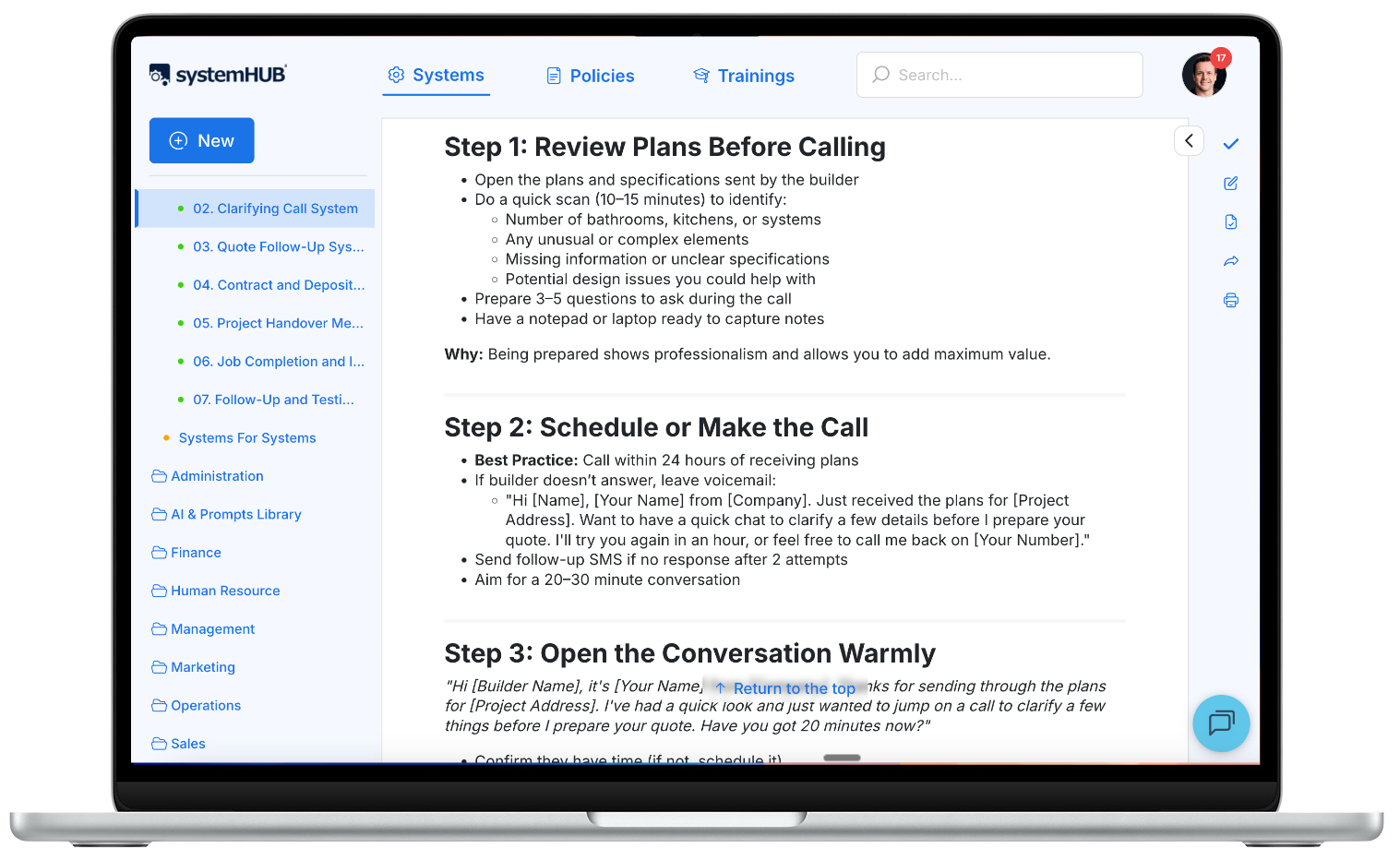
This is where systemHUB shines. Every system has a comment thread. Team members can flag issues, propose changes, or ask questions directly on the process. No separate form. No lost email. The context is already there.
If you're not on systemHUB yet, a simple shared form works. Just make sure one of the fields is "Which system is this about?" with a dropdown of your documented systems. That one constraint changes everything. It forces the person suggesting to think about where the fix lives.
Step 3: Evaluate with a filter
Your Systems Champion reviews the submissions weekly. Not daily. Not monthly. Weekly.
For each suggestion, they run three questions:
- Is this a symptom of a deeper system issue? Often the surface complaint points to something bigger. "The printer jams" might really mean "we're printing too much because the approval process still requires a hard copy."
- Is it easy to test? The best ideas have a low-cost experiment hiding inside them. If you can try it for a week and see what happens, it's worth trying.
- What's the smallest change we can make to find out? Don't redesign the whole system. Change one step. Measure. Adjust.
Three questions. Five minutes per suggestion. It doesn't need to be complicated.
Step 4: Close the loop
This is the part most businesses miss. And it's the one that matters most.
Every suggestion gets acknowledged. Every one gets a decision. Every submitter hears back.
Three outcomes are possible:
- Actioned. "Great idea. We're testing it next week. Here's who's leading it."
- Parked. "Worth doing, but not right now. Added to the improvement list for Q3."
- Declined with reason. "We looked at this. Here's why it won't work for us. Thanks for flagging it."
Seven days maximum from submission to response. Every time. No exceptions.
Replaces the suggestion box with a process that actually works.
- Team member spots a problem or improvement, attaches it to the specific system (not a general box)
- Systems Champion reviews submissions weekly, applies 3-question filter
- Easy wins get actioned within 2 weeks; bigger ideas go on a prioritised list
- Every submitter hears back within 7 days (actioned / parked / declined with reason)
Result: team feels heard, system gets better, owner not involved in every decision.
Why closing the loop matters more than anything
The single biggest reason employee suggestions dry up is silence.
Not disagreement. Not rejection. Silence.
People don't need you to say yes to every idea. They need to know you heard them, considered it, and made a call. That's what builds trust in the process.
Even a "no" with a reason creates more engagement than a dozen yeses that never get actioned. Because a "no" with a reason says: we're paying attention, we're thinking it through, we're being honest.
Silence says: we don't care what you think.
Your team will figure out which one is true within about a month.
Case study: Lime Therapy and team-driven improvement
Renee Simpson runs Lime Therapy, a multi-disciplinary allied health practice with around 40 staff in regional Australia.
Before SYSTEMology, Renee had done what most owners do. She'd hired consultants, paid for fancy policies, and built a thick folder of documents that nobody used. The business was growing but running on chaos. Every decision still came back to her.
Her breakthrough wasn't a new policy. It was a person.
Renee identified Kaleb Grant, a young occupational therapist on the team, as her Systems Champion. Kaleb didn't have a management title. He had something more important. Fresh eyes, attention to detail, and the trust of his peers.
Kaleb's job wasn't to come up with every improvement himself. His job was to build a culture where the team flagged problems, proposed fixes, and saw them implemented.
One of the first wins was their invoicing process. The team surfaced pain points, Kaleb mapped the system, they tested improvements, and the time required dropped by a factor of ten. Not because Renee had a brilliant idea in the shower. Because the people doing the work every day finally had a way to make it better.

Today, SYSTEMology is embedded in Lime Therapy's culture. Team members actively look for things to improve. Renee and Matt have stepped back from the daily grind because the systems, and the process of improving them, no longer need them in the room.
That's what a working suggestion system looks like. Not a box. A living process.
How this connects to Kaizen
What you're building here is Kaizen in practice.
Kaizen is a Japanese philosophy of small, continuous improvement. It's often credited with turning Toyota into the most efficient car manufacturer in the world. Not through giant leaps, but through thousands of tiny refinements driven by the people closest to the work.
The thing most small businesses miss is this: Kaizen is not a mindset you can install with a poster in the staff room. It needs a system. A way to capture ideas, evaluate them, and close the loop. The four steps above are that system.
Get the system running, and the mindset follows. Not the other way around.
Kaizen is also a reminder that people are your most important business system. The best automation in the world won't improve itself. The people using it will. If you give them a way. This is continuous improvement in practical form.
The bottom line
Ditch the box.
Build the process. Give it to your Systems Champion. Let them run it weekly, filter the ideas, and close the loop every time.
Within a few months, the improvements start compounding. Small fixes stack on small fixes. The business gets sharper. The team feels ownership. You stop being the one who has to spot every problem and propose every solution.
Simple beats perfect. Start with one suggestion, properly handled. Then the next.
A working suggestion system is really a signal that your Culture pillar is healthy. For how Culture stacks with Documentation and Tools, see The Three Pillars of a Systemised Business.
Ready to stop running your improvement process out of a cardboard box? systemHUB gives every system in your business its own comment thread, so team ideas land exactly where the work happens. Your Systems Champion reviews, responds, and actions them from one place. Try it free.