You documented a process. You handed it to your team. And they still come to you with questions every day.
Sound familiar?
Having systems isn't the same as having good systems. A procedure that sits in a shared folder and never gets followed isn't a system. It's a document.
So what separates a system that actually works from one that collects dust? After building, systemising, and selling three businesses, and coaching hundreds of others through the same process, I've found it comes down to eight characteristics.
If your systems have these, your business runs without you. If they don't, you're still the bottleneck.
1. It's built around the customer, not the business
The first question to ask about any system: does this help deliver a better experience for the person paying you?
It's easy to build systems that make your internal life easier. Filing systems. Reporting templates. Internal meeting agendas. Those have a place. But the systems that matter most are the ones that touch your customer's journey.
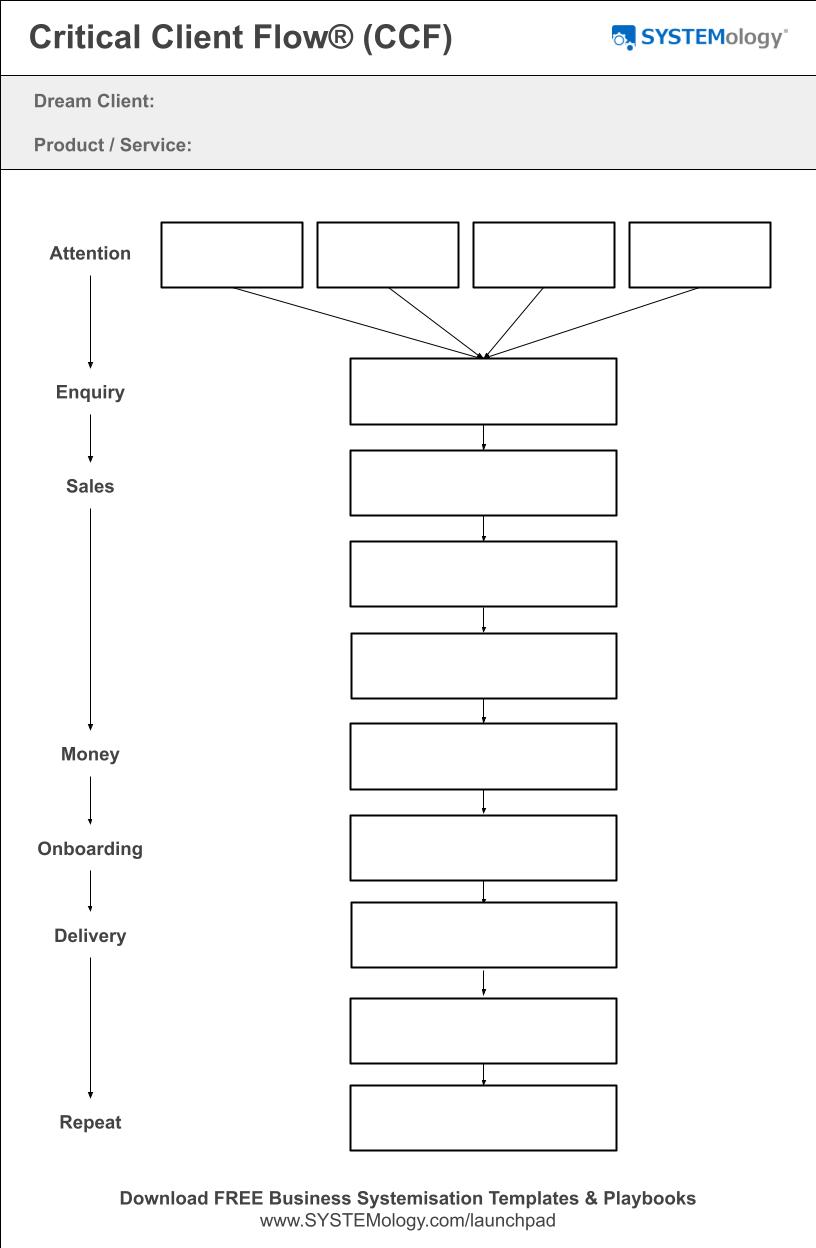
In SYSTEMology, we call this the Critical Client Flow. It maps the 10 to 15 steps that take someone from their first interaction with your business through to becoming a happy, repeat customer. When you build systems around this flow, every improvement directly impacts revenue, retention, and referrals.
Start there. Internal systems can wait.
2. It captures how your best people already do it
A good system isn't invented from scratch. It's extracted from someone who's already doing the work well.
In SYSTEMology, we call this person the "knowledgeable worker." They're the team member who consistently gets the best results. Your top salesperson. Your most reliable project manager. Your best customer service rep.
The process is simple: record them doing the work, then turn that recording into a step-by-step procedure. You're not creating something new. You're capturing what already works and making it repeatable.
When I ran Melbourne SEO Services, our best campaign strategist had a process for client reviews that was far better than anyone else's. We didn't write a theoretical "ideal" process. We recorded her doing three real reviews, documented the steps, and that became the system. Suddenly everyone's reviews were at her level.
The best-known way of doing something is almost always already happening inside your business. You just haven't captured it yet.
3. It has one job
A system that tries to do three things does none of them well.
Your client onboarding system handles onboarding. Not sales follow-up. Not invoicing. Not project scoping. Each of those is its own system with its own steps, its own owner, and its own outcome.
When systems try to cover too much ground, they become bloated and confusing. People skip steps because the document is 15 pages long and half of it doesn't apply to what they're doing right now.
Keep each system focused on one outcome. If your Critical Client Flow has 12 steps, that's potentially 12 separate systems, each doing one thing clearly.
4. Someone owns it (and it's not you)
Every system needs a name next to it. Someone who's accountable for keeping it current, training the team on it, and reporting on whether it's working.
Here's the part most business owners get wrong: that person should not be you.
In SYSTEMology, we call this person the Systems Champion. They're the detail-oriented team member who drives the documentation and adoption. The owner's job is vision. The Systems Champion's job is systems.
Sandra ran Taking Care Mobile Massage. Everything lived in her head. When the pandemic hit, her daughter Abby stepped into the Systems Champion role. Abby didn't just document the key processes. She owned them. She trained the team, updated the procedures when things changed, and made sure people actually followed them.
Sandra was able to exit daily operations entirely. Not because the systems existed on paper, but because someone owned them.
5. It's simple enough that anyone can follow it
This is the one I repeat the most: simple beats perfect.
A beautifully detailed 20-page procedure that nobody reads is worth less than a one-page checklist that everyone follows. Your systems need to be understood by the person doing the work, not just the person who wrote them.
SYSTEMology is built on this foundation. We start with what I call "overview systems," high-level steps that capture the top level of a process without getting lost in every edge case. You can always add detail later. But if the first version is too complex, your team will ignore it from day one.
Here's a test: could a new hire follow this system on their first week without asking a question? If the answer is no, simplify it.
The goal isn't a perfect document. The goal is a repeatable result.
6. You can measure whether it's working
A system without a metric is just a suggestion.
Every good system has a clear outcome you can track. For an onboarding system, it might be "time to first productive output." For a sales process, it's conversion rate. For a delivery system, it's client satisfaction score or completion time.
You don't need dashboards and complex analytics. You need one number per system that tells you whether it's getting the result you want.
When that number slips, you know exactly where to look. When it improves, you know the system is working. Without measurement, you're guessing.
7. Your team improves it, not just follows it
The best systems aren't set-and-forget. They get better over time because the people using them are empowered to improve them.
Renee runs Lime Therapy, an allied health practice with 40 staff. When she appointed Kaleb, a two-year occupational therapist with no systems experience, as her Systems Champion, the results were immediate. Kaleb didn't just document. He created a culture where the team flagged problems and suggested improvements.
The result? Invoicing time was cut by 10x. Not because the original system was bad, but because the team kept making it better.
This only happens when your people feel ownership over the systems, not just obligation. Give them permission to improve what they use every day. The system should be a living document, not a rule book.

8. It removes you from the process
This is the ultimate test. After the system is documented, trained, and running, are you still involved?
If the answer is yes, the system isn't done yet.
The whole point of building business systems is to create a business that works without you. Not because you don't care, but because your time is better spent on growth, strategy, and the things only you can do.
Ryan Stannard ran a construction firm where every decision went through him. His phone never stopped. After documenting their core systems with his daughter Eryn, they doubled their headcount from seven to 15 staff. Ryan now takes extended holidays. The systems run without him.
That's the test. Not whether the system exists, but whether you can step away and the result stays consistent.

The real test: could you leave for a month?
Here's a question I ask every business owner I work with: could your business survive without you for a month?
I had to answer that question myself when Luz Delia Gerber, wife of Michael E. Gerber (the author of The E-Myth), called me at 7 am and asked me to drop everything for three months to work with Michael on his final book.
Could my business survive without me for that long? It could. Because the systems were in place. Not perfect systems. Not every system. But the critical ones, built with these eight characteristics, running without me in the middle.
That's the goal. Not a binder full of documents. A business that runs.
Where to start
Don't try to fix all eight at once. Pick the system that's causing you the most pain right now. Score it against these eight characteristics. Find the weakest point and fix that first.
If it's not customer-focused, remap it around your Critical Client Flow. If nobody owns it, appoint a Systems Champion. If it's too complex, cut it in half. If there's no measurement, add one number to track.
One system. One improvement. Then move to the next.
If you want to understand what a business system is in more detail, or learn how to systemise your business from scratch, those guides walk you through the full process.
Once you know what a good system looks like, the bigger question is how to make all three legs, documentation, tools, and culture, reinforce each other. That framework lives in The Three Pillars of a Systemised Business.
Want to see how your systems stack up? systemHUB gives you a single place to build, store, and manage every system in your business. It comes loaded with 100+ templates so you're not starting from scratch. Try it free.