Every article on the internet about systemising a business assumes the same thing: your business runs on a single flow from enquiry to happy customer.
If you run a manufacturing business, you already know that's wrong.
You don't have one flow. You have two. You have a client flow — the sales cycle, the order intake, the account management, the repeat orders. And you have a production flow — the raw materials, the schedule, the machines, the quality control, the shipping. They run in parallel, they intersect at critical handoff points, and if either one breaks, the whole business breaks.
That's why most systemisation frameworks fall apart when applied to manufacturing. They were built for service businesses — digital agencies, accounting firms, allied health clinics — where the "work" happens in a single sequence. Manufacturers need a different approach.
Why manufacturing is different
Three things make manufacturing unique when it comes to systemisation.
Your "client experience" includes production you can't see. In a service business, the client is in the room. You can adjust in real time. In manufacturing, the client approves a spec in January and receives a product in March — and everything in between has to run without them. That gap is where quality, margin, and timeliness either hold together or fall apart.
Your machines have opinions. A physio clinic can hire another physio and double capacity. A label printer can't just hire another machine. Your production capacity is constrained by equipment you've already invested in, and your systems have to respect those constraints — scheduling, maintenance, changeover times, material flow.
Core systems and scale systems are genuinely different problems. This is the insight that advanced manufacturers figure out. Core systems run the client journey. Scale systems run the operation. They require different approaches, and most frameworks only teach you one.
The two-flow approach
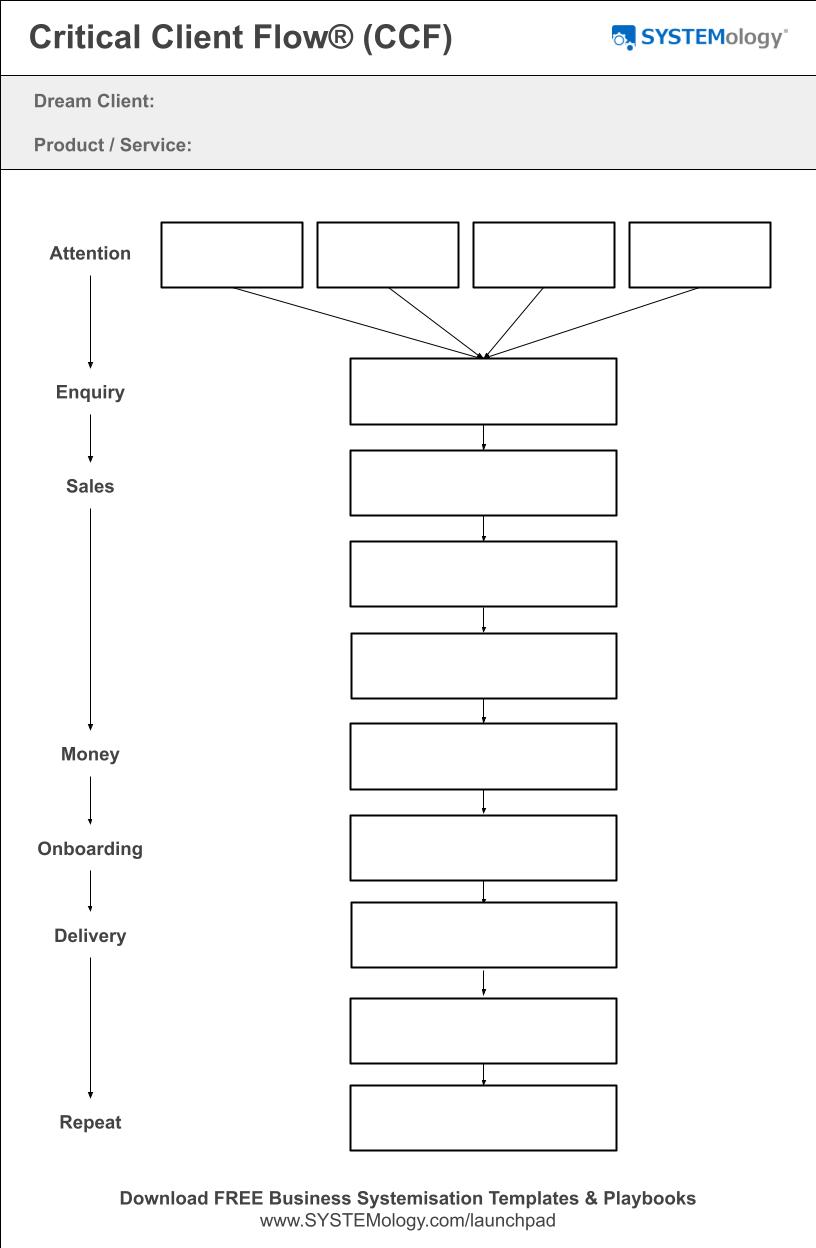
Instead of one Critical Client Flow, a manufacturing business needs two parallel maps.
Flow 1: The client flow (core systems)
This is the business-as-usual sequence from first contact to repeat order.
- Attract — Trade shows, referrals, industry directories, inbound enquiries.
- Qualify & quote — Technical brief, spec confirmation, capability check, quotation.
- Onboard — Account setup, sample approval, artwork sign-off, first PO.
- Deliver — Production scheduling, run, QC, packaging, shipping.
- Invoice & support — Billing, payment follow-up, issue resolution.
- Retain & grow — Account management, repeat orders, new product introductions.
This is what every business has. Nothing unusual here.
Flow 2: The production flow (scale systems)
This is the sequence that turns a purchase order into a finished product.
- Job planning — Scheduling the run, allocating machines, sequencing against other jobs.
- Material prep — Raw materials pulled, checked, staged for the job.
- Setup & changeover — Machines configured for the spec.
- Production run — The actual making.
- Quality control — Checks at setup, mid-run, end-of-run.
- Finishing & packaging — Secondary operations, labels, pallet build.
- Dispatch — Paperwork, loading, carrier handover.
- Machine reset / preventative maintenance — Ready for next job.
These are your scale systems — the recurring operational sequences that drive production. They don't map to a single client. They run continuously.
The insight from Kamika Castillo at The Label House Group: these scale systems require a different documentation approach. Instead of mapping a client journey, you map by cadence. What are the triggered tasks (start when X happens)? What are the daily tasks? Weekly, monthly, quarterly, annual? That's your scale systems framework.
The 4-step framework applied to manufacturing
Step 1: Define. Map both flows.
Start with the client flow. This is familiar territory for any business. Six to eight core systems covering the journey from enquiry to repeat order.
Then map the production flow. This is where manufacturers get stuck because there's no universal template — your flow is specific to your products and machinery. But every manufacturer can answer these questions:
- What triggers a production run? PO received, stock trigger, forecast.
- What's the setup sequence?
- What's the production procedure?
- What's the QC protocol at each stage?
- What's the dispatch sequence?
- What's the reset procedure?
Document those six, and you've mapped your production flow.
Step 2: Assign. Pick champions for each flow.
Here's where manufacturers often go wrong. They try to have one person own everything. That doesn't work because the skills are genuinely different.
Your Client Systems Champion is typically someone from sales, account management, or customer service. They understand the commercial flow.
Your Production Systems Champion is typically someone from the floor — a shift leader, a senior operator, a production manager. They understand the physical flow.
They collaborate at handoff points (how does a PO trigger a production schedule? How does a QC fail trigger a client conversation?). But they own their respective domains.
Step 3: Extract. Document what already works.
The knowledge is already in the business. It's in your best operator's head. Your most senior account manager's head. Your production manager's head. Your job is to pull it out.
Video capture works especially well in manufacturing because the work is visible. A machine setup is a physical sequence — record it. A QC check is a visual inspection — photograph the pass-fail criteria. A packaging procedure is a physical routine — film someone doing it correctly.
Bolton Sheetmetal's lesson: after 13 years of key-person dependency, Martin Farrow had to accept that the knowledge to run the business lived in his head, and until he extracted it, the business couldn't grow and he couldn't leave. The extraction process isn't optional — it's the whole point.
Step 4: Organise. Two libraries, one source of truth.
Most manufacturers end up with systems in two places: client-facing systems (CRM, quoting tool, account notes) and production systems (ERP, shop-floor manuals, quality docs). That's fine — but they need to be cross-referenced.
A new account manager needs to see both: "When this client places a PO over 500 units, here's what triggers on the production side."
A new operator needs to see both: "When you run this job, here's what's going into the product — and here's why this client cares about it."
The goal isn't to merge the two libraries. It's to make the handoff points visible.
Case study: Kamika Castillo at The Label House
Kamika Castillo runs operations at The Label House Group in Trinidad — a 45-year-old packaging and label manufacturing business that's one of the most sophisticated systemisation stories in the SYSTEMology community.
Starting point. A growing business with increasing complexity. Production lines, project management office, IT department, quality systems. The kind of complexity that kills manufacturers if it's not actively managed.
What Kamika did. She didn't just apply the framework — she extended it. After documenting the core client-journey systems, she realised that the scale systems (PMO, IT, recurring operational tasks) needed a different structure. She pioneered the use of cadence-based documentation: triggered, daily, weekly, monthly, quarterly, annual tasks, each with their own owner and documentation standard.
Then she went one level higher. She built a system for creating systems — a meta-system that defines how The Label House documents, reviews, and updates its processes. That's the mark of advanced systemisation: the systems reproduce themselves.
"I know determining where to start with scale systems is a bit different from core systems. So, instead of using the CCF to define the core processes, we define the recurring tasks (triggered, daily, weekly, monthly, quarterly and annually)." — Kamika Castillo
The result. A 45-year family business that doesn't depend on any single person, including the founder. Systems that survive staff turnover, promotions, and generational handovers. And a documented approach that scales as the business scales.
If you run a manufacturing business and you want proof that this works at your level of complexity — Kamika is it.
Bolton Sheetmetal and the "Oracle" problem
Martin Farrow — Bolton Sheetmetal (UK)
Thirteen years of building the business. Thirteen years of every decision running through one person's head. Every quote, every job plan, every material order, every quality call — Martin.
The breakthrough wasn't technological. It was the acceptance that the single biggest risk to his business was him. Once he committed to extraction, the systems moved from his head to his team's fingertips. Now the business can run a production week without him in the building.
If you've ever thought "my business is too complex to systemise" — Martin's story says otherwise. It's not that your business is too complex. It's that the complexity is living in your head.
Nick Pape — Glasshouse Fragrances (Australia)
Consumer products manufacturer. Had one employee — affectionately called "The Oracle" — who knew every quirk of every process. When The Oracle resigned, the business had weeks, not months, to extract what he knew.
They got through it, but the lesson stuck: every business has an Oracle. The question is whether you extract their knowledge on your schedule, or on theirs.
What changes when both flows are systemised
| Before | After |
|---|---|
| Owner approves every quote | Sales team quotes within defined parameters, owner reviews exceptions |
| Production relies on tribal knowledge | New operators trained in days, not months |
| Quality issues found at dispatch | Quality issues caught at setup and mid-run |
| One person runs every complex job | Any trained operator runs any job |
| Business can't survive a week without the owner | Business runs a full production cycle without owner intervention |
| Valuation 1 to 2x EBITDA | Valuation 3 to 5x EBITDA |
The exit-value shift is huge in manufacturing. A manufacturer with genuine, documented systems is a strategic acquisition target. A manufacturer running on tribal knowledge is a scary bet for any buyer.
The same framework works across industries: construction, plumbing, cleaning, digital agencies. The mechanics differ. The method doesn't.
Your next step
If you manufacture something for a living and this resonated:
- Grab a free copy of the SYSTEMology book. It's the framework Kamika and Martin used.
- Map both flows on one page — client flow and production flow, with the handoff points marked.
- Pick the most painful recurring failure — the one that costs you money every week. Start there.
This isn't about documenting everything. It's about documenting the things that break when you turn your back.
Ready to see what this looks like in your business? Book a free Good Fit call and we'll map both flows together.