If you own a cleaning business, you already know the trap.
You started with one van, a few good crews, and a promise that the work would be done properly. Fast forward a few years, and you're the scheduler, the quoter, the quality control officer, the trainer, the HR department, and on a bad week you're also the one grabbing a mop at 6pm because a crew called in sick.
You've built a service people love. You've also built a job that can't take a holiday.
Here's the good news: the cleaning industry is one of the most systemisable businesses on the planet. The work is repeatable. The standards are visual. The results can be photographed. And when you build the right systems, you can grow from two crews to twenty without multiplying your headaches.
Why cleaning businesses are uniquely hard (and uniquely easy) to systemise
Every industry has its own flavour of chaos. Here's what makes cleaning different.
The workforce is mobile. Your staff are spread across dozens of sites every day. You can't walk the floor. You can't do a quick visual check. Quality control has to happen at distance.
Staff turnover is high. Industry average is 200% or more annually in some markets. That means you're onboarding constantly, and every hour your best person spends training a new starter is an hour you're not growing the business.
The work is visual and variable. A clean office looks different to a clean house. A post-build clean is different to a weekly maintenance clean. The standards have to be specific enough to deliver consistently, but flexible enough to apply across different jobs.
Margins are tight. You can't afford to send a crew back for a second go. You can't afford to lose clients to the competitor down the road. You definitely can't afford to be the one doing every quote and every follow-up phone call.
But here's what makes it uniquely easy: every step of what you do is observable. Every cleaning job follows a physical sequence. Every client interaction follows a predictable pattern. And every quality standard can be captured with a checklist, a photo, or a one-minute video.
That's why cleaning businesses that commit to systemisation tend to transform faster than almost any other industry. The raw material is already there. You just need a framework to pull it together.
The Critical Client Flow for a cleaning business
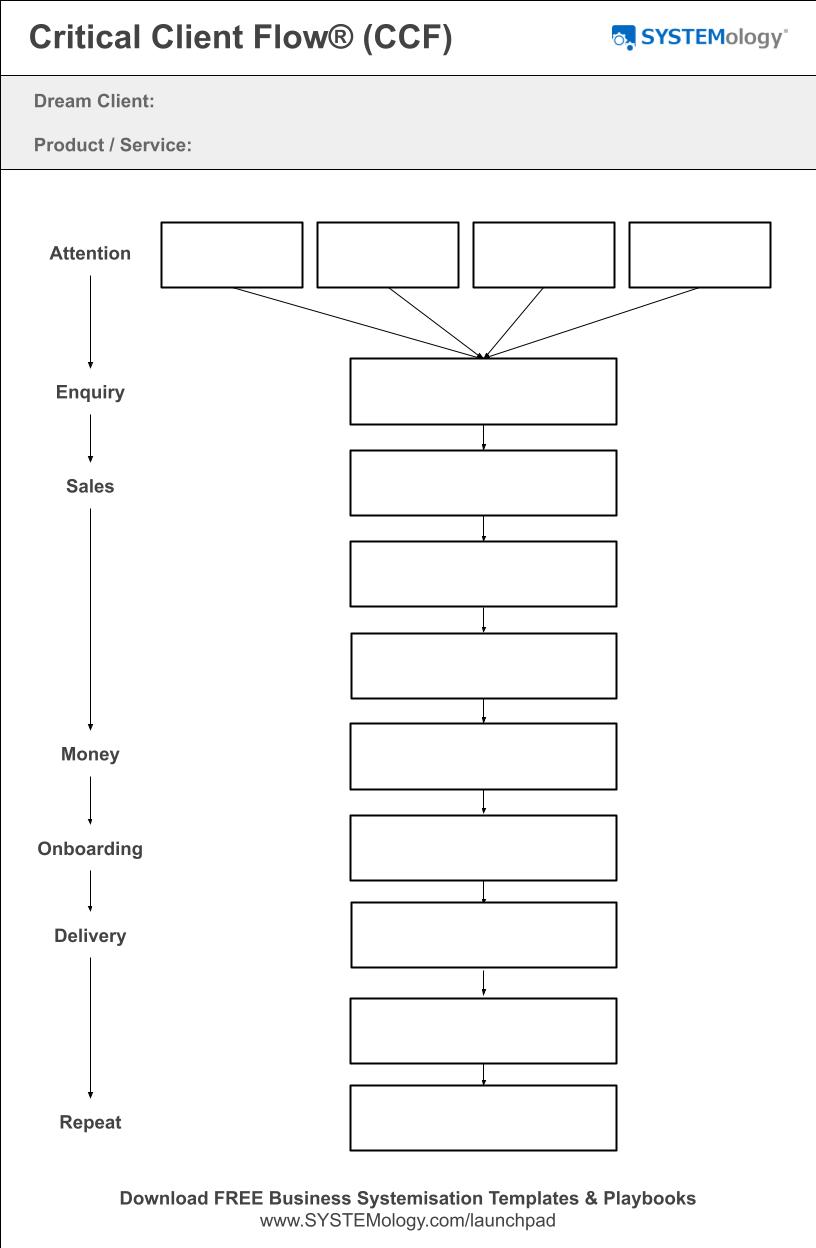
Every business has a core sequence of steps that turns a stranger into a happy, repeat customer. We call this the Critical Client Flow, or CCF.
For a cleaning business, the CCF typically looks like this:
- Attract — How does a prospect find you? Google Maps, referrals, signs on vans, a website that actually converts.
- Convert — How do you turn an enquiry into a confirmed booking? Quote request, site visit or quote-by-photo, proposal, signed agreement.
- Onboard — How do you set up a new client for success? Intake form, key handover, access arrangements, crew briefing.
- Deliver — How do you perform the clean, every time, to the same standard? Pre-job checklist, scope of work, cleaning procedure, QC checklist, photos.
- Invoice & follow up — How do you get paid and stay top of mind? Invoice sent same day, payment reminder, satisfaction check-in.
- Retain & refer — How do you turn one-off jobs into recurring revenue? Recall system, referral request, upsell specialty services.
This is the backbone of your business. Systemise these six steps and you've systemised most of the value your business creates.
The mistake most cleaning owners make is trying to document everything before documenting the critical path. They spend months writing SOPs for the payroll system while the quoting process lives entirely in the owner's head. Don't do that. Follow the client. Document the flow.
The 4-step framework applied to cleaning
Step 1: Define. Get clear on your critical processes.
Before you document anything, you need to know what to document. Most cleaning owners skip this and end up with 400 half-finished SOPs and none of them covering the stuff that actually breaks when they take a day off.
Map your Critical Client Flow. Identify the 10 to 15 systems that sit underneath those six steps. That's your list. That's where you start.
For a cleaning business, your non-negotiable systems usually include:
- Quote request, site visit, and proposal
- New client onboarding (intake, key or access setup, crew allocation)
- Standard residential clean procedure
- Standard commercial or office clean procedure
- End-of-job QC checklist with photo evidence
- Client complaint handling
- New staff onboarding (first two weeks)
- Weekly staff scheduling
- Weekly or monthly invoice run
- Client recall and retention
Step 2: Assign. Pick who'll own each system.
Here's where most owners get it wrong. They assume they have to write every SOP. That's the bottleneck that keeps the business stuck.
You don't write the systems. The person currently doing the work captures it, by recording themselves doing it while someone else watches and takes notes. We call this the knowledgeable worker and Systems Champion approach.
If your best cleaner Maria knows exactly how to do a premium residential clean, she's the one to capture it. Not you. You just need someone whose job it is to pull that knowledge out of her head and turn it into a documented system.
This is where a Systems Champion becomes the highest-leverage hire in your business. Not another cleaner. Not another admin person. Someone whose entire job is to run the systems project.
Step 3: Extract. Turn tacit knowledge into documented systems.
Record, don't write.
The fastest way to document a cleaning procedure is to record a video of your best cleaner doing it, narrating what they're doing as they go. Loom or a phone camera works fine. Then someone turns that recording into a checklist with timestamps.
A full residential clean? 20-minute video. A commercial office clean? 30-minute video. A post-build clean? 45 minutes with before-and-after photos.
You're not making feature films. You're capturing know-how in a format your team can re-watch.
Step 4: Organise. Make systems findable and used.
The worst thing that can happen to a beautifully documented system is that it lives in a folder nobody opens.
Put everything in a central hub your team actually uses. A Google Drive buried five folders deep doesn't count. A ring binder in the office definitely doesn't count. You want one place, findable by the CCF, searchable, with video and checklist side-by-side.
Once it's centralised, you integrate it into the work itself:
- Every new hire's first week — watch the onboarding systems before they're on a job.
- Every cleaner starts every shift with the "today's job" checklist open on their phone.
- Every QC photo gets uploaded as evidence.
- Every recurring meeting references the systems.
Systems that sit in a folder don't change anything. Systems that become part of the daily workflow change everything.
Case study: Jose Carrera at All-inclusive Care
Jose Carrera runs All-inclusive Care, an end-to-end facility services provider. The challenges he faced will sound familiar to any cleaning business owner.
The problem. Managing a large, mobile workforce across multiple sites meant quality was inconsistent. Staff turnover was constant, which made training a full-time job in itself. And because Jose was the hub that every decision flowed through — sales, scheduling, quality control — the business couldn't grow beyond what he could personally oversee.
The shift. Jose read the SYSTEMology book and committed to systemising the business from top to bottom. He focused on documenting every key process, starting with the Critical Client Flow: preparing a quote, onboarding a new client, the specific cleaning procedures for each job type, and client follow-up.
He used systemHUB to house these processes, creating a central knowledge base accessible to his entire team.
The result. The business now delivers consistent, high-quality service across all clients and locations, regardless of which crew shows up. Training new staff is significantly faster and more effective, which is critical in an industry where high turnover is the norm, not the exception. And Jose has been able to step back from the daily grind to focus on strategic growth.
"This is a powerful example of how systemisation can transform a traditional, service-based blue-collar business into a scalable, professional, and valuable asset."
Two more cleaning businesses worth studying
Dave Porter — PorterVac (gutter cleaning & roof restoration)
Dave runs a specialist gutter cleaning and roof restoration company with a fleet of vacuum trucks. His key realisation: "I used to think common sense was enough. Turns out, everybody needs a system to follow."
The shift came when he stopped trying to write the systems himself and instead involved his staff in documenting what they already knew. The result: a scalable model that doesn't depend on him or his general manager to hold everything together.
Marco Randazzo — Captain Duster (house cleaning)
A classic local house cleaning business. Marco applied the CCF framework to document every step: quoting, scheduling, the specific on-site cleaning procedure, and client follow-up. The result: more consistency, faster staff training, and the foundation to scale by adding crews and expanding service areas.
Both businesses prove the same point: the framework works whether you're cleaning offices for corporates or houses for homeowners. The mechanics differ. The method doesn't.
What changes when a cleaning business has systems
Let me be specific about what "systemised" actually looks like:
| Before | After |
|---|---|
| Owner does every quote | Admin handles most quotes using a template and pricing matrix |
| Training takes two weeks, results are inconsistent | Training takes three days, new hires reference videos on their phones |
| QC depends on owner visiting sites | QC depends on checklists plus photos uploaded after every job |
| Clients leave when "their" crew leaves | Clients stay because the service is consistent across crews |
| Owner works 60+ hours a week | Owner works 30 to 40 and can take two weeks off |
| Business worth 1 to 2x EBITDA (owner-dependent) | Business worth 3 to 5x EBITDA (systemised asset) |
That last row is the big one. A systemised cleaning business is a sellable asset. An owner-dependent one is just a demanding job that someone pays you to do.
The same framework works across industries: plumbing, construction, accounting, digital agencies, and more. The mechanics differ. The method doesn't.
Your next step
If you own a cleaning business and this resonated:
- Grab a free copy of the SYSTEMology book. It's the playbook Jose, Dave, and Marco used.
- Map your Critical Client Flow on one page. Six steps, with two or three sub-systems under each.
- Record one video. Pick your #1 most important recurring system. Have your best person do it while you film. That's your first documented system.
From there, the momentum builds itself. The business stops needing you at the centre of every decision, and you get back to running a business instead of being one.
Ready to see what this looks like in your business? Book a free Good Fit call and we'll map it out together.