If you own an auto repair shop, I can tell you exactly what you were doing 30 minutes ago without ever meeting you.
You were either:
- Under a car,
- On the phone explaining to a customer why the quote went up $400 once the job opened up,
- Or writing a work order while the phone rang and two technicians asked you questions at the same time.
You're the best mechanic in the shop. That's why you opened the shop. It's also the reason the shop can't run without you.
Here's what nobody told you when you bought the place: an auto repair shop is actually a professional services business, not a trade. Your customers aren't paying for parts. They're paying for diagnostic accuracy, honest recommendations, clean workmanship, and trust that the repair will hold. Build those systems, and you build a shop that can run whether you're under a car or not.
Watch: the auto repair CCF walkthrough
In the video below, I walk through the Critical Client Flow for an auto repair shop from end to end — the same framework we use with shops that join SYSTEMology. Watch it first if you prefer the visual version.
Then keep reading for the full breakdown.
Why auto shops are uniquely hard to run (even when the work is good)
Running an auto shop has specific pressures that don't exist in most service businesses.
Trust is the product. Customers can't verify the work themselves. They're taking your word that the brakes needed replacing. That makes your shop's reputation more valuable than almost any asset on the floor — and one bad review can cost more than a week of work.
The job grows mid-repair. You quote $400 for a brake job. The technician gets in there and finds the rotors are shot. Now you're calling the customer with a number that's double what you quoted. The way you handle that call determines whether they become a loyal customer or a Google reviewer.
Parts are a minefield. Right part, right price, right timing. Every one of those three fails regularly, and each failure costs margin, customer satisfaction, or shop time.
Technicians are expensive and hard to retain. A good tech can work anywhere. If your shop isn't a good place to work — clear systems, fair flat-rate billing, progression paths, good equipment — you'll lose them to the dealership or the independent down the road.
The owner is the best mechanic. This is the biggest trap. You can diagnose faster, you do cleaner work, you know the regulars. So you do the hard jobs yourself. And now you're the constraint on the shop's capacity.
Every one of these problems is a systems problem. None of them require you to be a better mechanic to solve.
The Critical Client Flow for an auto repair shop
Here's the flow every car takes through your shop (whether you've documented it or not):
- Attract — Google reviews, referrals, walk-ins, insurance and warranty networks.
- Book & intake — Phone booking, online booking, walk-in intake form, initial problem capture.
- Drop-off & check-in — Intake form, vehicle inspection, keys, customer expectations, contact preferences.
- Diagnostic — Initial scan, visual inspection, test drive, fault isolation, digital vehicle inspection (DVI).
- Estimate & approval — Estimate call, DVI report, additional work approval, upsell protocol.
- Repair — Job card, parts sourcing, labour allocation, progress tracking.
- Quality check & handover prep — Final inspection, test drive, clean-up, handover briefing.
- Pickup & payment — Invoice, payment, warranty explanation, follow-up scheduling.
- Follow-up & retention — Satisfaction check, next-service reminder, review request.
Nine steps. Your shop runs on these whether you've documented them or not. The difference between a good shop and a great shop is whether each step happens the same way every time — or whether it depends on who's working that day.
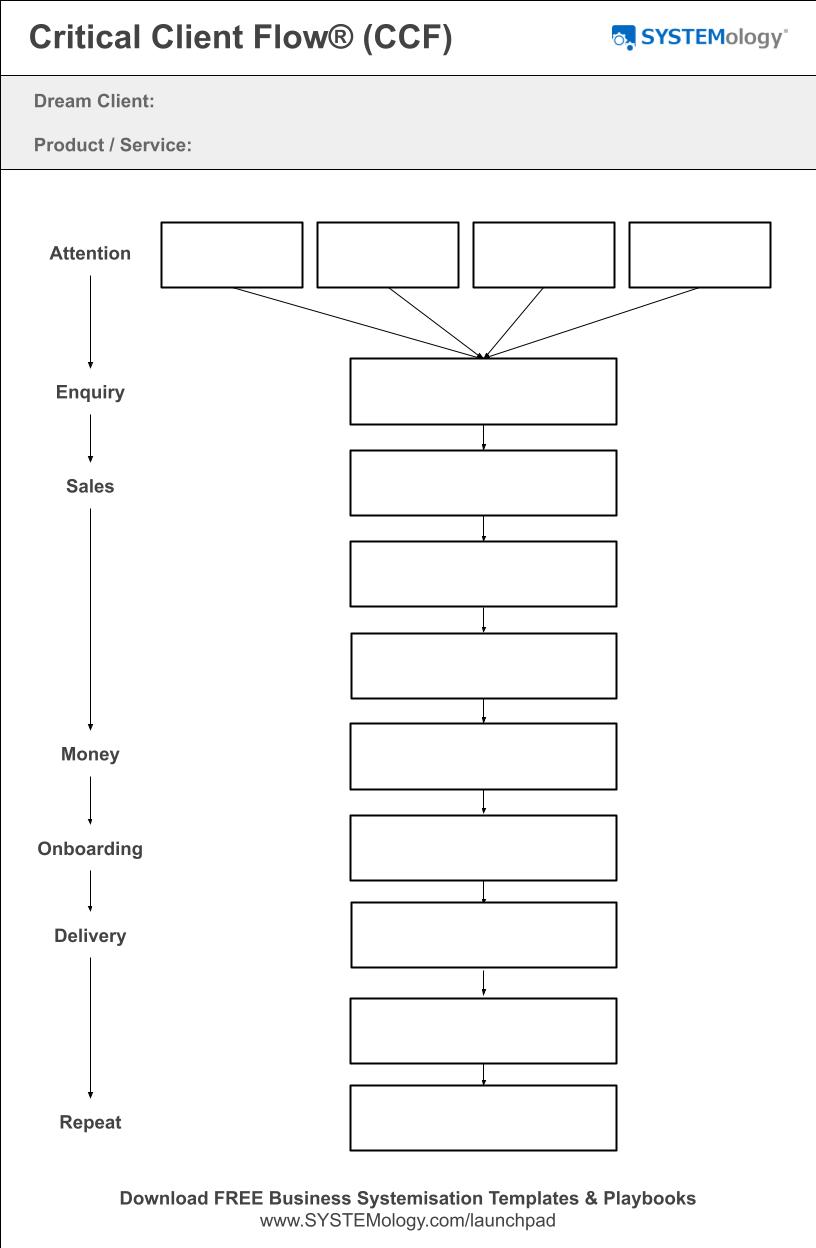
The 4-step framework applied to an auto shop
Step 1: Define. Your critical systems list.
From the CCF above, identify the 12 to 15 core systems that drive your shop. For most auto repair shops:
- Phone and online booking protocol
- Vehicle drop-off and intake (customer interview, walk-around, paperwork)
- Initial diagnostic procedure
- Estimate creation and customer approval call
- Additional work found approval protocol (the hardest one)
- Parts sourcing and ordering
- Job card and work order generation
- Labour allocation and flat-rate protocol
- Quality control and final inspection
- Test drive checklist
- Customer handover and invoice
- Warranty work protocol
- Comeback and complaint handling
- New technician onboarding
- Daily and weekly shop rhythm (huddle, board review, metrics)
Step 2: Assign. Who owns what?
Your shop foreman or service manager owns most of this. If you don't have one, hiring one is more important than any systemisation work. The owner-mechanic doing both technician work and management work is the single most common reason auto shops plateau.
Ideal split:
- Shop foreman or service manager — Owns the flow: bookings, diagnostics, estimates, customer communication, QC, handover.
- Parts person (or senior tech doubling up) — Owns parts sourcing, inventory, returns.
- Senior technician — Owns technical training, tool maintenance, technician development.
- Owner — Ultimately accountable for the whole, but operationally removed from daily work.
If you're still the shop foreman, you're still the bottleneck. Getting off the tools starts with hiring someone to manage the flow.
Step 3: Extract. Record what already works.
Auto shops have an advantage most professional services don't: the work is observable. Everything can be filmed, photographed, or checklisted.
- Diagnostic procedure — Record your best diagnostician talking through a real diagnostic while they do it. "I'm starting here because of X. If I see Y, I go to Z."
- Estimate call protocol — Record three estimate calls from your best service advisor. Note patterns. Build the script.
- Additional work approval — This is the big one. Record exactly how your best advisor handles the "we found more wrong" call. That's the most valuable system in the shop.
- Quality check — Photograph the final inspection steps. Build a visual checklist.
- Customer handover — Film a good handover. Document the customer's experience from car-pickup to drive-out.
You're not inventing anything. You're extracting it from the people who already do it well.
Step 4: Organise. One hub, always in use.
One central place. Organised by the CCF. Video plus checklist.
Then — integrate it into the daily workflow:
- Morning huddle (10 minutes, 7:30am) — today's jobs, constraints, who's working on what.
- Every job has a job card with the relevant systems attached.
- Estimate calls follow the script — the system is open on the advisor's screen.
- Final inspection follows the checklist — tick off each step with photo evidence.
- Weekly team meeting reviews one system at a time.
Systems that live in a folder don't change anything. Systems that live in the daily workflow change everything.
The hardest system in an auto shop (and how to get it right)
This is the moment where trust is either built or destroyed.
What happens without a system: Tech finds more issues. Writes them on a scrap of paper. Tells the service advisor between jobs. Service advisor calls the customer. Lists the issues. Quotes a rough number. Customer feels blindsided. Says "just do what you quoted." Shop either loses margin doing unbillable work, or returns the car with known issues, or does the work anyway and fights for payment.
What happens with a system: Tech completes a Digital Vehicle Inspection (DVI) with photos, video, and notes. Service advisor reviews the DVI, identifies what's safety-critical, what's recommended, what's optional. Service advisor calls the customer with the DVI link open. Walks them through the photos. Explains what has to happen now, what should happen within 30 days, what can wait. Customer makes an informed decision. Approves what they approve. Declines what they decline, with documented acknowledgment. Shop makes margin. Customer trusts the shop. Next service is pre-booked.
That's a system. It's not rocket science. But it's the difference between a shop that grinds out $800k in revenue and one that does $2m with the same headcount. Every part of this can be documented and taught.
What changes when an auto shop has systems
| Before | After |
|---|---|
| Owner is the lead tech | Owner works 30 hours and isn't the constraint |
| "Additional work" calls go badly 30-40% of the time | DVI + script approach = 70-80% approval rate |
| Technician onboarding takes 3-6 months | New techs productive in 4-6 weeks with documented training |
| Parts errors cost 5-8% of revenue in rework | Parts errors cut to 1-2% with documented sourcing |
| Customer retention 40-50% year-over-year | Retention 70-80% with recall and follow-up systems |
| Shop depends on 2-3 key people; any departure = crisis | Shop survives any single departure |
| Business worth 1 to 2x EBITDA | Business worth 3 to 4x EBITDA |
The exit multiple on a systemised shop is dramatically higher. Buyers pay for predictable cash flow. Predictable cash flow requires systems.
The same framework applies across trades businesses: plumbing, construction, cleaning, manufacturing. Different work, same method.
Your next step
If you own an auto repair shop and this resonated:
- Watch the CCF walkthrough video at the top of this article. Map your own CCF.
- Grab a free copy of the SYSTEMology book. The playbook's in there.
- Start with the "additional work approval" system. It's the highest-leverage system in any auto shop. Nail that one first.
Your shop can run whether you're under a car or not. You just need the systems to make it true.
Ready to see what this looks like in your shop? Book a free Good Fit call and we'll map it out together.