Most business owners think they have a systems problem.
They look around at the chaos, the missed deadlines, the dropped balls, the work that only the owner seems to be able to do properly, and they reach the same conclusion: "We need better systems."
So they go out and fix it. They document a few processes. They buy some software. They run a workshop. And for a few weeks, things feel better.
Then it all slowly drifts back to how it was.
Here is what I have learned after working with thousands of business owners. Systems initiatives do not fail because the documentation was bad. They fail because owners treat systemisation as a single problem, when it is actually three.
There are three pillars holding up every systemised business. If you only work on one, the whole thing eventually tips over.
The three excuses that kill every system
Before we get to the pillars, let me show you the shadow side — the three excuses you will hear every time a system fails to stick.
Watch for these. If you have been in business more than a year, you have heard them all already.
"I didn't know how." The system was never documented clearly enough for this team member to follow it. So they improvised. Or asked someone else. Or just guessed. The process happens, but not the way it was designed to happen.
"I didn't know it was my job." The responsibility was unclear. Two people thought the other was doing it. Or it fell into a gap between roles. Nobody owned the outcome.
"I don't want to." This one is the most honest. They knew how, they knew it was their job, and they chose not to do it the documented way. Maybe the old way felt faster. Maybe following the system felt like being micromanaged.
Each excuse points at a different pillar. Documentation fixes "I didn't know how." Tools fix "I didn't know it was my job." Culture fixes "I don't want to."
Fix the wrong pillar for the right excuse and nothing changes.
The Three Pillars framework

Think of the pillars as the three sides of a triangle. Each side is essential. They work together to support everything inside. Take away any one of them and the whole structure collapses.
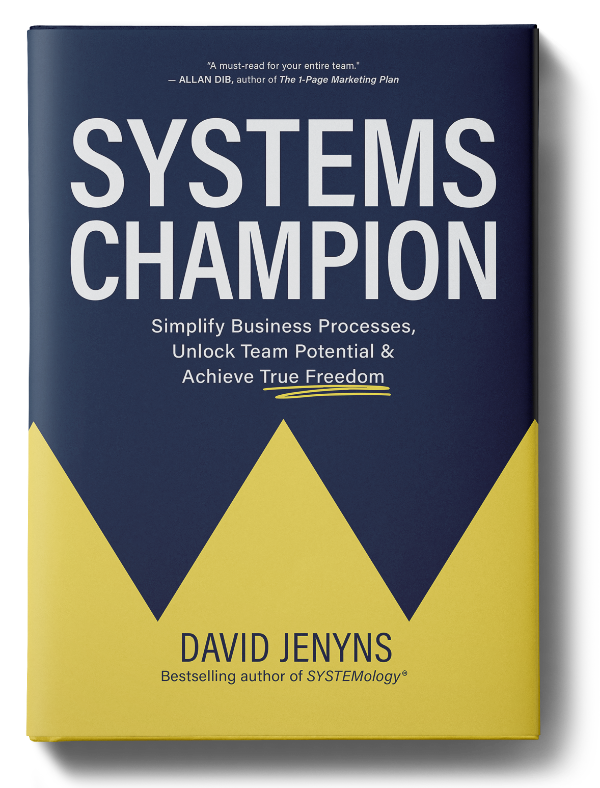
This is the framework I introduced in my latest book, Systems Champion. It is how I teach owners and Systems Champions to build businesses that actually stay systemised.
Here is a quick look at each pillar.
Pillar 1: Documentation. The "how we do it" of your business. Crystal-clear, accessible, up-to-date instructions that turn tribal knowledge into something your team can actually follow.
Pillar 2: Tools. The infrastructure that makes work visible, accountable, and efficient. Not just software, but anything that shows who is doing what, by when, and how.
Pillar 3: Culture. The environment where following systems feels natural, not forced. Where the team celebrates wins, suggests improvements, and treats systems thinking as part of "how we do things here."
Most businesses obsess over Pillar 1, touch Pillar 2 only when it hurts, and forget Pillar 3 entirely.
That is why so many system initiatives die.
Pillar 1: Documentation

The McDonald brothers did not build a global empire with Big Macs. They built it by documenting exactly how to make one.
One squirt of ketchup. One of mustard. 30 seconds from order to tray. A kitchen choreographed like an assembly line, every movement mapped, every process precise.
Ray Kroc walked into that original San Bernardino restaurant in 1954 and saw something other people missed. The McDonald brothers had not just created a faster burger. They had created a repeatable system for making a burger. That distinction is what turned a single hamburger stand into 38,000 locations.
Your business is not a hamburger stand. But the principle is the same. Your most valuable asset is not the product or the service. It is the accumulated know-how — the techniques, the sequences, the little decisions your best people make without even thinking about them.
That know-how is trapped in people's heads.
If your top performer quits tomorrow, most of what they know walks out the door with them. Documentation solves that. It turns tribal knowledge into a living playbook anyone with the right skills can follow.
Document what matters, not everything
Here is the trap. Most owners who embrace documentation try to document everything, and quickly collapse under the weight.
The fix is a concept from the book called Minimum Viable Systems.
The human body runs on maybe a dozen vital systems — circulatory, digestive, respiratory, endocrine, nervous. Everything else is detail. Your business is the same. Out of the hundreds of processes happening every day, a small fraction actually matter to whether your clients are happy and your lights stay on.
Your Minimum Viable Systems are that small critical fraction. The 20 percent of systems that produce 80 percent of your outcomes. Document those first. Leave the rest for later.
The question to test a system for MVS status is three words.
Is it essential, repeatable, and delegable?
Essential means the business breaks without it. Repeatable means it happens the same way more than once. Delegable means it can eventually be handed to someone cheaper or, increasingly, to an AI. Systems that tick all three boxes are where you start.
Inside your Minimum Viable Systems sits an even smaller core: the Critical Client Flow, the 10 to 15 steps that take a prospect from first contact to happy, repeat customer. That is where every systemisation journey should start.
What good documentation looks like
Three questions tell you how detailed a system needs to be.
Who is using it? An experienced bookkeeper running month-end might only need bullet points. A new admin assistant onboarding a lead into your CRM needs screenshots at every step.
How complex is the task? A five-step process can be a checklist. A multi-department workflow needs to be broken into chunks.
How often is it done? Daily tasks get reinforced by repetition, so light documentation works. Quarterly or annual tasks need heavy detail because nobody remembers what they did last time.
Good documentation is not a 50-page manual. It is the minimum amount of instruction needed for a competent person to achieve the right outcome.
If you want a deeper dive on the anatomy of a good system, my article on what good business systems look like walks through it. And if you are stuck on where to start, the humble checklist is almost always the right first move.
Pillar 2: Tools

Pillar 1 without Pillar 2 is a Word document nobody can find.
You can document every process perfectly, but if the documentation lives in a folder buried three clicks deep, if there is no accountability built in, if nobody can see who owns what or what is overdue, the systems will not stick.
Tools fix the "I didn't know it was my job" excuse.
The goal is what I call accountable transparency. Your tools should make it obvious, without anyone having to ask, who is doing what by when. Progress should be visible in real time. Responsibilities should be unmistakable.
When the tech stack is right, people autocorrect. They see they are behind and catch up. They notice their teammate is stuck and offer help. The system handles the nudging so you do not have to be the person chasing updates.
When the tech stack is wrong, everything depends on you remembering to ask. That is not a system. That is the owner as the bottleneck.
What the tools pillar actually covers
Three layers sit inside this pillar.
Where your systems live. Systems need a home. A single source of truth where every documented process lives, indexed, searchable, and accessible from any device. This is what platforms like systemHUB were built for. Compared with scattered Google Docs, it is the difference between a functioning library and a pile of paper on the floor.
Where work happens. Project management tools, shared task lists, CRMs. Anywhere your team actually does the work. These need to connect to your documented systems so that following the process is the path of least resistance.
How AI fits in. This is the part that is changing the fastest. AI now lets you document processes 10x faster by turning video recordings into step-by-step guides. It drafts customer responses. It summarises meetings. It surfaces patterns in your data. Every documented process you create is also training material for the AI assistants that will eventually handle a lot of the routine work for you.
This is why Systems Champion talks about the rise of the AI Champion — a new role that evolves naturally from Systems Champion. The person who already knows how every process in your business works is perfectly placed to decide where AI can add the most value.
For the philosophy behind this sequence — why systems come before AI, every time — my article on process first, then AI goes deeper. And if you are evaluating platforms, my comparison of systemHUB vs SweetProcess is a good place to start.
Pillar 3: Culture

The third pillar is the one most owners pretend does not exist, then blame when everything fails.
You can have great documentation. You can have great tools. And you can still watch your team quietly go back to the old way of doing things the moment you stop watching.
Culture is what makes people want to follow the systems.
There is a video I reference in Systems Champion that illustrates this better than anything I have ever seen. Derek Sivers calls it "How to Start a Movement." A shirtless guy at a music festival starts dancing alone. He looks ridiculous for about 20 seconds.
Then one person joins him.
That first follower is the hinge of the entire thing. They take a lone nut and turn him into a leader. Then a third person joins, and a fourth, and within 90 seconds the whole hillside is dancing.
Your business owner is the shirtless dancer. Your Systems Champion is the first follower. That is the person who takes a vision and turns it into a movement.
Three moves that build systems culture
Make it easy. If following a system takes more than two or three steps, simplify. Reduce friction at every turn. The documented way must be the path of least resistance. Small wins that people can pick up in an afternoon build far more culture than ambitious rollouts do.
Make it obvious. Put the documentation where the work happens. Checklists live inside the tool the team uses. Templates replace blank pages. Visual cues trigger the right behaviour. The right way should feel so natural that doing it the old way feels strange.
Make it fun. Celebrate system wins out loud. Show the team that documenting a process is how you hand off the parts of the job you no longer want to do. Run short, fun workshops. Invite suggestions. The businesses I see win long-term have all turned system building into a team sport, not a management directive.
What culture looks like when it clicks
Renee and Matt Kelly run Lime Therapy, an allied health practice in rural Australia. About 40 people.
Their transformation did not start with a consultant or a software platform. It started with appointing the right Systems Champion — a young occupational therapist on their team named Kaleb, who had a natural gift for organisation.
They protected his hours. Gave him space. Let him document the Critical Client Flow and roll it out. Then something quietly remarkable happened.
Team members started coming to Kaleb saying "I want to do what you are doing. I do not know what it is, but it looks fun."
The business saw hard numbers — invoicing time reduced tenfold. But the cultural shift was the real prize. Systems thinking became part of how the team talked. "SYSTEMology has become part of our language," Renee says. "Every problem, every opportunity, we now see it as a system."

That is what Pillar 3 looks like when it clicks.
For the team dynamics behind this pillar, my article on why people are your most important business system is a companion read. If your team is already drifting away from the systems, employee discretion vs systems shows where to draw the line.
The pillars only work together
Here is the part most frameworks get wrong.
The three pillars are not a checklist. They are not stages you complete in order. They are interconnected. Each one makes the others stronger.
The best documentation in the world is useless if your tools make it hard to find. The best tools in the world are shelfware if your culture does not embrace them. And the best culture will not survive without clear documentation and tools that hold people accountable.
Trying to build systems culture without proper documentation is like running a restaurant with no recipes. Trying to roll out sophisticated tools without a culture that uses them is like buying a Formula 1 car to drive to the supermarket — spectacular and pointless.
This is why the owners who ask "what is THE one thing I should focus on?" are asking the wrong question.
The right question is: which of my pillars is weakest, and what is the smallest next move I can make to strengthen it?
Your Three Pillars self-audit
Rate your business on each pillar. Be honest. Ten is strong, one is weak.
Documentation. Do you have written, accessible, up-to-date instructions for your Minimum Viable Systems? Could a new team member follow them to produce the right outcome without asking questions?
Your rating: ___ / 10
Tools. Does your team have one home for every system? Can anyone see who is doing what by when, without asking? Is following the documented way the path of least resistance?
Your rating: ___ / 10
Culture. Does your team actually follow the systems when nobody is watching? Do they suggest improvements? Do new hires pick up "how we do things here" within a few weeks?
Your rating: ___ / 10
Whichever pillar scored lowest is where you start. Not the shiniest one. Not the easiest one. The one that is currently holding the other two back.
For most businesses, the answer surprises them. They expected Documentation to be the weakest. The audit reveals Culture is.
The Systems Champion holds it all together
Every pillar needs an owner. Without one, the owner becomes the de facto champion, which means the moment a crisis hits (and one always does) everything stalls.
Your Systems Champion is the person whose actual job it is to keep all three pillars healthy.
They are not the business owner. They are not a senior manager. They are usually someone a few layers down in the org chart with the right mindset — organised, curious, patient with people, and genuinely interested in how things work.
Get the right Systems Champion in place and the pillars start reinforcing each other naturally. Documentation improves because someone is actually responsible for it. Tools get used properly because someone is running the training. Culture shifts because a first follower has appeared and given everyone else permission to join.
Learn more →
The full playbook for building each pillar lives in my book, Systems Champion. Four chapters on Documentation. Four on Tools. Four on Culture. A 90-day action plan that walks the Systems Champion through the entire build.
You can read the book summary here, or grab a copy at SystemsChampion.com.
The bottom line
Systems fail for the same reason buildings fall down. Weak foundations.
Not weak documentation. Not weak tools. Not weak culture. Weak in the places nobody was paying attention to.
The Three Pillars — Documentation, Tools, and Culture — are the foundations of every business that stays systemised. Most owners work on one. The ones who figure out all three end up with businesses that practically run themselves.
Start with the pillar that is weakest. Put a Systems Champion in charge of the build. Let the pillars reinforce each other over time.
That is how you get a systemised business that actually sticks.
Ready to build the foundation? systemHUB gives you a single home for all three pillars — documentation, tools, and the training content your Systems Champion will actually use. It comes loaded with 100+ SYSTEMology templates to get you moving. Try it free.