Looking for the role rather than the book? A Systems Champion is the person inside a business who owns systemisation: they capture how work is done, keep the documentation current, and drive the improvement cadence. It is not the owner, and it is not a full-time hire in most businesses. I've explained the role in full in what is a Systems Champion. The rest of this page summarises the book.
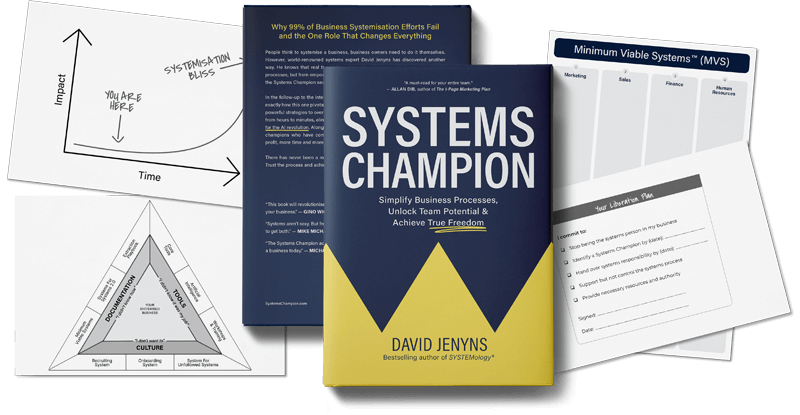
Systems Champion by David Jenyns is the practical sequel to SYSTEMology. Published in 2025, it's the playbook for the person who actually drives systemisation forward inside a business. It covers the Three Pillars framework (Documentation, Tools, Culture), integrates AI throughout, and starts with the most liberating line in business: "This book is not for you."
Learn more →
What Is the Systems Champion Book About?
The opening chapter says something no other business book says: this book is not for you.
Not if you're the business owner, anyway.
That sounds counterintuitive. You bought the book. You know your business needs systems. But here's the uncomfortable truth I've discovered after working with thousands of businesses: the owner is almost always the wrong person to drive systemisation.
You're a visionary. You think in possibilities and potential. You're built to spot the next big move, not document the current one. And every time you've tried to be the systems person, it's stalled. The systems you documented gathered digital dust. The standards you created got ignored. The tools you implemented didn't get used.
Systems Champion is written for two audiences. The first four chapters are for the business owner: how to find the right person, empower them, and get out of the way. The rest is a practical playbook for the Systems Champion themselves, giving them everything they need to transform your business from the inside out.
The book includes a Liberation Plan: a written commitment to stop being the systems person and hand that responsibility to someone better suited. For most business owners, signing it is the hardest and most important step they'll take.
Why Did I Write a Second Book?
When I wrote SYSTEMology in 2020, I had a dream: to free business owners worldwide from daily operations. That book helped thousands of businesses take their first steps toward systemisation.
But a pattern kept appearing. Businesses would learn the framework, get excited, start strong, and then stall. The missing piece wasn't the methodology. It was the person.
Every successful implementation I'd seen had one thing in common: someone inside the business who made systemisation their job. Not the owner. Not an external consultant. A dedicated team member who kept systems front and centre when everyone else was caught up in the daily whirlwind.
The world had also changed dramatically since 2020. AI tools that didn't exist when I wrote SYSTEMology were now transforming what was possible. What once required months of documentation could now be accomplished in weeks. The question was no longer whether to systemise, but how quickly you could adapt.
That's why Systems Champion exists. It formalises the role, integrates AI throughout the process, and tackles the number one complaint from SYSTEMology readers: "What do I do when my team won't follow the systems?"
What Are the Three Pillars Framework?
The heart of the book is the Three Pillars. Think of them as the legs of a stool. Each one is essential, and they work together to create stability. Remove one and the whole thing falls over.
Pillar 1: Documentation
Documentation is the foundation. It transforms all the invisible knowledge trapped in your team's heads into a visible, living playbook that can be shared, refined, and scaled.
But the book doesn't just tell you to "document your processes." It gives you specific tools.
Documented Habits turns documentation into a natural part of daily work, not a separate project. Minimum Viable Systems reinforces the principle from SYSTEMology: a rough but usable system beats a perfect system that never gets written. The Extraction Playbook gives your champion a step-by-step process for pulling knowledge out of people's heads, including how to run extraction interviews and which questions to ask.
The updated System for Creating Systems 2.0 integrates AI tools into the documentation process. What used to take hours of writing can now be accelerated with AI-assisted transcription, formatting, and editing.
Pillar 2: Tools
The best documentation in the world is useless if your tools make it hard to access. This pillar covers how to make systems visible, accessible, and impossible to ignore.
Accountable and Transparent shows how to create an environment where doing the right thing is the easiest path forward. In the Field covers tools for on-the-ground implementation, making sure systems work where the work actually happens, not just in a filing cabinet.
The AI Champion chapter is where this book diverges from everything else on the market. It makes the case that your Systems Champion naturally evolves into your AI Champion. The skills overlap almost perfectly: if someone can break down a complex process into clear, replicable steps that humans can follow, they can do the same for AI. A prompt is really just a system for instructing technology.
Workshops and Training gives your champion a framework for rolling out systems to the team without creating resistance.
Pillar 3: Culture
This is the pillar most businesses ignore, and it's the reason most systemisation efforts fail. You can have perfect documentation and brilliant tools, but if your culture doesn't embrace systems, nothing sticks.
Power of Culture explains why culture is the difference between systems that get followed and systems that get forgotten. Recruitment covers how to hire for systems-mindedness from day one. Onboarding shows how to use your systems as the backbone of every new hire's first 90 days.
And then there's the System for Unfollowed Systems (SFUS). This is the chapter that addresses the number one frustration I hear from business owners: "We built the systems, but nobody follows them." The SFUS framework gives your champion a structured approach for diagnosing why a system isn't being followed and fixing the root cause, not just the symptom. It's the most practical chapter in the book.
What Makes a Great Systems Champion?
After working with hundreds of Systems Champions, I've identified five qualities that indicate someone is right for the role. They don't need to be perfect in all five. But they should show potential in each.
1. Organisational skills and detail orientation. Systems are built on structure. Your champion needs a natural inclination toward order and a sharp eye for detail.
2. Exceptional communication and interpersonal skills. They'll be liaising with everyone at every level. They need to be as comfortable with senior management as they are with entry-level staff.
3. Curiosity and creative problem-solving. Every implementation hits roadblocks. Your champion needs to figure out workarounds and dig into processes they've never seen before.
4. Adaptability and tech-savviness. AI and technology are woven through the entire process. Your champion needs to be comfortable learning new tools and connecting systems together.
5. Leadership potential and assertiveness. They don't need to be a current leader. But they need the confidence to hold people accountable, even when there's pushback.
Where do you find this person? Look internally first. An apprentice keen to learn. A returning-to-work parent who already knows your business. An operations-minded team member who's been quietly organising things behind the scenes. If you can't find the right fit internally, hire externally. A fresh pair of eyes can be valuable.
For a deeper look at the role itself, see What Is a Systems Champion?
SYSTEMology vs Systems Champion: Which Book Do You Need?
These aren't competing books. They're sequential. Here's how they compare:
| SYSTEMology | Systems Champion | |
|---|---|---|
| Published | 2020 | 2025 |
| Written for | Business owners | Business owners + their champions |
| Focus | The methodology (what to do) | The implementation (who does it and how) |
| AI coverage | None (pre-AI era) | Integrated throughout |
| Key concept | Critical Client Flow | Three Pillars (Documentation, Tools, Culture) |
| Read this if | You haven't systemised yet | You've started but need someone to drive it |
| Best outcome | You know the framework | Your champion can run the project independently |
The short answer: read SYSTEMology first for the framework, then hand Systems Champion to the person who will drive it forward. If you've already read SYSTEMology, Systems Champion is the AI-era update and the people-side of the equation.
Resources and Next Steps
The Book. Systems Champion is available on Amazon. It includes exercises, evaluation matrices, and a 90-day implementation plan.
SYSTEMology (Book 1). If you haven't read it yet, start here. The SYSTEMology book summary gives you the complete framework.
systemHUB. The software platform built for the SYSTEMology methodology. Includes AI-powered documentation, 100-plus templates, and guided implementation.
Free Tools:
- Systems Strength Test: how systemised is your business today?
- Dependency Score: how dependent is your business on you?
- Cost Calculator: what are unsystemised processes costing you?
Related Reading: