Most dentists never planned to run a business.
They planned to do dentistry. They went to dental school. They did their residency. They got good at a craft that takes a decade of training to do safely. And then one day, usually sometime around their mid-30s, they bought a practice or built one, and discovered that nobody had ever taught them how to run the thing.
Suddenly they were the CEO, the HR manager, the marketing department, the billing supervisor, the IT support, and the person still doing most of the clinical work. The craft they trained for became maybe 40% of their week. The rest was fighting fires they were never trained to put out.
If any of that sounds familiar, this article is for you.
Here's the good news: a dental practice is one of the most systemisable professional services businesses in existence. The patient journey is predictable. The clinical procedures are already standardised. The compliance requirements force a baseline of documentation. The tools are mature. You have more raw material for systemisation than almost any other profession — you just need a framework to tie it together.
Watch: the dental practice CCF walkthrough
In the video below, I walk through the Critical Client Flow for a dental practice from the ground up — the exact approach we use with practices that join SYSTEMology. If you want the quick visual version of what this article covers, watch this first.
Then keep reading for the detail.
Why dental practices get stuck (even the successful ones)
Dental practices have a specific flavour of "stuck" that's different from other small businesses.
The clinical-commercial split. The dentist-owner's highest-value hour is in the chair doing clinical work. Every hour they spend on admin, management, or chasing problems is an hour that costs the practice four figures in lost production. But they're also the only person who can make many of the commercial decisions. That's a trap.
The chair utilisation problem. Your most expensive asset is a dental chair. Empty chair hours are pure loss. But filling chairs requires a recall system, a treatment plan follow-through system, a no-show recovery system, and a hygiene schedule — and if any of those break, chairs sit empty.
The hygienist/dentist coordination problem. Modern practices run hygienist-led examinations, with the dentist flowing between rooms. That's only efficient if the system runs smoothly. If it doesn't, the dentist is either overloaded or underutilised — and both hurt the business.
The recall gap. The average practice loses 20 to 40% of patients to "inactive" status over three years. Most of those patients aren't unhappy. They just didn't get contacted. A recall system that actually works is worth six figures a year to most practices.
The insurance/billing complexity. Every practice has stories of a six-month accounts receivable cycle with an insurer. Without a documented billing and follow-up system, revenue leaks continuously.
These aren't clinical problems. They're system problems. And they're the reason most dentists feel like the business is running them instead of the other way around.
The Critical Client Flow for a dental practice
Every dental practice has a predictable patient journey. Here's what it typically looks like:
- Attract — How does a new patient find you? Google, referrals, insurance directories, website.
- Enquiry to first appointment — Phone script, online booking, pre-appointment paperwork, intake.
- First appointment — Greeting, history, exam, x-rays, treatment plan, case presentation.
- Treatment plan acceptance — Case presentation, financing options, scheduling.
- Treatment delivery — Consistent clinical care across dentists, hygienists, and assistants.
- Post-treatment & payment — Billing, insurance claims, post-op follow-up.
- Recall & retention — Keep patients active and returning on schedule.
- Referrals & reviews — Turn happy patients into new-patient pipeline.
These eight steps capture most of the value your practice creates. Systemise these and you've systemised your business.
Notice what's not on this list: the clinical procedures themselves. Those are already standardised by your training. The gap isn't in the clinical work — it's in everything around it.
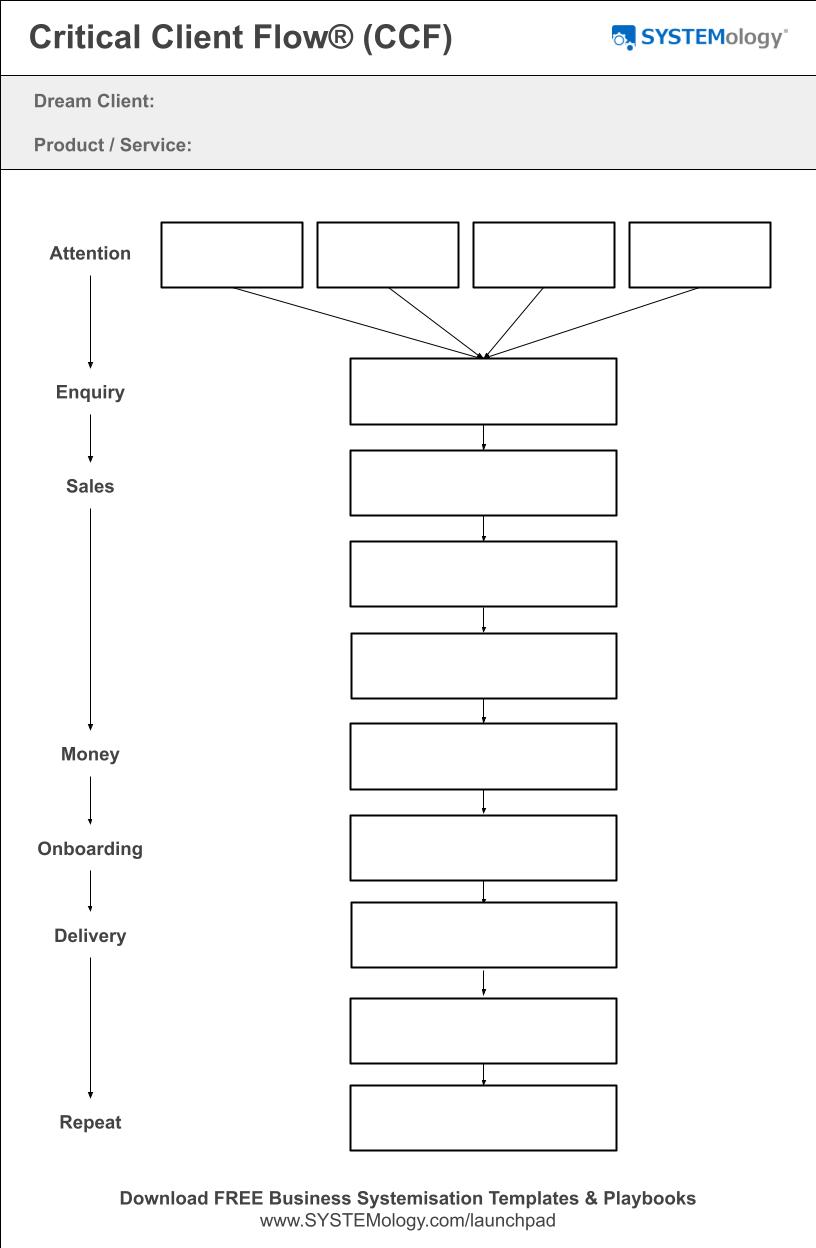
The 4-step framework applied to a dental practice
Step 1: Define. Your critical systems list.
Map the CCF above for your practice. Then identify the 12 to 15 core systems underneath it. For a typical dental practice, those include:
- New patient enquiry handling (phone and online)
- New patient intake and onboarding
- New patient exam protocol (non-clinical elements)
- Case presentation and treatment plan acceptance
- Scheduling and chair allocation
- Pre-appointment confirmation and preparation
- Hygienist-led exam flow (handoff between hygienist and dentist)
- Billing and insurance claim submission
- Accounts receivable follow-up
- Recall system (standard, overdue, long-inactive)
- Post-treatment follow-up (24-hour, 1-week, satisfaction check)
- Review and referral requests
- New staff onboarding (admin, hygienist, dentist, assistant)
- Complaint handling
Clinical systems are separate. You'll have infection control, emergency protocols, sterilisation procedures, and so on. Those are governed by regulatory bodies and should be documented to those standards. We're not replacing them — we're wrapping commercial and operational systems around them.
Step 2: Assign. Who owns each system?
The dentist-owner should own almost none of them.
Your practice manager owns most of the front-of-house and commercial systems. Your lead hygienist owns the hygiene-led exam flow. Your senior assistant owns the chairside systems and sterilisation. The dentist-owner should be ultimately accountable for the whole, but not operationally responsible for documenting or running any individual system.
This is the single biggest shift most dental owners need to make. You are not the bottleneck. Your practice manager is your Systems Champion.
If you don't have a practice manager capable of owning this, that's your first hire, before any systemisation work starts.
Step 3: Extract. Turn what works into documented systems.
Record, don't write.
Your best case-presenting dentist in the practice? Record them doing a case presentation. Transcribe it. That's your case presentation system.
Your best receptionist handling a new patient enquiry? Record three of those calls (with consent). Note the patterns. That's your phone script.
Your most efficient hygienist-to-dentist handoff? Film it from an angle that shows the room reset. That's your flow protocol.
You're not inventing systems. You're extracting them from the people who already do them well. And in a dental practice, those people usually already exist — you just haven't given them time or permission to teach their methods to the rest of the team.
Step 4: Organise. Make it findable, make it used.
One central home. Searchable. Organised by the CCF. Video and checklist side-by-side.
Then — and this is where most practices fail — you integrate it into the work. Morning huddle references the systems. New hires complete the systems onboarding before touching a patient. Weekly staff meeting reviews one system at a time and updates it. Every complaint or near-miss gets traced back to which system needs improving.
Systems that sit in a folder are a cost. Systems that run the practice are an asset.
What a systemised dental practice actually looks like
Let me describe a real day in a practice that's done this work.
7:30am. Morning huddle runs on a documented agenda. 15 minutes. Every staff member knows what's coming.
8:00am. First patients arrive. Front desk uses a documented check-in protocol. No scrambling.
Through the day. Hygienist-led exams run to a documented flow. Dentist flows between rooms with a documented trigger ("hygienist signals with X, dentist enters within two minutes"). Chair turnover follows a documented reset procedure.
After each appointment. Post-appointment workflow runs automatically: next appointment booked before patient leaves, treatment plan loaded to payment system, recall scheduled.
End of day. 10-minute staff debrief. Any system gaps get noted for the weekly systems meeting.
End of week. Practice manager reviews: percentage of new patients completing treatment plans, percentage of recall appointments attended, AR over 30, 60, 90 days. These aren't the dentist's problems. They're operational metrics owned by someone else.
Meanwhile, the dentist-owner is doing dentistry. In the chair. Where they want to be. At 5pm they leave. They don't take the phone home. They don't check emails during family dinner.
That's the destination. That's what "systemised" actually looks like for a dental practice.
What changes when a dental practice has systems
| Before | After |
|---|---|
| Dentist-owner does most management work | Practice manager runs the operation |
| Patient experience varies by who's on shift | Patient experience is consistent |
| Chair utilisation 65-75% | Chair utilisation 85%+ |
| Recall system catches 60-70% of due patients | Recall system catches 85-90% |
| Staff turnover = 6 weeks of training | New staff productive in 10 to 14 days |
| Dentist works 50-55 hours | Dentist works 35-40 hours, chair time protected |
| Practice worth 1 to 1.5x annual production | Practice worth 1.8 to 2.5x (systemised asset) |
That exit multiple matters even if you never plan to sell. A practice that's worth more is a practice with more optionality — bring in a partner, open a second location, take a six-month sabbatical, sell when it suits you.
The same framework works across professional services: accounting firms, law firms, and allied health clinics.
Your next step
If you own a dental practice and this resonated:
- Watch the CCF walkthrough video at the top of this article. Map your own CCF on one page.
- Grab a free copy of the SYSTEMology book. It's the playbook.
- Pick your most painful recurring failure — recall gap, chair utilisation, staff onboarding, AR collection. Start there.
You didn't become a dentist to manage a small business full-time. You became a dentist to do dentistry. Systems are how you get back to it.
Ready to see what this looks like in your practice? Book a free Good Fit call and we'll map it out together.