Your org chart is probably lying to you.
If it's a tree of names with lines between them, it's telling you who reports to who. That's nice for HR. But it's not helping you build a business that works without you.
The org chart most business owners have is built around people. The org chart you actually need is built around functions. Get that distinction right, and it becomes the foundation for every business system in your company.
Why the org chart is your first system
Every business, whether you've documented it or not, is made up of departments. Marketing. Sales. Operations. Finance. HR. Management.
Each department has responsibilities inside it. And each responsibility has a system, or at least it should.
The org chart is where all of this starts. It's the map that shows you where every system in your business lives. Without it, systemisation feels overwhelming because you don't know what you're organising.
Michael Gerber put it best: "Organise around business functions, not people. Build systems within each business function. Let systems run the business and people run the systems."
That advice is 40 years old. It's still the most important thing most business owners haven't done.
The problem with most org charts
Here's what I see when business owners show me their org chart.
It's a tree of names. Sarah does marketing. Tom does operations. Lisa handles finance and also HR and also customer complaints.
That's not an org chart. That's a list of what people happen to do today.
The problem shows up the moment someone leaves. When Sarah quits, you don't just lose a team member. You lose the marketing function. Because the marketing function was Sarah. There's no documentation, no system, no handover plan. Just an empty box on a chart.
The other problem: the owner's name is everywhere. They're the backup for sales, the escalation point for operations, the approver for finance, and the only person who knows how to handle the key accounts. The org chart looks like a leadership structure. In reality, it's a dependency map with one person at the centre.
If your name appears more than twice on your org chart, that's not a business. That's a job you gave yourself.
How to build one that actually works
Start with functions, not people. Here are the six core departments I use in SYSTEMology:
- Marketing: how you generate leads and get attention from your target audience
- Sales: how you convert prospects into paying clients
- Operations: how you deliver your product or service
- Finance: how money moves in and out of the business
- HR: how you hire, onboard, and manage your team
- Management: how you set direction, track progress, and lead
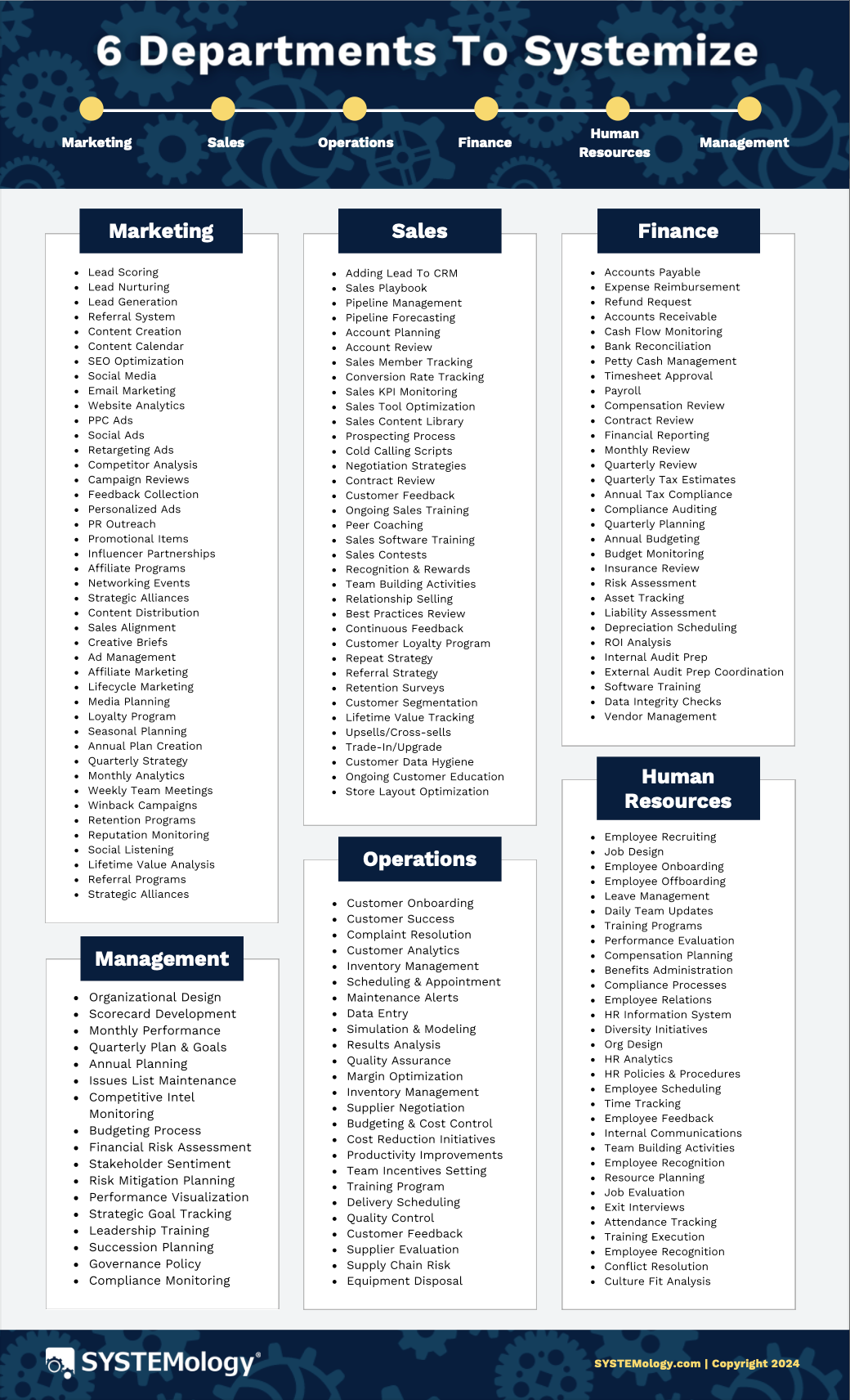
Adjust to fit your business. Maybe you combine Sales and Marketing. Maybe you split Operations into Delivery and Quality. Keep it simple. Six to eight departments is plenty for most businesses under 50 staff.
Under each department, list the key responsibilities. Not every task. Just the core recurring activities. Under Marketing, that might be: lead generation, social media, email campaigns. Under Operations: client onboarding, project delivery, quality control.
Now put names to the responsibilities. Write down who currently handles each one. If it's you, write your name. Be honest.
Here's the step that changes everything: look at where your name appears. Those are the systems you need to build first. Because until those responsibilities have documented processes that someone else can follow, you're trapped.
What it looks like in practice
Ryan Stannard runs a construction firm doing $15-20 million a year. When he mapped his business by function, the problem jumped off the page. His name was against nearly every responsibility. Quoting. Scheduling. Client communication. Quality checks. Supplier relationships.
His daughter Eryn joined the business and used that map as a roadmap. She worked through each function, documented the system, and trained the team. One by one, Ryan's name came off the chart and someone else's went on.
They doubled their headcount from seven to 15 staff. Ryan now takes extended holidays. The business didn't grow because they hired more people. It grew because the functions were documented and the right people could step into them.
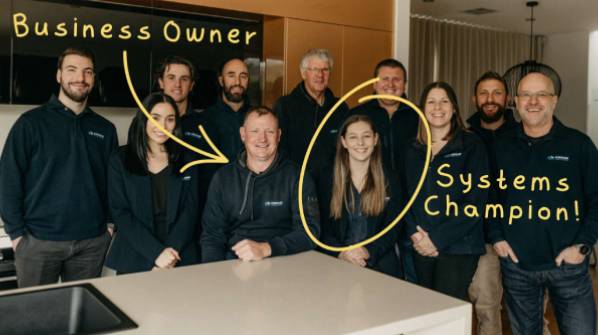
Renee runs Lime Therapy, an allied health practice with 40 staff. At that size, the org chart problem is even more acute. With 40 people across multiple locations, you can't run the business on tribal knowledge. Renee appointed Kaleb, a two-year occupational therapist, as her Systems Champion. His job was to map the functions, identify who held the knowledge for each one, and start documenting.
The results were dramatic. Invoicing time alone was cut by 10x. But the bigger win was structural. With the business mapped by function rather than by person, new hires could slot into a role with clear systems already in place. The business stopped depending on specific individuals and started depending on the systems those individuals followed.

Functions stay. People change.
This is the principle that makes the org chart your most important system.
People leave. People get promoted. People go on holiday. If your business is built around the people who happen to be there today, every departure is a crisis and every hire is a restart.
When you build around functions, the structure stays stable. The functions don't change when someone leaves. The systems inside those functions don't disappear. A new person walks into a role with documentation already in place.
I had to learn this at Melbourne SEO Services. For years, the business was structured around me. I was in the middle of everything. When I finally mapped the functions, separated them from my name, and documented the systems inside each one, I was able to hire a CEO and step away. The business didn't need me. It needed the functions I was performing. And once those functions had systems, anyone could perform them.
Mike Rhodes, a former E-Myth coach, had the same experience with his first business, an internet cafe in New Zealand. He created a manual that described every function of the business in detail. When he sold, the buyer paid top dollar. Not because the cafe was special, but because the manual proved the business could run without Mike. The org chart wasn't a reporting structure. It was a systems blueprint that made the business worth buying.
The bottom line
Your org chart isn't a reporting structure. It's the blueprint for where every system in your business lives.
Build it around functions, not people. Map who currently handles each responsibility. Then start documenting, one system at a time, starting with the ones that depend on you.
That's how you stop being the bottleneck and start being the owner. That's how you reduce owner dependency and build good systems that last.
Ready to organise your business systems? systemHUB lets you structure your systems by department, so your team can find and follow the right process every time. It comes loaded with 100+ templates. Try it free.