
Learn more →
Michael Gerber wrote The E-Myth in 1986. The E-Myth Revisited came in 1995. Between them, those two books reshaped how small business owners think about what they're actually building, and what separates a business from a glorified job.
Almost every small business framework of the last forty years is downstream of Gerber. The distinction between the Technician, the Manager, and the Entrepreneur. The idea of working on your business rather than in it. The notion that every business should be designed so it can run without the owner. All of that is Gerber's intellectual architecture.
But Gerber's genius was mostly philosophical. He told owners what to build and why it mattered. He didn't always tell them exactly how. Forty years later, we're standing on his shoulders, using the tools he gave us, and filling in the how-to layer he left to others to complete.
This article walks through what Gerber got exactly right, what he left unfinished, and how SYSTEMology and similar frameworks have built on his foundation to close the gap between "I understand this intellectually" and "my business actually runs this way."
What Gerber got right
The Technician Trap. Gerber's observation that most small businesses are founded by skilled technicians who then get trapped running a business they were never trained to build. A plumber opens a plumbing business. A designer opens a design studio. A chef opens a restaurant. The technical skill that made them excellent at their craft is not the skill they need to run a business, and the gap is the source of most small business failure. (This is the same gap that drives how to work ON your business, not just in it.)
This was Gerber's foundational insight. It reframed small business failure from "bad at business" to "caught in a predictable trap." The reframe changed what owners did about it, instead of trying harder at the wrong thing, they started trying to build something different.
Working on, not in. The idea that owners need to spend meaningful time working on the business (designing, improving, systemising) rather than only working in it (delivering). Every systemisation framework since is built on this distinction. The cliche has been repeated so often it's easy to forget how original it was when Gerber first formalised it.
The business as a franchise prototype. Gerber's proposal that every owner should design their business as if they were going to franchise it, even if they never plan to. The franchise test forces the owner to make the business replicable, documented, consistent, owner-independent. It's the single most useful design constraint in small business, and it came from Gerber.
The three roles: Technician, Manager, Entrepreneur. Every owner has to wear all three hats, and most are strong in one and weak in two. The framework helps owners identify which hat is missing and intentionally develop or delegate that role. It's still one of the clearest diagnostic tools in small business.
Quantification. Gerber's insistence that a business be run by numbers, not instincts. Documented metrics. Scoreboards. Quantification is what separates a feel-based business from a designed one. Again, adopted so broadly that we forget it had to be introduced. (For the practical version, see why numbers are the language of business improvement.)
Five ideas. Each one foundational. Each one still right.
Michael Gerber, David Jenyns, and the foreword
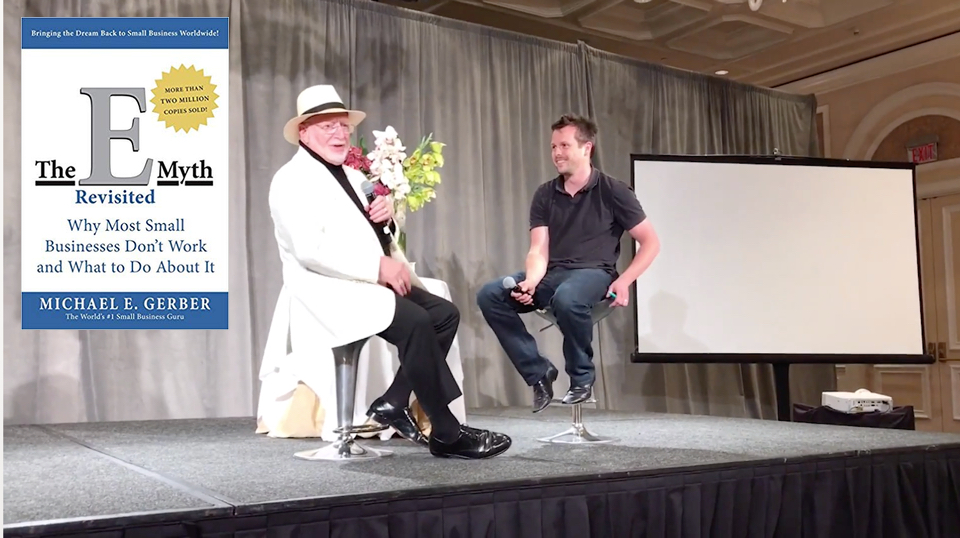
The Gerber-to-David link isn't just intellectual, it's personal.
David wrote SYSTEMology as the practical, step-by-step implementation guide that Gerber's work always implied but didn't fully deliver. Gerber read the manuscript, recognised it as the how-to layer to his philosophy, and wrote the foreword. That foreword is the passing of a baton, the philosopher of systems acknowledging that the practical implementation had been worked out by someone else, and endorsing it as such.
Gerber's foreword isn't a polite celebrity endorsement. It's the author of the original framework saying, in effect: I showed you why. This book shows you how. If you want to turn the why into an operational reality, this is the practical path.
The personal meeting behind the foreword is a story David has told publicly, Luz Delia Gerber, Michael's wife, called at 7 AM one morning to ask if David could drop everything and fly to the US for three months to work on a project. He couldn't. The fact that he couldn't, and why, was the starting seed for Systems Champion, the follow-up book about the role that lets a business run without its founder. The Gerber family lineage is woven through both books.
What Gerber left unfinished
Gerber was the philosopher. The practical implementation layer, the specific sequence, the specific deliverables, the specific roles, the specific tools, was left to others to work out.
Three specific gaps.
The starting-order gap. Gerber told owners to systemise. He didn't tell them which system to document first, second, third. Most owners, given the mandate, document random systems and run out of energy before they hit the ones that actually matter. The practical starting-order gap is what SYSTEMology fills with the Critical Client Flow, the map of how a customer moves through the business that tells you exactly which systems to document in what order.
The role gap. Gerber described what the Manager and Entrepreneur hats do. He didn't tell owners who specifically in their business should hold each hat. In modern small business, the dedicated systemisation role (the Systems Champion) is what actually executes the work Gerber described. Without naming that role and making it a specific hire or promotion, most owners try to hold all three hats themselves and fail predictably.
The tools gap. Gerber's era predated cloud software, AI, and the modern tool stack. His frameworks worked in 1995 with paper and phone. They still work, but they work dramatically better when paired with modern tooling, a process library platform, an AI drafting assistant, a communication stack that makes handoffs visible. Gerber didn't work this out because he couldn't have; the tools hadn't been invented. Forty years on, the tools are the part of implementation most frameworks have now incorporated.
None of these gaps diminish what Gerber built. They just show where the work has continued, the practical extensions that turned Gerber's philosophy into something small businesses can actually run on, today, with the team they have.
The modern continuation
If you were to describe what modern systemisation looks like in the spirit Gerber started, practical implementation that carries his philosophy into action, it would include:
- A documented Critical Client Flow as the first systemisation artefact
- A dedicated Systems Champion role, either promoted from inside or hired
- A process library (platform-backed, cloud-accessible) rather than a binder or a shared drive
- AI-augmented drafting and maintenance of the library
- A weekly rhythm for improvement led by the Systems Champion
- A quarterly review cycle to keep the library from rotting
- An annual rethink at the owner level
That's the modern continuation of Gerber's framework. It doesn't replace his work, it operationalises it. The Three Pillars of a Systemised Business, documentation, tools, culture, is one way to frame what the implementation layer looks like; the Systems Champion role is another; the AI Champion role is the latest evolution. Every element is still in Gerber's spirit; every element just makes the spirit executable for a small business with, say, 15 people and limited time.
This is what it means to stand on a giant's shoulders. Gerber gave us the philosophy that changed what small business was supposed to be. The practical implementation layer, seven stages, defined roles, modern tools, AI leverage, is what carries the philosophy into the operational reality of a 2026 small business.
The lineage
The story isn't that Gerber's work is outdated. It's that Gerber's work is the foundation, and every systemisation framework today, including SYSTEMology, is an operational extension of what Gerber made philosophically coherent.
Owners who read The E-Myth Revisited and then try to implement it with 1995 tools find it hard. Owners who read it and pair it with a modern implementation framework find it much easier, because the philosophy is now backed by a practical sequence, a defined role, a platform, and AI leverage.
The lineage matters because it tells owners something important: the concepts they're struggling to implement are correct. They've been correct for forty years. The gap has always been in the how-to layer, and the how-to layer is now well-developed. If you read Gerber ten years ago and felt the ideas were right but the implementation was unclear, the implementation is now clear.
Standing on Gerber's shoulders means taking his philosophy as given, inheriting the forty years of work done to operationalise it, and building your business on that foundation, knowing the gap between "I understand" and "my business actually runs this way" has been bridged.
Ready to operationalise the Gerber philosophy? The E-Myth Revisited Alternative page lays out the practical implementation layer. For the diagnostic, run the Owner Dependency Score to see how far from Gerber's franchise prototype ideal your business currently is. The SYSTEMology Launchpad gives you the post-book next steps. Then put the implementation on rails with a systemHUB free trial.