"Work on your business, not in it."
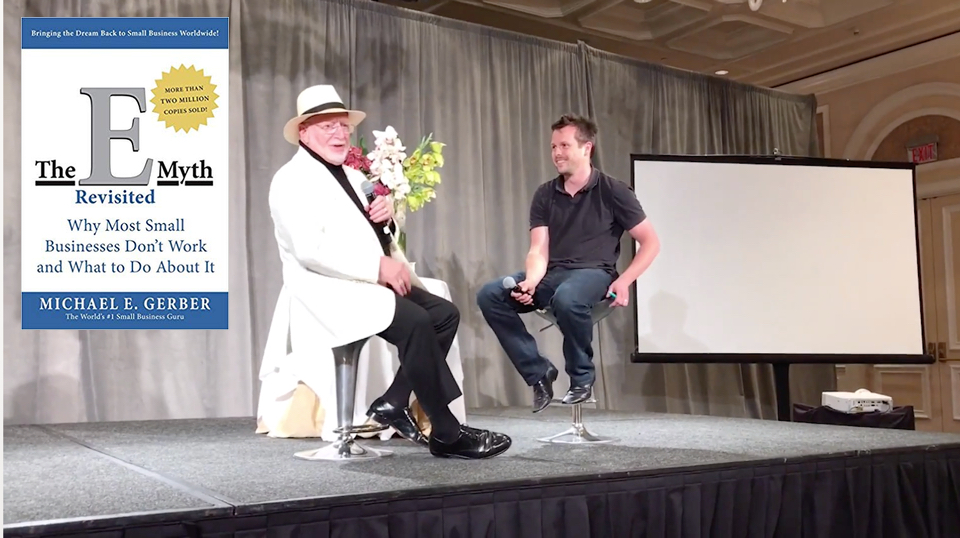
If you've read one book on business, you've heard this line. Michael Gerber put it in The E-Myth Revisited and it has been quoted back to exhausted business owners ever since.
The advice is right. But most owners have no idea what it actually means in practice. Monday morning comes, the phone rings, a client needs something, a staff member is sick, and another week disappears working in the business. The advice is printed on a fridge magnet somewhere. It's not running the week.
This article is about what working on the business actually looks like. Seven habits you can put in your calendar today. Plus the one question that tells you whether you're doing it or just feeling busy.
Why most owners stay stuck in the business
The problem is not motivation.
Most business owners genuinely want to get out of the daily grind. They know the business runs them. They feel it in their body by Thursday afternoon. And they mean it when they say they'll carve out time next week to finally step back.
Next week never comes. The reason is not willpower. It is that the business has been built entirely around the owner. Every decision routes through them. Every quote. Every difficult client. Every new hire. The business rewards them for staying in the work. It punishes them the moment they try to step out.
That's the owner's trap. And you do not escape a trap by trying harder. You escape it by changing the machine so it doesn't need you in the middle of it.
Working on the business is the process of changing that machine.
The one question that exposes everything
Before we get to the seven habits, one question.
If you had to step away from your business for 90 days with no phone, no email, no "quick check-ins," what would fall over?
Hold that answer in your mind.
Whatever you pictured first, that is what working on the business actually looks like. It is methodically removing each of those things from your head and putting it into a system your team can run without you.
Not in theory. In writing. In one place. With an owner who isn't you.
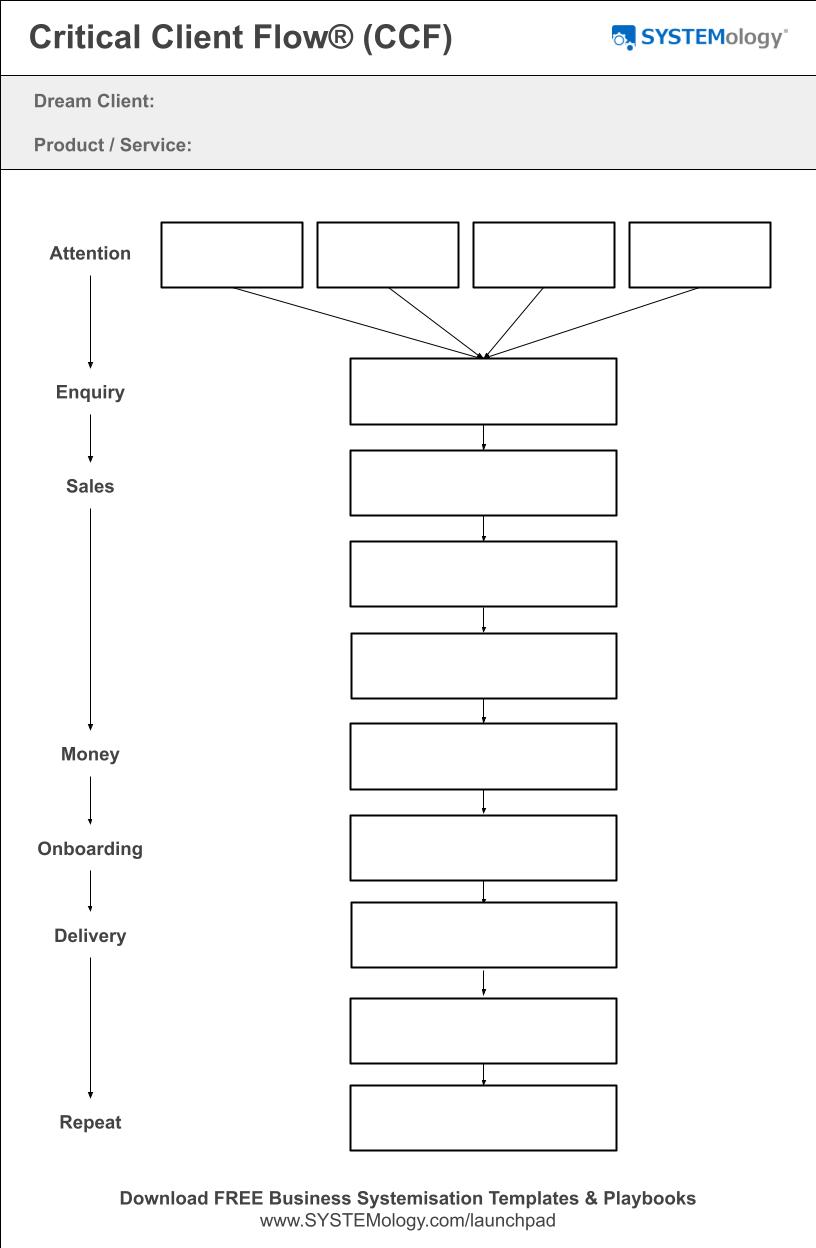
This is the same thought experiment behind the Critical Client Flow. You map the full path a client takes through your business, from first contact to repeat sale. Then you look at every step and ask: if I was gone tomorrow, would this still happen the same way?
The 7 habits of working ON the business
Here is what should actually be in your calendar.
1. Block the time
If it's not on your calendar, it's not happening.
Most owners try to squeeze "on the business" time into the gaps. There are no gaps. Block two to four hours a week, same time every week, and protect it like a client meeting. Nobody books over a client meeting. Nobody should book over this one.
The team needs to know: this is time the owner works on the business. They do not interrupt it.
2. Map the Critical Client Flow
Before anything else, get the full client journey on one page.
From how a client first hears about you, through the sale, onboarding, delivery, follow-up, and repeat purchase. Ten to fifteen steps is normal. This is the map you will use for every improvement decision from now on.
Most owners have never done this. They know each piece in isolation but have never seen the whole flow drawn out. Drawing it is the single highest-leverage hour you will spend this year.
3. Pick one system to document each month
Not ten. Not a "documentation project." One system. This month.
Start with the one that, if it broke, would cost you the most sleep. Write it down so a competent new hire could execute it without interrogating you. Test it by actually having someone follow it.
Next month, pick another one. Twelve systems a year. Compound.
4. Appoint a Systems Champion
You are not the person who will keep systems alive. You run the company.
Someone else owns the day-to-day of documentation, updates, and training. That person is your Systems Champion, and they usually already work for you, the meticulous one, the asker of questions, the one who reorganises the shared drive without being told. Give them the role formally and protect their time for it.
Without this person, everything you document will be out of date inside six months. With them, your systems become an asset that grows in value.
5. Work the numbers, not the tasks
Working on the business means looking at results, not activities.
What was our gross margin this month? What's our close rate? How long did onboarding take on average? What did our last five clients score us out of ten?
You don't need a data dashboard to start. You need five numbers, reviewed weekly, that tell you whether the machine is healthy. When the numbers drift, that's your cue to fix a system, not to jump in and personally save a project.
6. Meet with the Champion, not the crisis
Replace your "quick chats" with structured rhythms.
Your Systems Champion gets a weekly 30 minutes. What's been documented, what's drifted, what needs owner input. Your leadership team (even if it's one other person) gets a monthly 60 minutes. What's the state of the numbers and which system gets improved next quarter.
When a fire appears, the first question is not "how do I put it out?" It is "which system is broken that let this fire start?"
7. Kill something every quarter
Every quarter, cut one thing the owner personally does.
It might be approving every quote under $5,000. It might be writing the Friday update email. It might be being copied on every new client contract. Whatever it is, find a replacement, a system, a tool, a delegation, a trust adjustment, and hand it off.
Do this four times a year. In three years you will barely recognise your role.
The habit that starts everything else.
- Close email, Slack, and the phone. The block is uninterruptible unless a client emergency requires owner judgement.
- Review the five scoreboard numbers from last week. What moved, what didn't.
- Meet with the Systems Champion (30 minutes). Updates, blockers, owner decisions.
- Advance the current "system of the month." Draft it, test it, or hand it off to the right owner.
- Review the "kill this quarter" list. One small step toward removing an owner dependency.
Result: The block that nobody else protects for you, because nobody else can. Miss it twice and the whole habit collapses.
Luke Davies and the builder who built himself out
Luke Davies runs Davies Construction, a custom home builder in New Zealand.
Custom builds are a brutal category to systemise. Every home is different. Every client has opinions. Every site has surprises. For years Luke ran the business the way almost every builder does. He personally managed every project, every client, every supplier. He was the common thread holding it all together.
That common thread was also the ceiling. The business couldn't grow past Luke's personal capacity, and Luke couldn't get off the site long enough to work on growth.
He read SYSTEMology and had the moment most builders eventually have: I am the bottleneck, and the only way out is a machine that doesn't run through me.
Luke committed. He mapped the full design-and-build flow, from first client meeting to handover. He documented each stage. He put it all in one place, a playbook his team could follow. He stopped being the project manager and started being the business owner.
What changed? Luke got his evenings back. The team delivers projects consistently without him on every call. He has time to sell, to plan, to breathe. The business grew because Luke stopped being the ceiling.
The before/after is not about capability. Luke was a brilliant builder before the systems and he's a brilliant builder after. What changed is the machine. He built a business that builds homes. Instead of a guy who builds homes and owns a business card.
The trap: working around the business
Here's the failure mode I see most often.
Owners hear "work on the business" and interpret it as "do more strategy." So they book a leadership offsite. They read another book. They hire a business coach. They build a vision wall with coloured sticky notes.
None of it touches the machine.
Strategy is useful, but strategy without systems is a wish list. If the machine still requires you at the centre, you do not have a business. You have a self-employed job with ambitions.
Working on the business means changing how the work gets done, not adding a new layer of thinking on top of the same broken machine. It's operational. It happens in the guts of the business, in the documented process, in the Systems Champion's weekly review, in the habit of killing one owner-dependency each quarter.
Less whiteboard. More playbook.
How long does this take?
Honest answer: longer than you want, faster than you think.
The first 90 days are the hardest. You are building the habit, appointing the Champion, mapping the CCF, documenting the first three or four systems. It will feel slow because nothing looks dramatically different yet.
By six months, the pattern is different. You are not being asked to make every decision. The team has something to reference. The Champion has momentum.
By twelve months, the business functions without you for short stretches. A week here. A two-week family holiday there. It doesn't collapse.
By three years, most of what used to live in your head lives in the system library, and the business grows because the growth is no longer constrained by your personal bandwidth.
The owners who get this compounding are not smarter or harder working than the ones who don't. They just did the uncomfortable thing of blocking the time and protecting it. Week after week, quarter after quarter.
The bottom line
"Work on the business" is simple to quote and brutal to actually do.
The owners who do it don't have some secret. They have a rhythm. Blocked time. A mapped Critical Client Flow. A Systems Champion. One documented system a month. Five numbers reviewed weekly. And the discipline to kill one owner-dependency every quarter.
That's it. No offsite required.
The business you want is on the other side of those habits. The business you have is the one you keep propping up by being in it.
Close the laptop. Block the time. Start with the Critical Client Flow. The rest compounds.
Ready to actually do it? Start with the Owner Dependency Score, ten questions, five minutes, tells you exactly how much the business depends on you. Then give your Systems Champion somewhere to build the playbook with a systemHUB free trial.