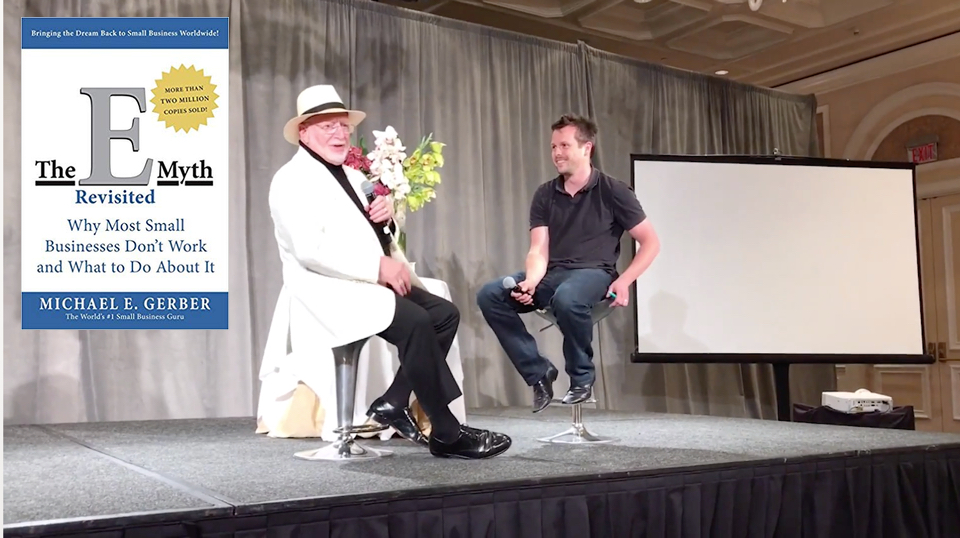
The E-Myth Revisited told you to work ON your business, not IN it. But it never told you how. SYSTEMology is the practical, modern alternative to E-Myth that turns that philosophy into a step-by-step process. And Michael E. Gerber himself wrote the foreword.
Learn more →
The Book That Changed Everything (And Then Left You Stuck)
If you're a business owner, chances are someone has handed you a copy of The E-Myth Revisited and said, "You need to read this."
And they were right. Michael Gerber's core insight changed the way millions of entrepreneurs think about their businesses. Stop being the technician. Build a franchise prototype. Create systems so the business can run without you.
The E-Myth has sold over 5 million copies worldwide. It's recommended more often than almost any other business book. The concept of working ON your business, not IN it, has become part of the entrepreneurial vocabulary.
But here's the problem.
Most people who read The E-Myth got inspired for about a week. They sat down to document their first process. And then they got stuck.
Where do you start? Which systems matter most? Who does the documenting? How do you organise it all once it's written down?
The book gave you the philosophy. It gave you the WHY. But it never gave you the playbook. And for 30 years, that gap has left business owners feeling motivated but paralysed.
Why Did Michael E. Gerber Write the Foreword to SYSTEMology?
Here's a story most people don't know.
In 2018, I received an email from someone called Luz Delia Gerber. I didn't recognise the full name, but I was familiar with a certain Michael E. Gerber. I figured it was a coincidence. I'd never met him. I had no connection to anyone who knew him.
All the email said was, "Call me." So I did.
What followed was one of the most surreal conversations of my life. Luz Delia, Michael's wife, had been following my work. Gerber, at 80 years old, was preparing to launch his 29th and final book in the E-Myth series. For the first time, he wanted to self-publish. And he wanted help.
I spent the next 12 weeks working 60-plus hours a week on the project. Unpaid. I wrote thousands of emails, made hundreds of phone calls, and lined up interviews across the globe. That book became Gerber's first Amazon bestseller within 24 hours of launch.
After the launch, Michael invited me to his Dreaming Room event in Carlsbad, California. I was then asked to facilitate a mastermind dedicated to the future legacy of his work. And then the Gerbers offered me the opportunity to run their company.
I declined, not because it wasn't a great offer, but because I was on my own path.
What matters is this: Gerber read SYSTEMology. And he wrote the foreword. Not a blurb. Not a tweet. The actual foreword.
Here's what he wrote:
"I invented 'working ON your business, instead of IN it' almost 43 years ago with my very first E-Myth Book. And here I am telling you that David Jenyns has not only DONE it, but he's now written the brilliant book to teach you exactly how to do it, too!"
The man who coined the most famous phrase in business systems looked at SYSTEMology and said: this is the how-to I never wrote.
David Jenyns with Michael E. Gerber. Gerber wrote the foreword to SYSTEMology, calling it "the brilliant book to teach you exactly how to do it."
What's Changed Since The E-Myth Was Written?
The E-Myth Revisited was published in 1995. Think about what business looked like then.
No cloud tools. No project management software. No Zoom. No AI. No remote teams. Most small businesses operated from a single physical location with a handful of local employees.
Gerber's "franchise prototype" model assumed exactly that kind of business. It made sense for a bakery in 1995. But in 2026, your team might be spread across three countries, your clients find you through Google, and half your processes could be automated with AI tools that didn't exist two years ago.
According to a 2024 report by McKinsey, 72% of companies have now adopted AI in at least one business function. Remote and hybrid work is standard across professional services. The gig economy means businesses routinely engage fractional workers who need to hit the ground running without months of shadowing.
The principles of E-Myth still hold. The application needs a complete overhaul.
What Are the Key Differences Between E-Myth and SYSTEMology?
E-Myth isn't the only framework out there. Business owners today have several options. Here's how they fit together. They're not competitors. They're complementary layers.
| Framework | Focus | Core Question |
|---|---|---|
| E-Myth | Philosophy | WHY should I systemize? |
| EOS (Traction) | Leadership operating system | WHO runs the business and how? |
| Scaling Up | Strategic planning | WHERE are we going? |
| SYSTEMology | Operational extraction | HOW do we actually get the systems out of people's heads? |
E-Myth gives you the conviction. EOS gives you the leadership structure. Scaling Up gives you the strategic plan. SYSTEMology gives you the practical process for extracting, documenting, and embedding the systems that make everything else work.
You can use SYSTEMology alongside any of them. In fact, many businesses running EOS or Scaling Up discover that they still have a gap when it comes to the actual documentation and delegation of daily operations. SYSTEMology fills that gap.
As Jack Daly, author of Hyper Sales Growth, put it: "What Michael Gerber started, David Jenyns completed."
How Does SYSTEMology Actually Work?
Learn more →
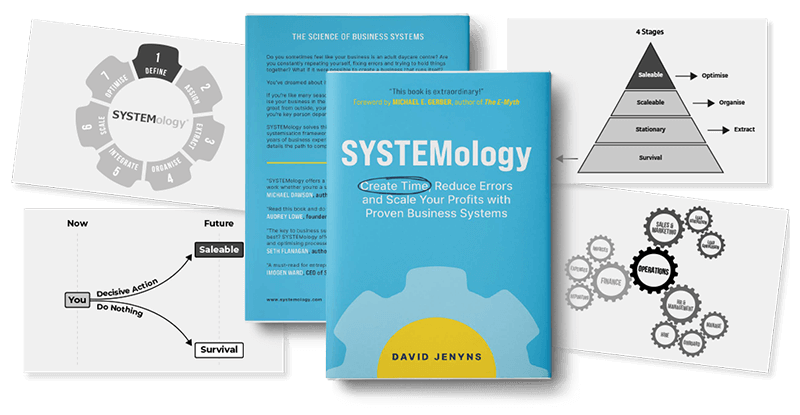
SYSTEMology is a seven-stage framework. Each stage builds on the last.
1. Define. Identify the 10 to 15 most critical systems in your business using the Critical Client Flow. This maps how value moves from the moment a prospect finds you through to repeat business. You don't need hundreds of systems. You need the right ones first.
2. Assign. Hand each system to a knowledgeable worker, the person in your team who does that task best. This is the counterintuitive insight that makes the whole thing work. The owner should never be the one documenting. Your best people already know how to do the work. Let them record it.
3. Extract. The knowledgeable worker records themselves doing the task. No writing. No templates. Just screen recording or video. A Systems Champion, a detail-oriented team member, then turns that recording into a step-by-step procedure.
4. Organise. Store everything in a central platform so your team can find it when they need it. This is where systemHUB comes in, a purpose-built tool for housing your business systems. No more scattered Google Docs or forgotten Dropbox folders.
5. Integrate. Embed the systems into daily operations. This means linking them to onboarding, reviews, and checklists so they actually get used, not just filed away.
6. Scale. Once systems are running, you can hire into a structure. New team members learn from documented processes, not from shadowing someone for three weeks. This is how you grow without chaos.
7. Optimise. Systems aren't set-and-forget. Build in regular review cycles so your team updates and improves processes as the business evolves. AI tools can now accelerate this step dramatically, identifying bottlenecks and suggesting improvements.
The big shift from E-Myth? You don't need to do any of this yourself. The framework is designed so the owner steps back from day one.
Here's a quick overview of how the seven stages fit together:
As Gino Wickman, author of Traction, put it: "A must for any business owner and their leadership team."
Does It Actually Work?
John Crow runs a boutique law firm with 15 staff across three locations in the US, specialising in estate planning and probate.
He read The E-Myth. He loved the idea. But legal work is procedural and highly variable. His firm deals with 95 different counties, each with different rules. Systemizing felt impossible.
Then he found SYSTEMology.
He appointed a Systems Champion, Callie Saulsburry, who had a background in education. She used the SYSTEMology book as her guide. They started by documenting the Critical Client Flow for estate planning, then used the same framework to tackle probate, county by county.
The result? New hires onboard faster. The team now proactively requests new systems. And John has a clear path to scaling across the Southeast without being the bottleneck.
That pattern repeats across hundreds of businesses. Construction firms, accounting practices, marketing agencies, healthcare clinics. The framework works because it doesn't depend on the owner doing everything. It depends on the team.
Andrew Griffiths, one of Australia's most recognised small business authors, called SYSTEMology "the new E-Myth." And Gerber himself said it was "the book I wish I had written."
How Do You Start Systemizing Your Business Today?
You don't need to read a 300-page book before you take action. Here's where to start.
Step 1: Map your Critical Client Flow. Grab a whiteboard or a blank page. Write down every major step a client goes through with your business, from first contact to repeat purchase. You'll end up with 10 to 15 core processes. That's your starting list.
Step 2: Pick one system and assign it. Choose the system that causes the most pain or gets asked about most often. Assign it to the team member who does it best. Have them record themselves doing it.
Step 3: Turn the recording into a procedure. Your Systems Champion watches the recording and writes it up as a simple, step-by-step process. No perfectionism. Done is better than perfect.
You can complete this cycle in a week. Do it 10 times over 90 days and you'll have the critical systems that free you from the daily grind.
Want to see where your business stands right now? Take the free Systems Strength Test to find out.
If you're ready to go deeper, grab the SYSTEMology book. It walks you through every stage, with real examples and templates. And systemHUB gives you the platform to house it all.
The Bottom Line
The E-Myth changed how business owners think. SYSTEMology changes what they do.
Gerber gave us the vision. SYSTEMology delivers the vehicle. And the man who invented "work ON your business, not IN it" looked at that vehicle and said: this is what I was pointing toward all along.
If you've read The E-Myth and loved the idea but never made it real, you're not alone. Millions of business owners are in the same spot. The gap was never motivation. It was method.
Now the method exists.