Documenting a system is step one.
Keeping it useful is a habit.
Most small businesses document a process, get a little excited about it, then forget. Two years later the documentation is wrong, the team has quietly worked around it, and you're back where you started.
I see it all the time. The business owner who tells me, "Yeah, we documented everything back in 2022. We've got a big folder of SOPs." And when I ask when anyone last opened one, the room goes quiet.
Systems are not a project. They are a rhythm. If you want to improve your business systems, you need to build an ongoing loop that turns static documentation into a living, breathing operational asset.
Here is how that loop works.
Why systems decay
Your business changes faster than static documents can keep up.
New team members join and bring their own way of doing things. New tools replace old ones. Client expectations shift. A supplier changes their process and knocks yours out of alignment. Every month, a little drift. Every quarter, a little more.
Without a maintenance habit, systems rot. The team stops trusting the documentation because it's wrong often enough to be useless. They default back to tribal knowledge. And tribal knowledge always ends up in the owner's head.
This is the silent killer of systemisation in small businesses. Not the documentation itself. The failure to keep it alive.
Remember the first principle from what is a business system: a system is only as good as the result it delivers. If it stops matching reality, it stops delivering.
The improvement loop: a simple rhythm
You don't need a fancy framework. You need a cadence. Four layers, each with its own purpose.
The operational rhythm that keeps your systems alive.
- Weekly (5 min per system): Systems Champion spot-checks a handful of systems. Was it followed? Any issues flagged?
- Monthly (30 min per department): Team review. What's slowing you down? What's out of date?
- Quarterly (1 to 2 hours): Deeper review of critical systems. Measure against objectives. Pick 2 to 3 to improve next quarter.
- Annually (full audit): Archive what's no longer relevant. Consolidate overlapping systems. Prune the library.
Result: Systems stay current. Team trusts the documentation. Improvement compounds over time.
Weekly (5 minutes per system, as needed)
Your Systems Champion does a quick spot-check on a handful of systems. Was the system followed? Was anything flagged by the team? Any client feedback that points to a gap?
This is not a deep audit. It's a heartbeat. Five minutes, a quick note, move on.
Monthly (30 minutes per department)
Bring the relevant team members together for a short review. One question: what's slowing you down?
Then list what is out of date. What got changed in practice but not in writing. What new situations came up that the system did not cover.
Update the systems that need it. Leave the rest alone.
Quarterly (1 to 2 hours)
Deeper review of your critical systems. The ones in your Critical Client Flow. Measure them against their stated objectives.
Is the sales process still converting at the rate we expect? Is the onboarding system still getting clients to value in the right time frame? Is the delivery system still producing the quality we promise?
Pick two or three systems to improve in the next quarter. Put owners on them. Move on.
Annually (full audit)
Once a year, zoom out. Archive systems that are no longer relevant. Consolidate overlapping ones. Kill the ones nobody uses.
This is where you prune the library so the team can actually find what they need. A system library that has doubled in size every year without an annual cleanup becomes a graveyard.
What to look for in each review
Whether it's weekly, monthly, or quarterly, the questions are the same. Four of them.
- Is the system being followed consistently? If the answer is no, find out why. Either the system is wrong or the training is. Sometimes both.
- Are the results matching the objective? Every system should have a measurable outcome. If the result has drifted, the system needs attention.
- Has anything changed that the system doesn't reflect? New software, new team member, new client type, new regulation. Any of these can quietly break a good system.
- Is there a faster or simpler way to achieve the same outcome? Not every month. Not for every system. But the question keeps you looking for improvement instead of coasting.
Four questions. That's the whole framework. Write them on a sticky note and put them in front of your Systems Champion.
Belinda Noakes and The Leadership Sphere
Belinda runs The Leadership Sphere, a consulting firm specialising in leadership development and breakthrough performance. Consulting is a brutal business to systemise because the value sits in the heads of senior consultants.
Belinda and her team systemised their client engagement delivery. Assessments. Workshops. Follow-up programs. They documented the Leadership Sphere way of doing each one so new consultants could be brought on without compromising quality.
But here is the interesting part. The methodology kept evolving. New research came in. New client types brought new challenges. New team members had better ideas than the founders.
Without an ongoing improvement loop, those systems would have fallen behind the best version of their delivery within six months. They would have been documenting yesterday's version of their craft.
So they run a monthly review with their senior consultants. What worked? What drifted? What needs updating? That loop is what turns a static consulting manual into a living operational asset. It's also what lets them scale without becoming a factory.
For a firm that teaches leadership and breakthrough performance, systemising and continuously improving is not just operational. It's congruent. They are living their own message.
Who runs the loop
The loop is not the owner's job.
I want to be blunt about this because it's where most small businesses fail. The owner thinks they need to personally drive the review. They put it on their calendar, miss it twice, feel guilty, and eventually give up.
This is almost always the Systems Champion's responsibility. Not yours.
Your job as the owner is to reinforce the priority. We run this business on systems. Systems are how we protect quality, train new people, and free the team to do their best work. That message gets repeated. Often.
Your other job is to support decisions to kill or consolidate old processes. The Systems Champion will come to you with: we've got three overlapping onboarding systems, two of them are from 2023, let's kill them. Your answer is yes, and thank you.
The Champion runs the loop. You clear the path.
A trap to avoid: improvement theatre
Here's where small businesses go wrong the other direction.
They create what I call improvement theatre. Constant edits to documents that nobody actually uses. Version 14 of the onboarding SOP. Colour-coded status tags. Beautiful dashboards tracking which systems were updated this month.
None of it touches the actual work.
Improvement is not activity. It's impact.
Improve the systems people use. Leave the rest alone unless there is a real reason to touch them. If a system has not been opened in six months and nobody has complained about it, it's probably dormant for a reason. Let it sleep.
The rule I use: improve what is load-bearing. The systems inside your Critical Client Flow. The ones that affect revenue, quality, or team capacity. Those get attention. Everything else waits.
This is a close cousin to the Kaizen mindset. Kaizen is the culture of continuous improvement: everyone contributes small ideas all the time. The improvement loop is the operational rhythm that actually captures those ideas and turns them into updated systems. You need both. Culture without rhythm produces a lot of ideas that go nowhere. Rhythm without culture produces a Systems Champion shouting into a void.
Tools for the loop
You can run this loop on pen and paper. I'm not going to tell you that you can't.
But the loop gets faster when you can see a few things at a glance:
- When each system was last updated
- Who edited it
- Who's opened it recently
- Whether it has a clear owner
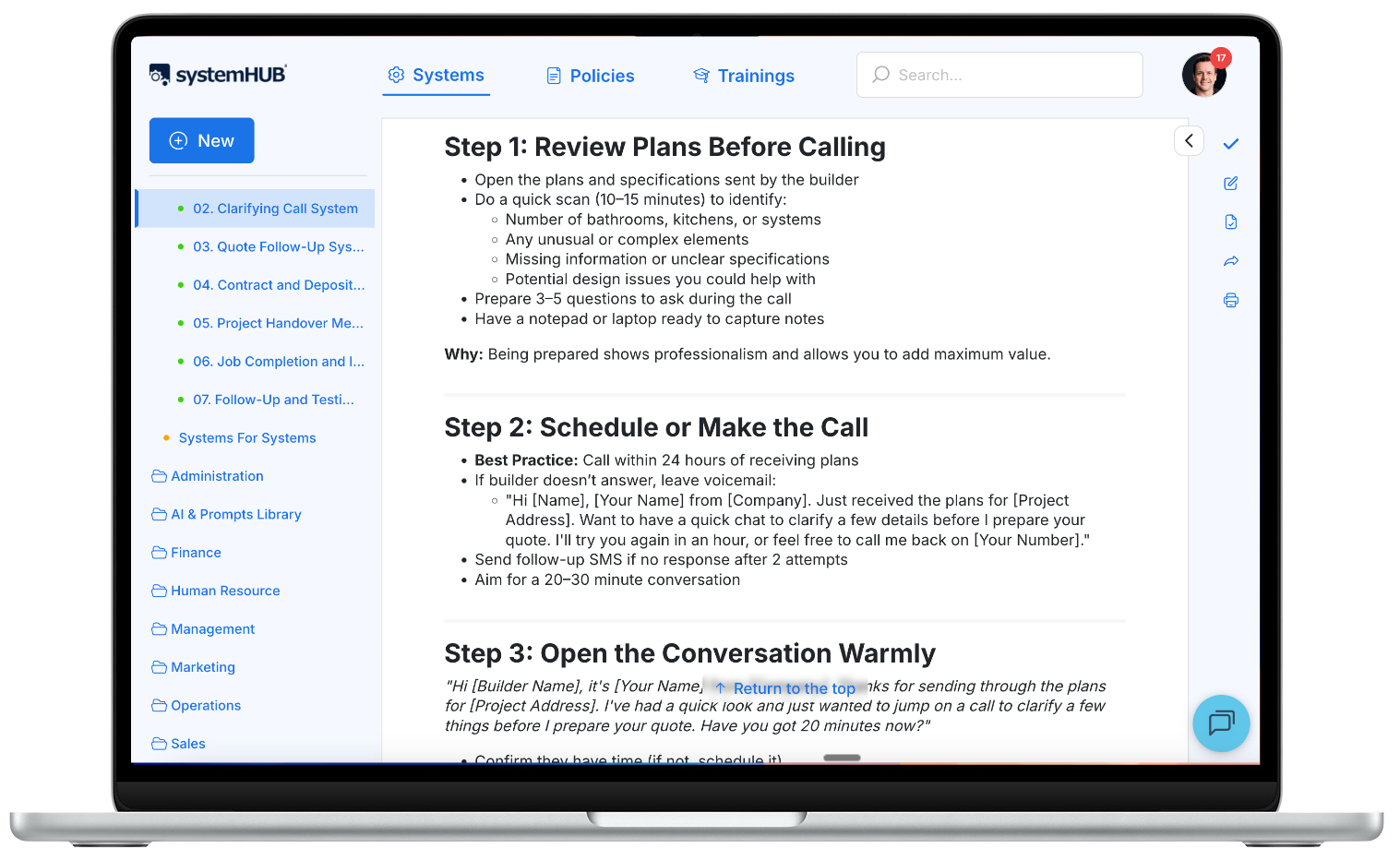
That visibility is what separates a loop that gets run from a loop that gets forgotten. systemHUB surfaces this natively. If you're using Google Docs or a shared drive, you can rig it up with a bit of discipline, but you'll spend the first 10 minutes of every review figuring out what changed since last month.
Without that visibility, the loop slows. And a slow loop stops happening.
One more thing. Whatever tool you use, make it the single source of truth. If there are two places systems live, there will be two versions, and they will disagree. You don't need a perfect tool. You need one place.
How this fits with high-performance systems
If you've read the piece on high-performance business systems, you know there are six levers that take a system from working to world-class. Measurement, training, ownership, tooling, integration, and improvement.
Improvement is the sixth lever. The improvement loop is how you actually pull it.
Without the loop, a high-performance system slowly drifts back to average. The measurement framework goes stale. The training is based on last year's version of the process. The owner has moved on and nobody replaced them.
With the loop, you compound. Every month, the best parts of your business get a little better. Every quarter, a critical system gets materially improved. Every year, the whole library gets pruned and tightened.
That's what separates businesses that run on systems from businesses that have a folder of SOPs. Same characteristics of good business systems to start. Completely different trajectory after 12 months.
The bottom line
Improvement is not a project. It's a rhythm.
Weekly heartbeat. Monthly review. Quarterly deep dive. Annual audit.
Four simple questions every time. Systems Champion runs it. Owner reinforces the priority and clears the path. Improve what's load-bearing. Let the rest sleep.
Do that for a year and your systems will be meaningfully better than they are today. Do it for three years and you'll have an operational asset most competitors can't touch.
Simple beats perfect. Always.
Improvement only compounds when all three pillars of the business are working together. For the framework that connects documentation, tools, and the culture that keeps improvement alive, see The Three Pillars of a Systemised Business.
Ready to make the loop easy? systemHUB gives you the visibility to run this rhythm in minutes per week. Last-edited dates, ownership, usage, all in one place. Try it free.