Kaizen sounds like something from a Toyota factory floor.
You picture engineers in white coats, stopwatches, and six-sigma black belts. Charts on the wall. Team huddles at dawn. It feels like a big-company thing. Something that belongs in automotive manufacturing, not in your plumbing business, accounting firm, or digital agency.
Here is the truth. Kaizen is actually one of the simplest, most effective habits a small business owner can adopt. It does not need a factory. It does not need a consultant. It does not need a black belt.
But it does need one thing first. And most small businesses skip it.
What Kaizen actually is
Kaizen is a Japanese word made of two parts. Kai means change. Zen means good. Together: change for the better.
Masaaki Imai, the man who introduced the concept to the West, defined it like this: "ongoing improvement involving everybody, without spending much money."
Read that again. Ongoing. Everybody. Without spending much money.
It is not a project. It is not a software rollout. It is not a big transformation. It is a daily habit of looking for small, practical ways to make things a little bit better.
A 1 percent improvement this week. Another 1 percent next week. Over a year, that compounds into something remarkable.
In SYSTEMology, this philosophy sits at the core of everything. Nothing is ever finished. Every system is a living document. Every process has room to get better. That is the cultural piece that separates businesses that keep improving from businesses that plateau and eventually slide backwards.
Why most small businesses cannot do Kaizen (yet)
Here is where it gets uncomfortable.
You cannot improve what you have not documented.
Kaizen is about making today's way of doing things a little bit better than yesterday's way. That requires a baseline. A current standard. A "this is how we do it right now" version that everyone on your team follows.
Without that baseline, you are not improving. You are just changing things. One team member does it one way. Another does it a different way. A third invents a third way. None of it is better or worse than the others, because none of it was ever the standard to begin with.
That is not continuous improvement. That is chaos with good intentions.
Toyota did not start with Kaizen. They started with documented work standards. Standard operating procedures on every machine. Every worker trained on the same way of doing each task. Once the standard was in place, then, and only then, did they start asking: how can we make this standard a little bit better?
Most small businesses have it backwards. They try to improve first, document second. Or worse, they skip documentation entirely and just hope the "improvements" stick.
They do not.
The SYSTEMology prerequisite: document, then improve
If you want Kaizen to actually work in your business, here is the order:
Step 1: Document your Critical Client Flow. This is the 10 to 15 steps that take someone from first interaction with your business through to becoming a happy, repeat customer. You can learn more in my article on how to systemise your business. It is the backbone of how your business delivers value. Map it first.
Step 2: Get your team using the systems consistently. A document that sits in a folder is not a system. A system is something people actually follow. Every day. Until it becomes "how we do things here." This is the part that trips most owners up. Documentation is the easy part. Adoption is where the real work happens.
Step 3: Then you can Kaizen. Once the baseline is in place and the team is using it, you have something to improve. You can now ask: where is this slow? Where do mistakes happen? What is the team complaining about? What could we automate? Every answer becomes a small improvement to the documented standard.
Skip the first two steps, and your Kaizen efforts just add noise to a system nobody was following anyway.
6 Kaizen practices that work for small business
Ron Carroll wrote a piece years ago laying out 10 ways to achieve continuous improvement. Good list. But for a small business owner running at full speed, 10 is too many.
Here are the 6 that actually move the needle.
1. Start with yourself
Kaizen is cultural. If the owner does not walk the talk, nobody else will.
You cannot ask your team to look for improvements if you are not actively doing it yourself. You cannot ask them to follow systems if you bypass the systems when things get busy. You cannot ask them to document a better way if you never document anything.
The first person who needs to change is you. Not the team.
2. Involve everyone
Your team knows things you do not.
The person answering the phone knows which client questions come up over and over. The person doing the invoicing knows which steps are slow. The person on the tools knows which supplier is always late. They are the closest to the work. They see the problems first.
Most owners miss this because they are too busy solving problems themselves. Stop being the bottleneck. Ask your team. "What is slowing you down? What could be better? What is annoying you right now?"
You will be surprised how many good ideas they already have. They have just never been asked.
3. Get specific
Kaizen is not about "doing better." It is about measurable change.
"Our customer service is improving" is not Kaizen. "We reduced response time from 4 hours to 90 minutes over the past six weeks" is Kaizen.
Specifics turn vibes into progress. Without a number, you are just guessing.
If you cannot measure it, pick something adjacent that you can. Count the things. Time the things. Track the things. The act of measuring is often 80 percent of the improvement.
4. Keep it simple and cheap
You do not need a $50,000 software platform to improve a process.
Most of the wins in a small business come from small changes. A better checklist. A different order of steps. A single automated reminder. A template instead of a blank page. These cost nothing and take an afternoon to implement.
Simple beats perfect. Cheap beats elegant. Done beats planned.
If an improvement needs a six-month budget approval and a consultant, it is probably not Kaizen. Come back when you have a smaller, faster version.
5. Focus on the critical
Do not try to improve everything at once.
Start with your Critical Client Flow. The core of how you deliver value. Those 10 to 15 steps are where 80 percent of your quality, speed, and consistency live. Fix those, and everything else gets easier.
Your side projects can wait. Your "someday" ideas can wait. The thing your clients actually pay you for cannot.
6. Never stop
Kaizen is not an annual review. It is a weekly habit.
Once a week, sit down with your Systems Champion or team lead. What system did we use this week that was slow, broken, or frustrating? What is the smallest improvement we could make to it? Who is going to make that improvement, and when?
Five minutes of that conversation, every week, compounds into a business that gets measurably better every month.
Case study: Lime Therapy
Here is what this looks like when it actually works.
Renee and Matt Kelly run Lime Therapy, a multi-disciplinary allied health practice in rural Australia. Around 40 staff. Fast-growing. And until they joined our Systems Champion program, they were drowning.
Renee is a big-picture visionary. She is not a details person. The business grew on her vision, but it lacked the underlying systems to sustain that growth. They had invested heavily in creating policies that sat in a folder, unused. They were missing the "how-to" of embedding processes into the culture.
Sound familiar?
Here is what changed. They appointed Kaleb Grant, a young occupational therapist on the team, as their Systems Champion. Not a senior manager. Not an outside consultant. Just a detail-oriented team member who had the right mindset for the role.
Kaleb documented the Critical Client Flow. He got the team using the systems. He built a culture where team members proactively flagged problems and suggested improvements.
Then Kaizen kicked in.
The invoicing process was the first big win. It was taking way too long and producing too many errors. Kaleb worked with the team to document how it was being done, then started finding the slow points, the duplicate steps, the bottlenecks.
The result? Invoicing time was cut by 10x. Not 10 percent. Ten times faster.
That did not happen because someone bought new software. It happened because they documented the baseline, got the team using it, and then systematically improved it week by week. That is Kaizen. But notice: it only worked because the systems existed first.

The team at Lime Therapy now speak the language of systems. They proactively look for opportunities to improve. SYSTEMology has become part of the company's DNA, not a project that ends.
That is what Kaizen looks like in a small business.
The Systems Champion is your Kaizen leader
In Japanese companies, Kaizen is cultural. It is how everybody thinks, every day. It took them decades to build.
You do not have decades. And in a small business, "everybody does it" usually means nobody does it, because nobody owns it.
Kaizen needs a person. Someone whose job it is to drive the improvement cycle. Someone who meets with the team, tracks the improvements, and keeps the wheel turning when the owner gets busy putting out fires.
That person is your Systems Champion.
The Systems Champion is not just a documenter. They are the engine of continuous improvement. They own the systems library. They run the weekly improvement conversations. They spot the patterns across departments. They bring improvement ideas to the owner with a plan, not just a complaint.
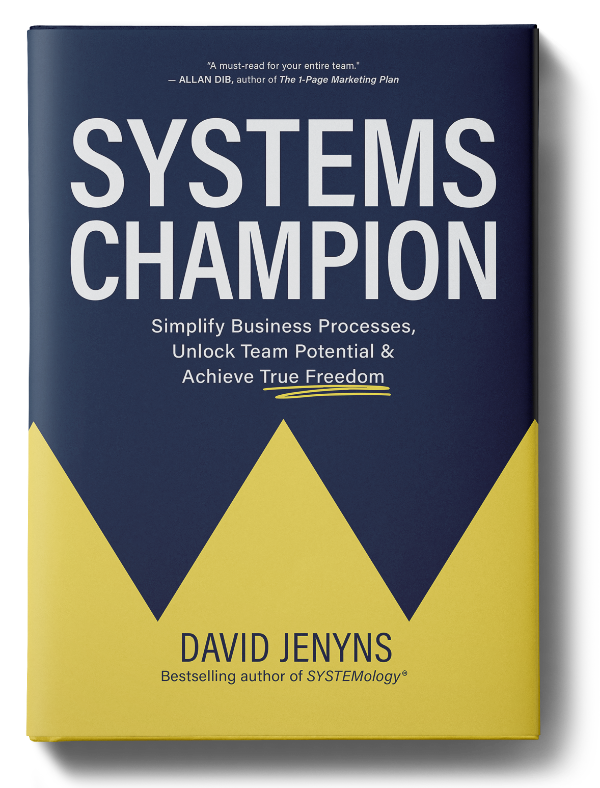
Learn more →
I wrote an entire book about this role because it is that important. Systems Champion is the practical playbook for the person who will actually drive the Kaizen culture in your business.
Most small businesses try to make Kaizen work without a Systems Champion. It never sticks. The owner gets excited for two weeks, then a crisis pulls them away, and the improvement cycle stops.
Appoint the champion. Give them the time and authority. Kaizen follows.
The bottom line
Kaizen is the "how" of making systems get better over time.
But it only works when business systems are in place.
Document first. Get the team using the systems consistently. Then, and only then, start the weekly habit of small, measured improvements. Keep it simple. Keep it cheap. Involve everyone. Focus on your Critical Client Flow. And put a Systems Champion in charge of keeping the cycle turning.
Miss the foundation, and Kaizen is just another word for busy.
Start with the foundation, and Kaizen becomes the quiet engine that turns a good business into a great one.
Simple beats perfect. Documented beats improvised. And a little bit better, every week, beats one big transformation that never comes.
If you want to go deeper on what good systems actually look like, my article on the characteristics of good business systems is a good next read. And if you want to compare Kaizen with other business improvement methods like Six Sigma, Lean, and the theory of constraints, I have covered those too.
Kaizen is the cultural cousin of Lean, and one of many improvement methodologies business owners consider. For how it stacks with Six Sigma, Theory of Constraints, EOS, and a business coach, and why SYSTEMology comes first, see Where SYSTEMology Fits in the Business Improvement Ecosystem.
Ready to start building the foundation Kaizen needs? systemHUB gives you a single place to document, store, and improve every system in your business. It comes loaded with 100+ templates to get you started. Try it free.