Most small businesses acquire clients on owner energy.
The owner runs the website updates, posts on LinkedIn, replies to inbound enquiries, follows up with prospects, closes deals, and produces the thought leadership that drives the pipeline. When the owner is energised, the pipeline fills. When the owner is distracted by operational fires, the pipeline dries up. Three months later, revenue drops. The owner re-energises, fills the pipeline again, and the cycle repeats.
This isn't a marketing problem. It's a systems problem. Client acquisition that depends on owner energy doesn't scale, doesn't survive an owner taking a holiday, and doesn't produce the kind of predictable growth a business can actually plan around.
The fix is to systemise the six pieces of client acquisition that most owners hold in their head. Once systemised, the pipeline keeps filling whether the owner is at the helm or on a beach. This article walks through each piece, shows you what systemising it looks like, and uses a mission-driven e-commerce brand as an example of how even an unconventional category benefits from the design.
Why most marketing doesn't run on systems
Three structural reasons.
It looks like creative work, so owners don't systemise it. Most owners see marketing as inherently ad-hoc, you write the post, you think of the campaign, you create the content. Systems feel like they'd strip out the creativity. They don't. Systems handle the scaffolding (what to post, when, where, to whom). The creative work happens inside the scaffolding and benefits from the discipline.
It feels urgent but not important. Marketing is easy to push off. Operational fires are loud and immediate. The pipeline is quiet and abstract. Owners default to fixing the fire and push the pipeline work to next week, which becomes next month, which becomes next quarter, which is when they realise the pipeline is empty.
The knowledge lives in the owner's head. What worked, what didn't, which audience responds to what, which pitches convert. All of it sits in the owner's intuition with no documented artefacts. The day the owner stops doing marketing, the knowledge leaves with them. (Related: how to reduce owner dependency, the same pattern shows up in every department that still runs on the founder's head.)
Systemising fixes all three by making marketing a repeatable process with documented knowledge that the team can run.
The 6 marketing and sales systems every small business needs
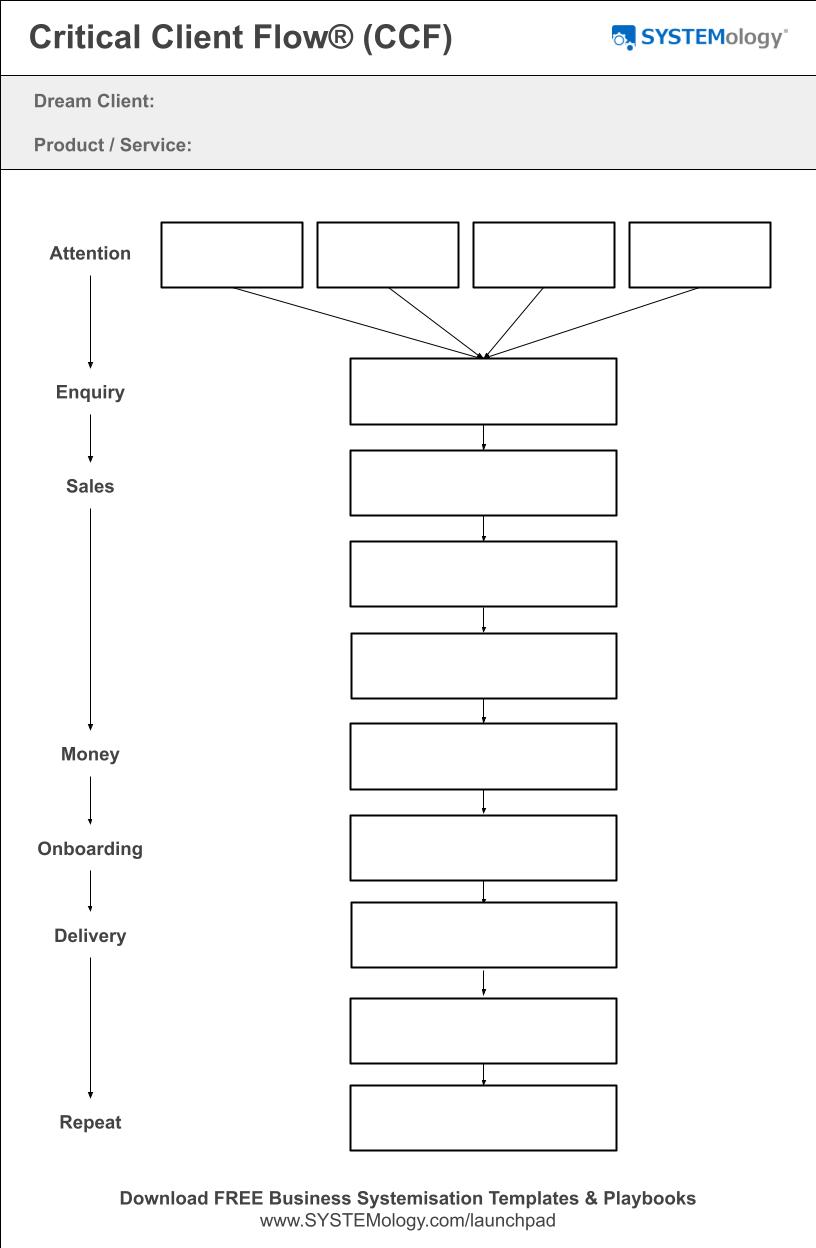
1. A Critical Marketing Flow. One-page map of how a stranger becomes a customer. The stages they move through, the systems that move them, the owners of each. Most small businesses have never drawn this map, and it's why their marketing feels disconnected. Drawing the CMF is the first systemisation move. Everything else follows. (If you haven't drawn a full Critical Client Flow yet, start with that, the free CCF template gives you the one-page scaffold.)
2. A content production system. Not a content strategy, those are abundant. A production system: who writes, who edits, who publishes, what cadence, what topics, what calls to action. The system produces a predictable volume of content (say, two posts a week, one podcast a month, one article a quarter) on a known rhythm. The team runs it. The owner isn't the bottleneck.
3. A lead capture and nurture system. Every lead who lands on your site, shows interest, or enquires gets captured in one place, tagged by source and topic, and receives an appropriate follow-up sequence. Most small businesses have this partially, spreadsheets, CRMs with some contacts, email list with some leads, and nothing systemised. Install a single source of truth (usually a CRM), define the capture routes, and document the follow-up sequences.
4. A sales conversation system. How you handle a qualified lead. What questions you ask. What objections you expect. What materials you use. What next-step you propose. Most small business sales is intuitive and therefore inconsistent. Documenting it (not scripting, documenting) produces a 20-40% lift in close rate in most businesses that install the system, because every conversation runs through a disciplined path instead of improvisation.
5. A referral generation system. Most small business growth comes from referrals, and most small businesses have no system for producing them. Install one: a documented thank-you process for every existing referral, a systemic ask at the end of every engagement, a tool for tracking where referrals come from so you can invest in the referrers producing the most value. Free leverage, almost never installed.
6. A weekly marketing and sales scoreboard. Five numbers you review with your team every week: new leads, qualified leads, opportunities, closed deals, revenue booked. The scoreboard exposes where the funnel is leaking and forces conversations about fixing the leak rather than just running more top-of-funnel activity. Most small businesses look at the top of the funnel and ignore the middle; the scoreboard fixes that.
Six systems. Each one documentable in a week or two. Collectively they make client acquisition a machine instead of an owner project.
Henry Reith and Oh Crap: systemised marketing in a mission-driven e-commerce brand
Henry Reith runs Oh Crap, an Australian e-commerce brand selling compostable dog poop bags. The business combines a strong environmental mission (reducing single-use plastic in an underappreciated category) with disciplined operations that let the mission actually scale rather than stay aspirational.
E-commerce is a particularly interesting systemisation case study because the marketing and operations are deeply intertwined. You can't just systemise marketing in isolation, you're also systemising fulfilment, customer service, subscription management, and the retention mechanics that turn first-time buyers into repeat customers. Henry's team has worked through that integration thoughtfully, which is why the brand has been able to maintain market leadership in its category.
The underlying pattern isn't unique to Oh Crap. Any mission-driven e-commerce brand hits the same challenge: the mission attracts customers who want to believe the business is doing things right, and the business actually has to do things right, which means systemised operations behind the mission-forward brand. Systemising the six elements above (CMF, content production, lead capture and nurture, sales conversation, referral generation, scoreboard) applied to e-commerce specifics (product launches, subscription flows, repeat purchase cadence) produces a brand that can keep growing without the owner holding every thread personally.
To round out the case study, a second proof point: Haley Santos's work at BiOptimizers (a US nutritional supplements brand) is a textbook example of systemising the marketing and sales stack in a rapidly-scaling consumer business. Haley, as the BiOptimizers Systems Champion, documented the Critical Marketing Flow across the business, from cold traffic through customer support into subscription retention, and built the processes that let the team grow from about 40 people to about 150 without the marketing function breaking. The pattern translates across e-commerce categories. The specifics change; the six systems don't. (The underlying framework comes from SYSTEMology and Systems Champion, the two books that cover the "how" in depth.)
The systemisation sequence for marketing and sales
You can't install all six systems at once. Here's the order that works.
Month 1. Draw the Critical Marketing Flow. One-page map. Share with the team. Agree on the stages and ownership. This is the map everything else builds on.
Month 2. Install the weekly scoreboard. Five numbers, weekly review. This gives you visibility before you start fixing anything.
Month 3. Document the sales conversation system. The highest-leverage documentation because it typically produces the fastest revenue lift.
Month 4. Install the lead capture and nurture system. Pick your CRM, consolidate contacts, document the follow-up sequences.
Month 5. Install the content production system. Cadence, ownership, topics, rhythm. The team runs it.
Month 6. Install the referral generation system. Thank-yous, systemic asks, referrer tracking.
By month six, all six systems are running. Month seven onwards is optimisation: which content topics convert best, where the funnel leaks, which referrers produce the most, which sales conversations close at the highest rate. The scoreboard makes all of that visible.
The move
The move is to draw the Critical Marketing Flow this week. One hour, one page, stages and owners. Nothing more.
That one artefact, more than any single marketing technique, is what unlocks the rest of the systemisation. The CMF makes the current state visible. The current state makes the gaps visible. The gaps tell you which system to build next.
Without the CMF, marketing systemisation is abstract and infinite, there's always more to do and no obvious starting point. With the CMF, the work becomes concrete, ordered, and finishable. Most owners never draw it because it feels too basic. The ones who do unlock everything that follows.
Ready to systemise your client acquisition? Start by drawing your Critical Client Flow, then run the Owner Dependency Score to see how much of the marketing machine is still sitting in your head. Once you're ready to hire someone to own the systemisation, use the Systems Champion Position Description as your starting template. Then put the six systems on rails with a systemHUB free trial.