Ask a small business owner how their marketing works and you'll get one of two answers.
Answer one: "We don't really have a system. I just do what I can when I can."
Answer two: a twenty-minute explanation of the agency, the ads, the newsletter, the LinkedIn posts, the podcast, and the referrals, ending with "but it kind of all runs through me."
Both answers describe the same problem. The marketing is running on the owner's attention, not on a system. When the owner is busy, marketing drops. When marketing drops, so does the pipeline. Six weeks later, the owner is stressed about sales and drops everything to do marketing. The cycle repeats.
Marketing is the single area where small businesses lose the most money to not-systemising. This article is about fixing that.
Why marketing is the last thing owners systemise
Operations get systemised first because operations break loudly. A delivery error, a missed shift, a rejected invoice, each one creates an immediate problem that demands a system.
Marketing breaks quietly. When marketing is half-broken, you don't notice for three to six months. You just feel the pipeline get thinner. By the time it's obvious, the damage is done and the recovery takes another three to six months.
So most owners treat marketing as a creative activity, not a process. Every campaign is a one-off. Every post is written from scratch. Every launch is a fire drill. And the one person who knows how the whole thing fits together, the owner, becomes the bottleneck the business can never solve for.
The good news: marketing is actually more systemisable than most of operations, because the same handful of actions repeat endlessly. Content gets written. Leads get captured. Emails get sent. Reports get reviewed. Each of those is a system waiting to be built.
The Critical Marketing Flow
Before you systemise any marketing, draw the flow.
A small business marketing machine has three stages.
Attract. Where new people first encounter the business. Content, ads, partnerships, referrals, events, SEO, social, podcast appearances.
Convert. The path from interested stranger to customer. Lead magnets, email nurture, landing pages, sales calls, proposals, onboarding.
Retain. Keeping customers buying, referring, and advocating. Email, community, customer success, case studies, review requests, loyalty programs.
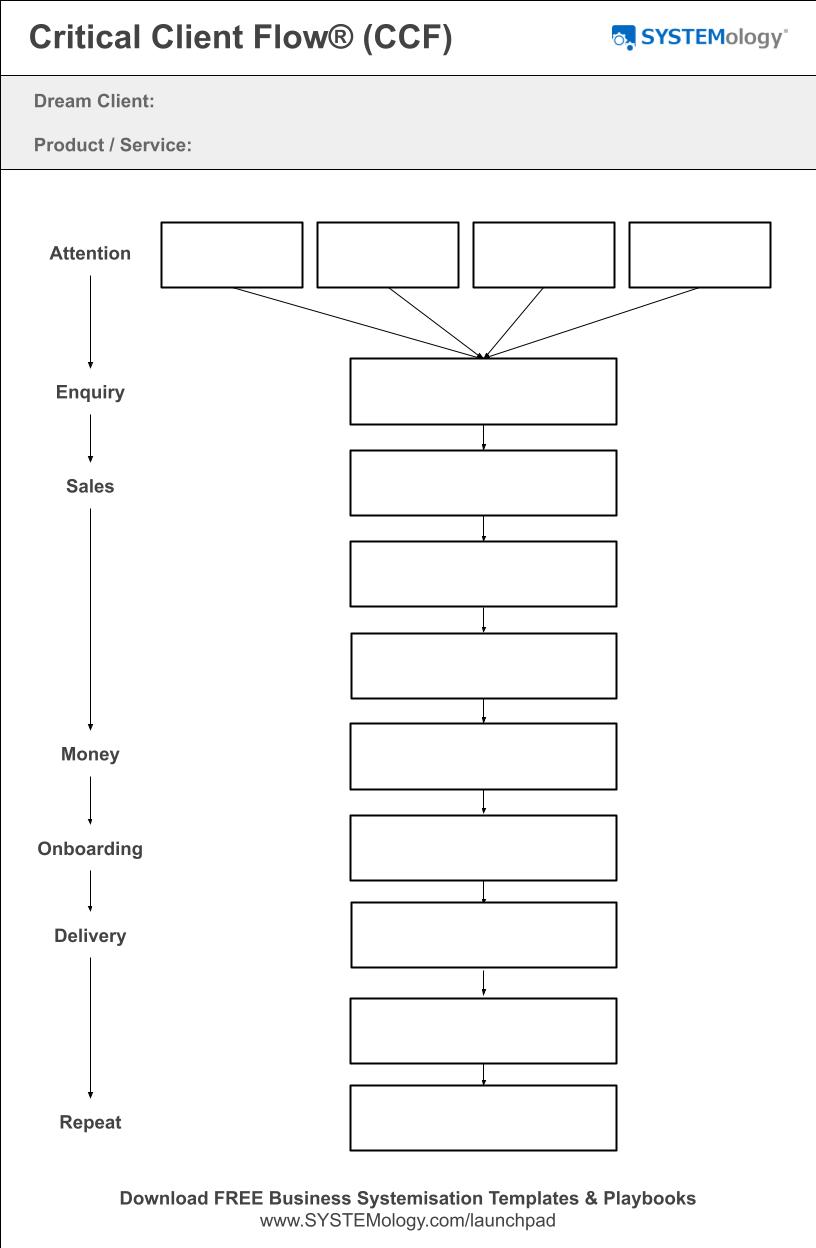
On one page, map the specific steps in your business for each stage. Don't describe what you wish you did. Describe what actually happens. Most owners have never drawn this on a single page, and when they do, the gaps become obvious within five minutes.
This map is your Critical Marketing Flow, the subset of the Critical Client Flow that concerns attracting and converting. Everything downstream of "new customer" is operations. Everything upstream is marketing. The boundary matters because the systems on each side need different owners.
The 8 systems that run a small business marketing machine
If you systemise these eight, you have a marketing engine. The owner can step out for weeks and it still runs.
1. Content production system
How a content piece gets from idea to published, for each format (video, article, podcast, social). Roles, tools, checklists, review steps.
2. Lead capture system
Where leads come in, what fields you collect, where they go, who gets notified, what the first automated message looks like.
3. Email nurture system
The welcome sequence, the newsletter cadence, the segmentation logic, the sender voice, the review process.
4. Sales enablement system
The proposal template, the follow-up cadence, the CRM hygiene, the reporting the owner actually reads.
5. Ad management system
If you run paid, the budget approvals, creative refresh cadence, reporting rhythm, platform-by-platform playbook.
6. Review and testimonial system
How you ask, when you ask, where they go, how they get used. Nobody does this well, and it's free.
7. Analytics and reporting system
The five numbers reviewed weekly. The deeper dive monthly. Who runs it, where it lives, how it turns into decisions.
8. Content repurposing system
One idea turned into six formats, on a schedule. The highest-leverage system on this list and the least documented.
You don't build all eight in a month. You build them in the order your Critical Marketing Flow tells you to. Start with the biggest bottleneck.
One idea, six formats. Same week. Named owners.
- Long-form piece lands in the "repurpose queue" with a brief and transcript attached.
- Junior / VA extracts 5-10 quote cards, 3 short clips, and a one-paragraph summary.
- AI drafts the LinkedIn post, the email newsletter section, and the tweet thread against the brand voice guide.
- Content lead reviews, adjusts for taste, approves the batch.
- Scheduler queues everything across channels per the publishing calendar. Analytics auto-tag for reporting.
Result: One long-form piece produces 10-15 distribution assets. Owner never touches it. Consistency compounds every week without creative drag on the team.
Haley Santos and BiOptimizers' scaling engine
BiOptimizers is a direct-to-consumer health supplements company in the United States. Growing fast, fully remote, scaled from 40 people to 150 in the space of a few years.
In a business like that, marketing is not a department. It's the whole machine. Content, paid, email, community, customer success, all running at volume, across time zones, with no central office where anyone can walk over and ask the owner a question.
The CEO read SYSTEMology and made an unusual call for a fast-growing marketing-heavy business. Rather than lifting someone out of the team to systemise part-time, he hired a dedicated Systems Champion. Haley Santos. Full-time role. Her first task: read the book and absorb the methodology.
What came next is the part that matters.
BiOptimizers had the usual resistance you find in creative-heavy teams, the belief that systems would sterilise the work. Haley's job was to prove that wrong by building systems that freed the creatives up, rather than cornering them. She started where every Systems Champion should: the Critical Client Flow. Which processes, if documented, remove the most owner dependency and free the most team capacity?
For a remote-first, marketing-led business, the answers were different from what you'd find in a construction firm. Content production pipelines. Launch playbooks. Customer success handoffs. Community management protocols. The systems that let a fully virtual team operate asynchronously across continents without constant real-time coordination.
Three things changed. The company scaled to 150 people without the wheels coming off. The systems became a safety net, when someone left, the knowledge stayed. And the founder-CEO stopped being the single node everything ran through.
That is what a systemised marketing machine looks like at scale. Not boring. Not creative-killing. Just predictable, documented, and designed to run without the owner at the centre.
The AI layer for 2026 marketing
Marketing is the area of small business where AI is changing the economics fastest.
A few examples of what's now routine inside a well-systemised marketing function.
- Content repurposing. One long-form video becomes a podcast episode, an article, five LinkedIn posts, a newsletter, three short clips, and a tweet thread. Most of the work is automated. A human reviews for voice.
- First drafts. A model produces the first pass of an article, an email, or an ad. A human edits. The draft-to-finished time drops by 70%.
- Research and personalisation. Before a sales call, a model reads the prospect's site, LinkedIn, recent news, and produces a one-page brief. The salesperson walks in warm.
- Reporting narratives. The analytics system generates not just numbers but a weekly commentary, what moved, what didn't, what to investigate.
- Quality checks. Every outbound email, post, or piece of copy gets scanned for tone, typos, and alignment with the brand guide before it goes out.
None of it replaces the creative thinking. All of it removes the grunt work around the creative thinking, which is 80% of what marketing people actually do hour to hour.
Two conditions, though. First, you need the underlying system documented before AI adds value. A model has nothing to check against without a style guide, a brand voice doc, a content playbook. Process before AI, always. Second, the AI enhances the human, it doesn't replace the human sense-check on taste and judgement. Marketing that sounds like a language model wrote it is recognisable, and customers bounce off it.
The trap: systemising the wrong things
One warning.
It's tempting to systemise the visible parts of marketing first. The social posting. The newsletter send. The bits the owner sees every day.
Those usually aren't where the leverage sits.
The leverage sits in the unglamorous plumbing. The lead-to-CRM handoff. The proposal-to-follow-up sequence. The quarterly content plan. The analytics rhythm. The stuff that shows up only when it breaks, but breaks expensively when it does.
A good test: if the owner went away for four weeks, which marketing system would fail first? Whatever you just pictured is the system to document first. Not the one you enjoy doing. The one that dies without you.
The bottom line
Marketing is the area where not having systems costs you the most, for the longest time, before you notice.
Map the Critical Marketing Flow. Build the eight systems. Appoint someone other than you to run them. Layer AI on top of the documented processes, never in place of them. And trust the machine enough to step back and look at the scoreboard rather than jump in and personally save the next launch.
Do that, and marketing stops being the thing that keeps you trapped. It starts being the thing that grows the business whether you're in the office or on a family holiday for three weeks.
Want to find where your marketing time is going? The Owner Time Audit shows you exactly how much of your week is trapped in low-value work your business could already run without you, usually a large chunk lives inside marketing. Then build the systems in a systemHUB free trial.