"Business process" is one of those phrases everyone uses and nobody defines. Ask five business owners what it means and you'll get five different answers. Ask the same five owners what separates a process from a system, or a process from a procedure, or a process from a workflow, and the answers get even fuzzier.
The fuzziness isn't trivia. Owners who don't have a clean definition of "business process" end up systemising inconsistently. They document some things at the wrong level of detail, miss others entirely, and build libraries full of artefacts that nobody can quite categorise. The fuzziness propagates into the work itself, a team without a shared definition of "process" runs workflows that drift.
This article gives you a clean definition, shows you how to identify the real processes in your business, and walks through why the distinction between process and system and procedure actually matters when you're trying to scale a small business.
The clean definition
A business process is a defined sequence of steps that transforms an input into an output, owned by a specific person or team, triggered by a specific event, measurable by a specific outcome.
Unpack that definition and three things are doing the work.
Sequence. A process is a set of steps in a specific order. Not a bundle of tasks. Not a collection of activities. An ordered sequence, step one, step two, step three, step four. Order matters because the output depends on the sequence being correct.
Input → Output. A process takes something in and produces something different out. A sales inquiry comes in, a qualified opportunity goes out. A project handover comes in, a billed invoice goes out. Without input and output, you don't have a process; you have ambient activity.
Owner, trigger, measure. Every real process has a named owner, a specific trigger that starts it, and a measurable outcome that tells you whether it worked. Missing any of those three and you have at best a loose habit, not a process.
That's the definition. Four minutes to write; a career to apply consistently.
Process vs system vs procedure
These three words get used interchangeably in small business and shouldn't be.
Procedure is the most granular. The exact step-by-step of how to do a specific task. "How to process a client refund" is a procedure. It tells you what buttons to press, what fields to fill, what email to send.
Process is the ordered sequence of procedures that produces a meaningful business outcome. "Client refund handling" is a process. It strings together multiple procedures (the refund processing, the client communication, the internal logging) into a coherent end-to-end workflow.
System is the broader ecosystem of process + people + tools + documentation + culture that reliably produces a specific outcome. "Customer service system" is a system. It includes the processes (like refund handling), the people (CS team), the tools (CRM, email, phone), the documentation (scripts, templates), and the culture (tone, empathy, autonomy).
Procedure → Process → System, in increasing order of scope. Small businesses frequently conflate all three, which is why they build libraries where everything is called a "process" and nothing is categorised properly. (See what is a business system for the broader system-level discussion.)
How to identify your business's processes
Most small businesses have somewhere between 15 and 40 real processes. Finding them requires one specific exercise.
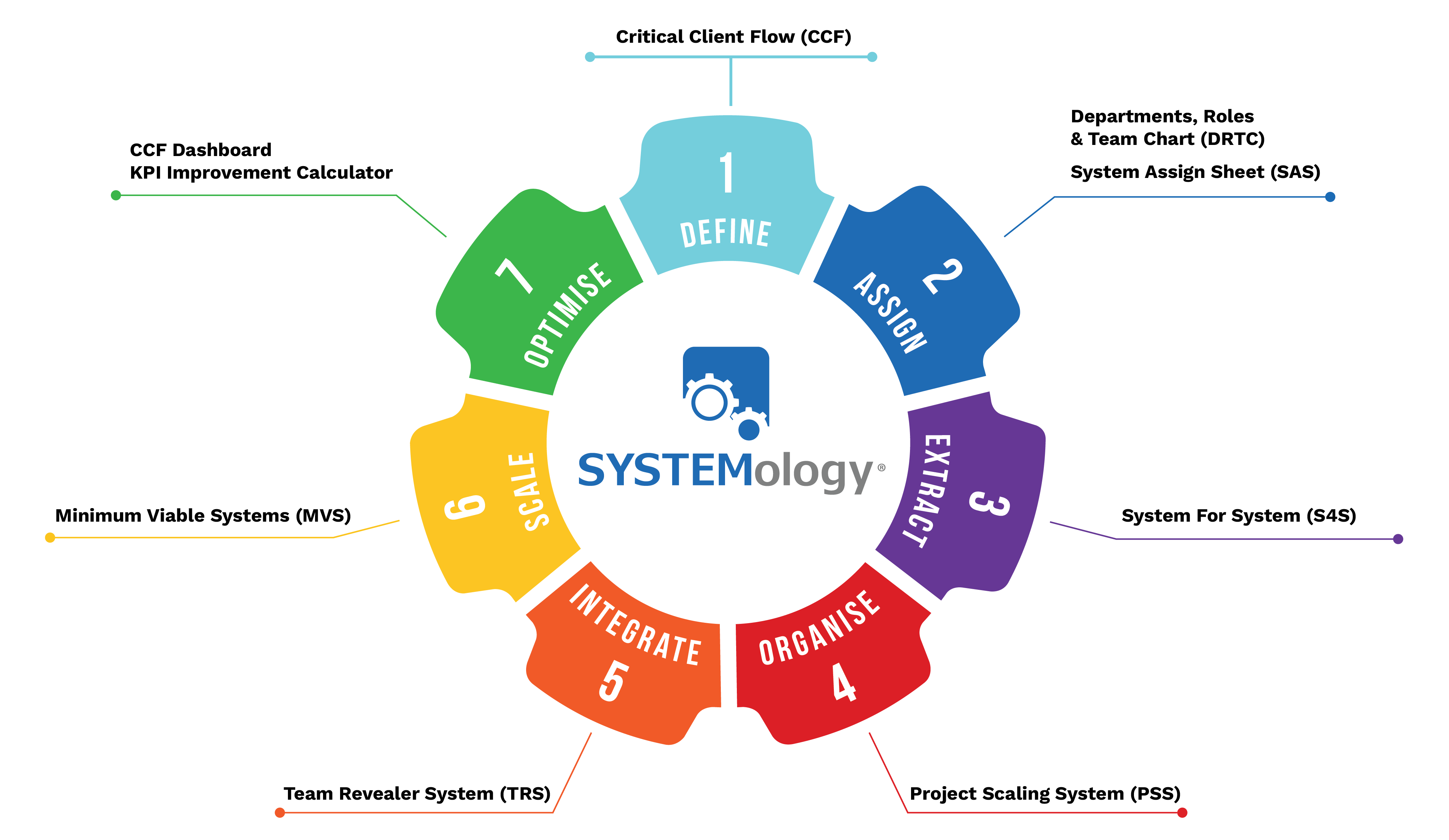
Draw your Critical Client Flow. The one-page map from first customer touch to repeat purchase. 10-15 stages is typical. Every stage on that map is either a single process or a small cluster of processes. The CCF tells you how many real processes your business has, what they do, who owns them, and what the handoffs between them look like. It's the single most useful hour a small business owner can spend on understanding their own operation.
Add the internal processes that don't show up on the CCF. Things like payroll, tax preparation, hiring, performance reviews, financial close. These aren't customer-facing but they're real processes that need to exist, be owned, and produce consistent outcomes. Usually there are 5-15 of these.
Audit each for the definition test. For every identified process, check: is the sequence defined, is the input-output clear, is there a named owner, is there a trigger event, is there a measurable outcome. Any process that fails more than one of these tests is under-designed and should be the first target for improvement.
This exercise typically takes 2-3 hours with your Systems Champion. It's the foundation of every systemisation effort, because you can't systemise what you haven't identified.
Luke Davies and Davies Construction: processes at work on a custom build
Luke Davies runs Davies Construction, a custom home builder in regional Australia. Custom builds are an interesting case for process definition because every single project is different. No two homes are identical; no two clients want the same thing; no two sites have the same constraints.
The common assumption is that custom work can't be systemised because there's no repeatable output. Luke's operation demonstrates why that's wrong. The processes aren't around the output, they're around the workflow. The sales discovery process is the same regardless of which home gets built. The design review process is the same. The supplier coordination process is the same. The site-to-office handoff process is the same. The billing cadence is the same.
Davies Construction has identified, named, and documented each of these processes. Each has an owner. Each has a trigger. Each has measurable outcomes. The homes they build are wildly different from each other; the processes that produce them are remarkably consistent. That's the pattern. Variable output, consistent process. It's what lets Luke scale a build-to-order business without becoming the bottleneck on every project. (The broader pattern around how to systemise a construction business extends this same principle across the industry.)
Why the distinction matters for systemisation
Small businesses that don't distinguish process from system from procedure make three classic mistakes.
They document procedures when processes are the right level. Every small task gets its own document, producing a library of hundreds of granular artefacts that nobody can navigate. The right level is usually process, one document per coherent end-to-end workflow, with procedures embedded inside it.
They confuse systems with processes, and systemise at the wrong scope. They create a "customer service process" when what they really need is a "customer service system", including people, tools, culture, and documentation, not just the workflow. Or they create a system when a single process is enough, and over-build for the current stage of the business.
They under-define processes. They call something a process when it lacks an owner, a trigger, or a measurable outcome, which means it's not a real process, it's an aspirational label. Work done inside under-defined processes produces variable output, which propagates into variable quality, which propagates into customer friction.
Getting the definition right isn't pedantic. It's the foundation of clean systemisation. Every small business that's systemised well has a shared definition of "process" in the team. Every small business that's systemised poorly usually has fuzzy definitions and a fuzzy library to match.
The definition test
The simplest test for whether you have a real business process: can you state, in one sentence, what triggers it, what it produces, and who owns it.
"Our client onboarding process is triggered when a signed contract is received, produces a fully-configured new-client account within 48 hours, and is owned by the operations manager."
That sentence passes the test. Every real process in your business should be articulable this way. If you can't articulate it, you don't have a process, you have unorganised activity.
Walk your Critical Client Flow and your internal process list with this test. Every process that passes gets documented and improved. Every process that fails gets the definition clarified first, then documented. Do this one time thoroughly and you've done more to systemise your business than most owners do in years of effort.
Ready to identify your real processes? Start with the SYSTEMology Starting Point to see which of the 7 stages you're currently on. Draw your Critical Client Flow to map the processes that matter most. Then document them in a systemHUB free trial.