I teach one of Chet Holmes's ideas in my own training. It's the Dream 100 and I credit him every time. So when an owner asks me where to start on sales I often point them to The Ultimate Sales Machine. It's one of the few sales books that reads like a procedure and not a pep talk. Michael Gerber wrote its foreword too, which is a small link between this book and mine.
This page is a summary of the twelve strategies and the key lessons. It also covers the one thing the book can't do for you: keep going when the owner's discipline runs out. If you've already read it, jump to how to systemise it.
The Ultimate Sales Machine: The Short Version
Read it. It's a practical plan for building the sales and marketing side of a business. It's built on repetition and not on talent. Chet's big claim is that you don't need 4,000 new ideas. You need twelve good ones done 4,000 times each.
The review in three lines:
- What it gets right: building the management basics before the sales skills, educating buyers instead of pitching them and going after your best 100 buyers on purpose.
- Where it stops: the engine is the owner's discipline, it covers only sales and marketing and it doesn't say how to capture the work as systems.
- How to use it: treat each strategy as a system to build and not a habit to maintain.
The Ultimate Sales Machine Summary: What Does the Book Say?
Chet Holmes (who died in 2012) was a sales trainer and Jay Abraham's partner in a training program. The Ultimate Sales Machine came out in 2007. He says he ran sales for a magazine publisher and later ran several companies while going into the office only two days a week. His method is to model what a top producer does and then turn it into procedure so ordinary people can repeat it.
The core idea is simple. Success comes from a handful of strategies done with relentless discipline. He calls it pigheaded discipline and determination. The book lays out twelve strategies and says to build them in order, with the management building blocks first and the sales and marketing skyscraper on top.
What Are the 12 Strategies in The Ultimate Sales Machine?
- Time management. Do the most important things first and protect that time.
- Higher standards and regular training. Drill a few core skills every week and don't rely on one-off events.
- Effective meetings. Use short, regular workshop-style sessions to improve one thing at a time.
- Becoming a brilliant strategist. Put strategy before tactics and build a core story.
- Hiring superstars. Hire on the psychological profile of top performers and not on the resume.
- Getting the best buyers. Pick your Dream 100 and go after them relentlessly.
- The seven musts of marketing. The marketing basics every business should have in place.
- Visuals and presenting. Show the story, don't just say it.
- The nitty-gritty of the Dream 100. The day-by-day tactics for reaching those buyers.
- The seven steps to every sale. A repeatable sequence for each sales conversation.
- Follow-up and client bonding. Stay in touch and build the relationship after the sale.
- All systems go. Set goals, measure what you do and put it all in motion.
What Are the Key Lessons of The Ultimate Sales Machine?
These are the five Ultimate Sales Machine lessons I'd keep:
- Do a few things relentlessly. Mastery comes from repeating twelve strategies, not from chasing the next tactic.
- Educate buyers and don't just sell. Build one core story around real data about the buyer's market. Open with the problems they face and bring your solution in last.
- Choose your best buyers on purpose. The Dream 100 is a list of your ideal clients plus a planned sequence of contact. A small number of the right buyers can be most of your sales.
- Train in small weekly doses. One hour a week on one improvement beats a big annual workshop. Add up 52 weeks and you have a different company.
- Inspect what you expect. A new habit sticks when someone checks it every day until it's automatic.
What Does The Ultimate Sales Machine Get Right?
A lot. These are the four I've seen hold up.
It builds the foundations first. Most sales books jump to tactics. This one starts with time, standards and training. That order is right. A strong sales skill dropped into a messy business doesn't last.
It's close to a procedure book. Chet's belief is that plans and procedures beat talent. His own companies, he says, ran without him. That's the same outcome I care about. It's why his book sits well next to mine.
The Dream 100 is concrete. Write down a hundred perfect-match buyers and put them in a spreadsheet. Plan a sequence of outreach and keep at it. It's simple enough that an owner can start this week. I teach it for that reason.
The weekly rhythm is the quiet gem. One hour a week on one improvement is the part most owners skip. It's also what turns a good idea into a habit the team shares.
Where Does The Ultimate Sales Machine Stop?
None of this is a criticism of Chet. He set out to give owners a plan for sales and he did. But when owners try to act on the book I see three gaps. They're the gaps documented systems exist to fill.
The engine is the owner's discipline. The book leans hard on pigheaded determination. That works while the owner is fired up. It's also a person and not a system. When the owner has a bad month or goes on holiday the machine slows down. A system keeps running when the discipline dips.
It stops at sales and marketing. The twelve strategies are about winning customers. They say little about delivering the work, running the operation or handling the money. If you win more customers for a business that only delivers when you're in the room you've made the dependency worse. Sales is the first half of your Critical Client Flow. The second half still needs systems.
It doesn't show you how to capture the work. The book gives you scripts and training sessions. It doesn't say where the script lives, who owns it or how it gets updated when something changes. I made the same point about the other books in my E-Myth Revisited review and my Work the System comparison. The ideas work. The capture is the missing piece.
How Do You Systemise The Ultimate Sales Machine?
This is my take and not Chet's. Each of his strategies can become a system with an owner. Here are six I'd start with.
| The system to build | |
|---|---|
| Core story | One page that tells your market story, plus the presentation built from it. |
| Dream 100 | A target list, an outreach sequence and a named owner for each account. |
| Seven steps of a sale | A call checklist and a recorded example of your best call. |
| Follow-up | A follow-up sequence that runs the same way after every sale. |
| Hiring superstars | A hiring procedure built around the profile of your best people. |
| Weekly training | A standing one-hour slot with an agenda and one improvement each week. |
The trick is how you capture them. Ask the person who does the task best to record themselves doing it. A call, a follow-up or a meeting all work. Today AI can turn that recording into a first draft of the checklist or script in minutes. Then someone who didn't write it follows it. Where they stumble you fix the page. That's the method behind SYSTEMology and it turns Chet's repetition into something the team owns.
Where to Start
If you've read the book and the machine keeps stalling, don't read another one. Build one system.
- Write your Dream 100. List the hundred buyers you'd most like to win and put them in a spreadsheet.
- Record your best sales call. Turn it into a one-page checklist. Ask someone who didn't write it to follow it and fix the page where they stumble.
- Book the weekly hour. One hour a week to improve one sales system. Keep the slot even when you're busy.
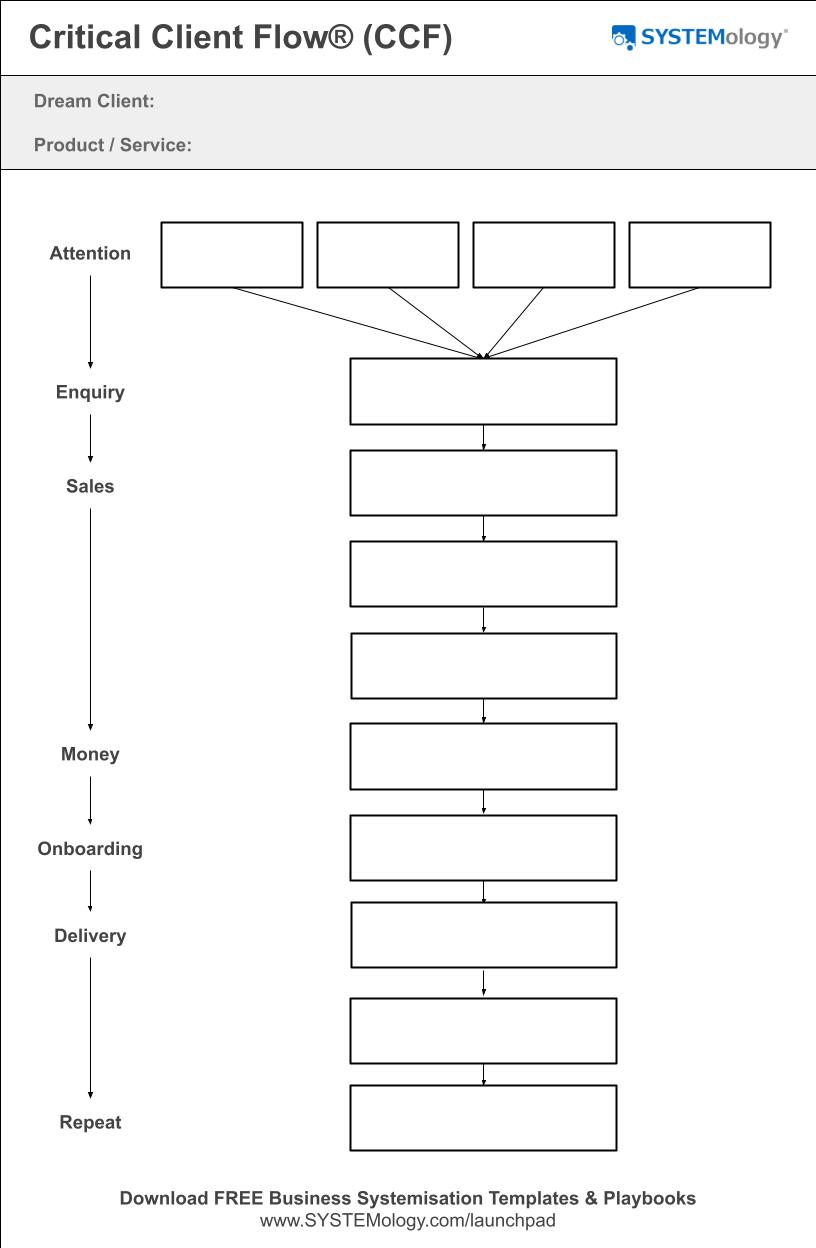
Sales is only the first stage. To see the whole flow and where the gaps are, map your Critical Client Flow. To see where you stand first, take the free Systems Strength Test or the Owner Dependency Score. When you're ready for the whole method the book walks you through every stage.
This is my own summary and view of the book. "The Ultimate Sales Machine" is the title of Chet Holmes's book and I'm not affiliated with Chet Holmes, his estate or his company.