Most business owners want a culture of excellence. Very few know how to build one.
They put values on the wall. They hire carefully. They give speeches. They tell the team that "we don't do mediocre work here." Then they wonder why, a year later, the culture still feels the same as every other small business in their category.
The problem isn't that culture can't be changed. It's that culture is a system-level output, not a speech. A culture of excellence emerges from six specific design conditions. Skip the conditions and no amount of hiring, values, or motivation will produce it. Install the conditions and excellence becomes the path of least resistance, not the exceptional effort.
This article walks through the six conditions, shows you what each one looks like in practice, and covers why a non-profit serving tens of thousands of animals a year is one of the sharpest case studies of the design approach working in the wild.
Why culture initiatives usually fail
Three common failure modes.
Slogans without scaffolding. The most common failure. The leadership team picks five values, has them laser-cut onto the wall, runs a quarterly all-hands on "living the values," and assumes that's the work. It isn't. Values on walls don't change behaviour. Values built into hiring criteria, performance conversations, onboarding materials, and daily rituals do.
Excellence defined as "working harder". Owners mean well but end up rewarding long hours rather than good systems. A team that works 70-hour weeks to produce adequate work is not an excellent culture, it's a burnout culture with excellence as a pretext. Real excellence cultures work sustainable hours and produce exceptional output because the system is designed to make that possible.
Excellence dependent on the owner's personal standards. The owner enforces quality by personally reviewing everything. That works at a certain size. It collapses above 10-15 people because the owner can't review fast enough, and standards drift the moment owner attention moves. Excellence has to be structural rather than personal, or it doesn't scale. (Related: how to reduce owner dependency, the structural shift every growing business has to make eventually.)
The six conditions below fix all three failure modes by making excellence the structural default instead of a heroic effort.
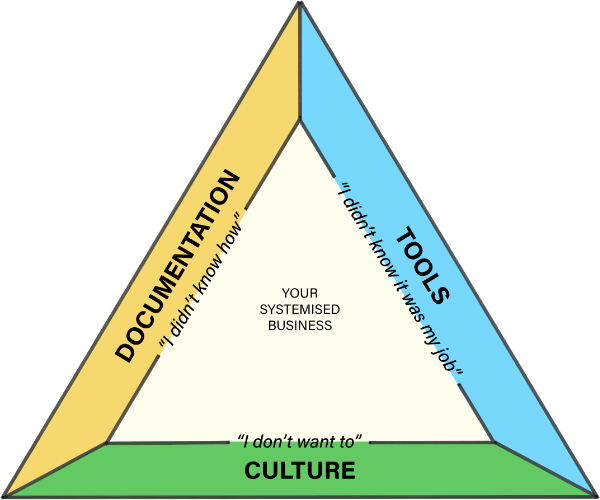
The 6 design conditions for a culture of excellence
1. A documented standard for what "excellent" means. Vague excellence is unenforceable. Documented excellence is the baseline. For every important deliverable in your business, there should be a written standard, not a long document, a single page, describing what excellent looks like. The team refers to it during work. New hires are trained against it. It gets reviewed quarterly and updated when the work evolves.
2. Hiring for standards, not just for skills. Skilled team members who don't care about excellence produce adequate work. Less skilled team members who genuinely care about excellence usually out-produce them within a year. Build excellence standards into your hiring process: ask candidates about moments they held themselves to a high standard that nobody required of them. Hire the answer, not the credentials. (The deeper how-to lives in hiring for a systemised business.)
3. Peer-level review and accountability. Owner-only review doesn't scale. Peer review does. Install a rhythm where team members review each other's work against the documented standard before it ships. This is cheap (30 minutes a week per person), effective (catches most drift), and culturally important (makes excellence a team value, not an owner mandate).
4. Visible, celebrated examples. A culture of excellence is taught by the examples the leadership celebrates. If the leadership celebrates hustle, the team values hustle. If the leadership celebrates a specific example of thoughtful, excellent work, what made it excellent, what the team member did, what standard it met, the team values that. Weekly shoutouts, monthly highlights, quarterly retrospectives with specific examples: all cheap, all culturally enormous.
5. Permission and process for continuous improvement. Excellence cultures are improvement cultures. The team has explicit permission to flag broken systems, permission to propose improvements, and a rhythm for implementing them. This removes the "this is how it's always been done" inertia that kills excellence in mature businesses. Monthly "what's broken" sessions with the team, followed by implementation of the top three items, is the mechanical form of this.
6. Protected thinking time for the team. You can't produce excellent work while constantly interrupted. Excellence cultures protect focus time, deep work blocks, meeting-free days, no-interruption hours. Small businesses tend to treat focus as a luxury and hustle as the default, which is why their output plateaus at adequate. Protecting focus is culturally radical in most small businesses and operationally obvious to every team that does it.
Six conditions. Each one installable. Collectively they produce the culture. Without the conditions, the culture doesn't form no matter how hard the leadership tries. With them, the culture forms almost automatically because excellence is what the system rewards.
Alexandria Tannehill and the Humane Society of the Pikes Peak Region
The Humane Society of the Pikes Peak Region is a large non-profit based in Colorado Springs serving 25,000 animals per year across multiple locations. Alexandria Tannehill leads the systemisation effort, with Sarah Taylor acting as the dedicated Systems Champion who worked across 19 different departments to document the core processes.
Non-profit is an unusual place to find a culture of excellence case study. Funding is constrained. Staff turnover is chronically high. Volunteer turnover is higher. The work itself is emotionally heavy, rescuing, fostering, adopting, and sometimes euthanising animals. Every structural factor in a non-profit of this scale conspires against a culture of excellence forming.
What Alexandria and Sarah built is a demonstration of how the six design conditions above can overcome those structural headwinds. Documented standards for every department. Onboarding that trains against the standards rather than relying on shadowing. Peer-level process ownership across the 19 departments. Celebrated examples of systemisation wins. A continuous improvement rhythm led by the Systems Champion. Protected thinking time for the leadership team.
The result, visibly in the organisation: new hires and volunteers ramp faster because the standards are documented. Consistency of animal care has improved across locations. The organisation has become more resilient because no single person's departure takes critical knowledge with them. The team feels more confident and empowered because the expectations are clear.
In other words: the culture of excellence in the Humane Society isn't a function of charismatic leadership or heroic individual effort. It's a function of the design conditions being in place. If those conditions can hold in a 25,000-animal-per-year non-profit with high turnover and emotional intensity, they can hold anywhere. The design is what scales, not the personality.
How fast does culture actually change?
A realistic timeline.
Month 1-3. The documented standards get written. The peer review rhythm starts. The team notices something is different but hasn't internalised it yet. Some resistance from long-tenured team members who were operating on tacit standards.
Month 4-6. Hiring starts to reflect the new standards. New hires onboard against documented expectations. Celebrated examples become part of the weekly rhythm. Continuous improvement sessions produce the first visible wins.
Month 7-12. The culture starts to feel different. New hires who joined post-installation say the business feels unusually disciplined for its size. Long-tenured staff either embrace the new culture or self-select out (some of both, usually).
Year 2. The culture is self-sustaining. New hires arrive into a documented, peer-reviewed, continuously-improving environment and adapt immediately. The leadership team spends less time enforcing the culture because the system enforces it.
Year 3+. The business is known in its category for its standards. Recruiting gets easier because candidates self-select toward the reputation. Customer experience compounds. The culture has become a competitive moat.
This timeline is realistic and repeatable. The work is slow-feeling in months 1-6 and accelerates from month 7 onwards. Most culture initiatives fail because the leadership gives up in months 3-4 when results aren't visible yet. The design approach requires patience for the first six months and produces outsized returns thereafter.
Start here
If you want to start this week, pick one deliverable in your business and write a one-page standard for what excellent looks like. That's the first move. 60 minutes, one deliverable, one page.
Then install peer review on that one deliverable. Two team members review each other's work against the standard before it ships. Weekly rhythm.
That's the smallest possible installation of the design approach. One deliverable, one standard, one peer-review rhythm. Once it's running, expand, second deliverable next month, third the month after.
By the end of a year, your most important deliverables all have documented standards and peer-review rhythms. Your hiring incorporates excellence criteria. Your team has permission to improve and the rhythm to do so. The culture you wanted to have has started forming structurally rather than rhetorically.
Ready to design your culture of excellence? The Business Valuation Calculator shows what your current operation is worth, and how much multiple expansion a culture of excellence unlocks at exit. For the dimension-by-dimension diagnostic, run the Systems Strength Test. Then house the standards and peer-review rhythm in a systemHUB free trial.