Most small business marketing is a creativity problem pretending not to be a systems problem.
Owners obsess over the hook, the image, the angle, the channel, the copy. Those matter. But the underlying engine, the system that turns attention into qualified prospects into customers, is what actually determines whether the marketing works. A mediocre creative hook in a well-designed system produces more customers than a brilliant hook in a broken system. Almost every small business I've seen has the creative work mostly fine and the system work mostly absent.
This article walks through eight specific rules of customer acquisition that make the system work. Not channel tactics. Not hook formulas. The underlying structural rules that determine whether marketing produces customers reliably or burns budget inconsistently. Each rule is operational, not creative. Each is applicable regardless of which channels or media you use.
Why most small business marketing underperforms
Three structural reasons, all of them systemic.
The acquisition system is run on the owner's attention. When the owner is energised, the pipeline fills. When the owner is distracted, it dries up. Three months later revenue follows. Most owners don't see the correlation because of the lag. The business thinks "this quarter's marketing isn't working" when the actual problem was six months upstream in an attention-dependent acquisition system.
Marketing knowledge sits in one head. What's working, what's not, which audience responds to what, which hooks convert, all of it is in the owner's intuition with no documented artefact. The day the owner steps back from marketing, the knowledge leaves with them. The team, however skilled, can't run what hasn't been written down.
Channels are added before the system is designed. Most small businesses operate multiple channels (social, email, referral, direct outreach, ads) without a unified system underneath. Each channel runs its own logic, its own cadence, its own measurement. The customer experience is fragmented; the operational cost is high; the results are mediocre. (See how to systemise your marketing for the full framework.)
The eight rules below fix all three. They turn marketing from owner energy into a documented, repeatable acquisition system that produces customers reliably, and keeps producing them whether the owner is at the helm or on a beach.
The 8 rules
1. One source of truth. All leads, all sources, all interactions live in one place. Usually a CRM, sometimes a well-designed spreadsheet for early-stage operations. Multiple lead lists across tools is the most common small-business marketing failure, and it invisibly costs dozens of hours per quarter in administrative work plus unknown numbers in leaked opportunities. Fix this rule first; every other rule depends on it.
2. Every lead source has a named owner. Referrals, organic search, paid, direct, events, partnerships. Each source has a specific team member or role accountable for the quality and throughput of that source. Without named ownership, every source underperforms because no one is watching it closely enough.
3. Known conversion rates at each stage. How many leads become opportunities. How many opportunities become customers. What the average time is between stages. These numbers exist in every business that's measured them and nowhere in every business that hasn't. Unknown conversion rates mean you can't find the leak, can't forecast, can't improve. Measurement is the prerequisite for everything else.
4. A documented sales conversation. What questions get asked, what order, what objections get surfaced, what materials get used, what next-step gets proposed. Not a script, a documented flow that preserves practitioner judgement while removing variability in what the sales conversation covers. Installation typically lifts close rates 20-40% in small businesses within a month. (Covered in detail in how to add new clients with better marketing systems.)
5. A structured follow-up sequence. Most small-business lead leakage happens in follow-up. A lead expresses interest, doesn't close that week, slips into the cracks. Fix: every lead gets assigned to a follow-up sequence based on their source and qualification. Automated where possible, personal where necessary. No lead falls through because nobody remembered to chase.
6. A referral ask at every engagement end. The highest-margin lead source in most small businesses is referrals, and most small businesses have no system for producing them. At the end of every successful engagement, a specific, systematised ask. Not a generic "any referrals?" but a designed prompt aligned to the specific success the customer just experienced. Free leverage; almost never installed.
7. A weekly marketing and sales scoreboard. Five numbers reviewed with the team every week: new leads, qualified leads, opportunities, closed deals, revenue booked. The scoreboard exposes where the funnel is leaking and forces conversations about fixing the leak rather than just running more top-of-funnel activity. Most small businesses look at the top of the funnel and ignore the middle. The scoreboard fixes that.
8. Quarterly strategic review of what's working. At the quarter, a structured review with the team: which channels produced the best customers, which converted most cheaply, which lifecycle stage most improved. Reallocate attention and budget based on evidence, not intuition. This is the rhythm that turns tactical marketing into strategic marketing over years. (See why numbers are the language of business improvement for the broader measurement pattern.)
Eight rules. Each one a structural property, not a tactical choice. Collectively they turn marketing from an art that depends on the owner into a machine that produces customers reliably across changes in channel, team, and economic cycle.
Henry Reith and Oh Crap: mission-driven marketing systemised
Henry Reith runs Oh Crap, an Australian e-commerce brand selling compostable dog poop bags. The brand combines a strong environmental mission (reducing single-use plastic in an under-appreciated category) with the operational discipline needed to actually scale the mission rather than let it stay aspirational.
E-commerce is an instructive case for acquisition systemisation because the volume forces the issue. At hundreds or thousands of transactions per month, you can't run acquisition on the owner's attention, the system either exists or the business stalls. Henry's operation demonstrates what it looks like to install the eight rules in a mission-driven consumer brand.
Lead sources (organic, paid, retail partnerships, direct-to-consumer subscription) are managed with named accountability. Conversion rates at each funnel stage are measured weekly. Follow-up sequences run across every customer touchpoint. Referral mechanics are built into the product experience itself. A weekly scoreboard keeps the team oriented to the numbers that actually drive the business. Quarterly reviews steer strategic attention toward what's working.
What this produces, visibly: a brand that's scaled to market leadership in its category in Australia without losing the mission-driven positioning that attracted customers in the first place. The operational discipline underneath the mission is what makes the mission scalable. The two aren't in tension; they're the two halves of the same system. That's the replicable lesson. Mission-driven brands that don't systemise the acquisition side stall at a few hundred thousand in revenue; the ones that do routinely reach tens of millions.
How to install the 8 rules
You can't install all eight at once. Here's the order that works.
Month 1. Rules 1 and 2, one source of truth, named ownership of each source. Consolidate the lead data. Assign each source to a person. This month is infrastructure.
Month 2. Rule 7, the weekly scoreboard. Five numbers, reviewed weekly with the team. You need this before rule 3 because the scoreboard is what makes conversion rate measurement real.
Month 3. Rule 3, known conversion rates at each stage. With the scoreboard running and lead data consolidated, stage-by-stage measurement becomes possible.
Month 4. Rule 4, documented sales conversation. Now that the funnel is visible, the highest-leverage middle-of-funnel fix is the conversation itself.
Month 5. Rule 5, structured follow-up sequence. Close the leakage gap.
Month 6. Rule 6, referral ask at every engagement end.
Month 7+. Rule 8, quarterly strategic reviews become the ongoing rhythm.
Seven months of focused installation produces a marketing system that runs reliably. Compare that to a year of unfocused channel chasing and the compounding difference is dramatic. The businesses that commit to the installation are noticeably more resilient through the subsequent year's marketing cycles than the ones that don't.
The rules applied
Pick rule 1 and install it this week. Pick rule 7 (the scoreboard) and install it next week. Those two alone transform the marketing conversation in most small businesses, because they create visibility where there was none and accountability where there was fuzz.
Everything that follows, the documented conversation, the follow-up sequence, the referral mechanic, the quarterly strategic review, is easier to install once the foundational visibility is in place. Most owners try to install rule 4 or rule 6 first because those feel most tactical, and they struggle because the foundational rules aren't in place. Start with 1 and 7. The rest follows.
Marketing that produces customers reliably is an engineering outcome, not a creative one. Creative matters; the engineering is what makes the creative actually convert. Install the engineering first. The creative will start producing more.
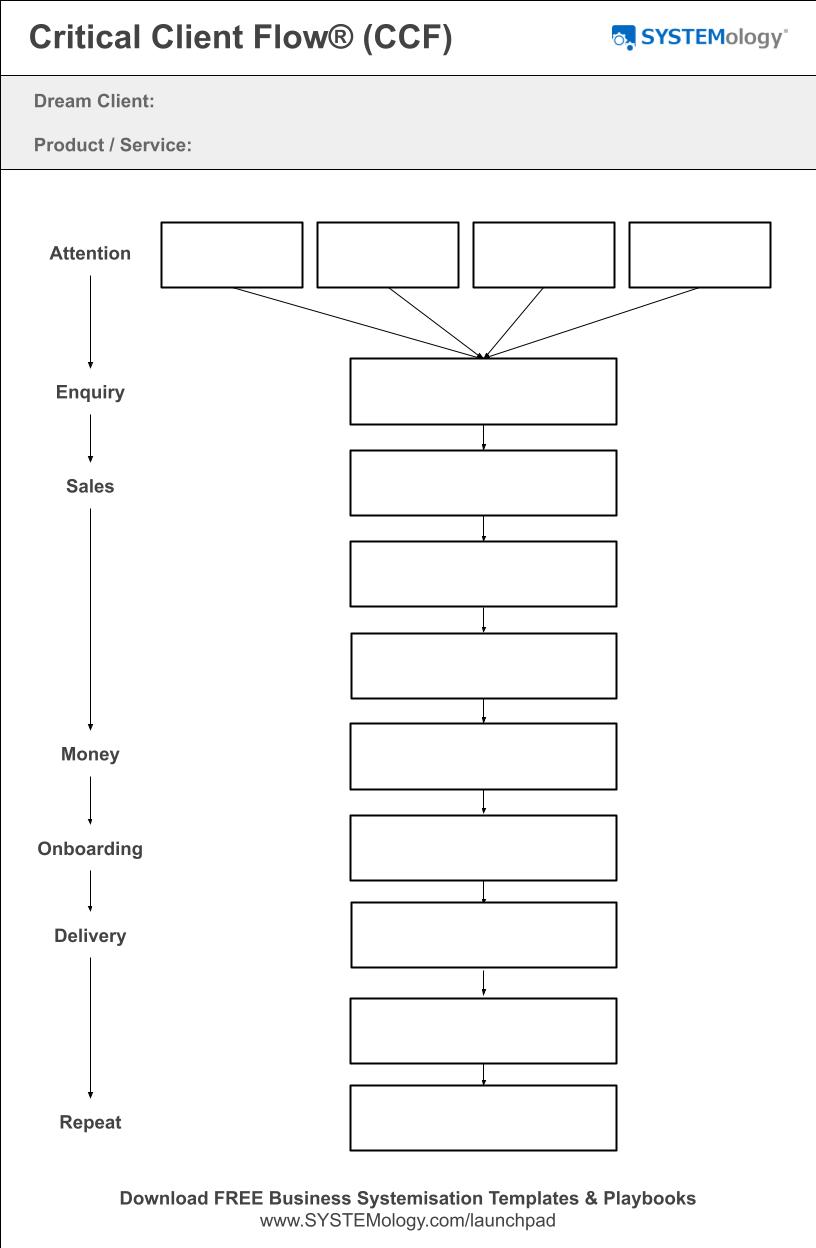
Ready to systemise your customer acquisition? Run the Owner Dependency Score to see how much of the marketing machine is currently running on your attention. Combine it with the Critical Client Flow template to map the full flow. Then install the rules with a systemHUB free trial.