Most small business owners treat quality and efficiency as a trade-off. Push harder on efficiency and quality slips; invest more in quality and efficiency slows. It's a forced choice that shows up in every operating decision, do we ship faster or ship better.
The trade-off is mostly a myth. It holds in some specific situations (manufacturing at scale, regulated work, genuinely complex creative output), but in the typical small business most of the time, quality and efficiency move together. The systems that produce consistent quality usually also produce faster throughput, because the same thing, documented standards, removes both errors and hesitation.
This article walks through five easy wins that lift both quality and efficiency at the same time. Each one is implementable in a single week. Collectively they recover significant operational capacity without any trade-off. The businesses that install them stop arguing about quality-vs-speed because the argument stops being relevant.
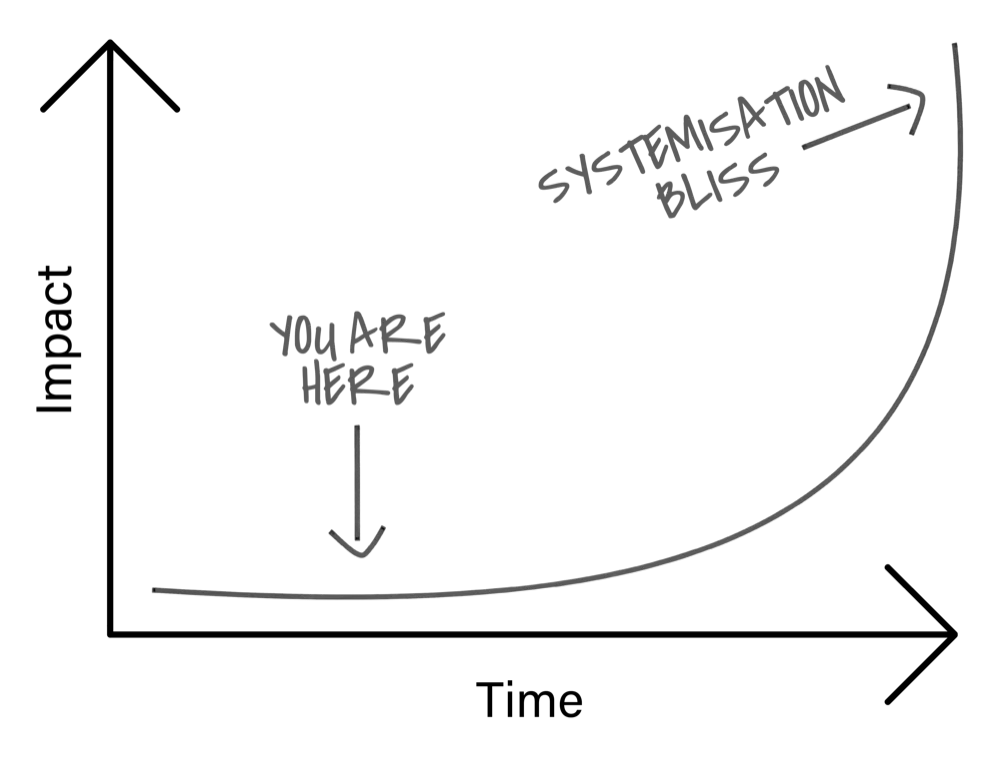
Why quality and efficiency usually move together
Three reasons the "trade-off" breaks down in practice.
First, rework is the biggest efficiency killer in most small businesses, and rework is almost entirely a quality problem. When the first version of the work is correct, nothing has to be redone. When the first version is sloppy, the team spends time fixing what they already produced. Quality discipline at the front of the workflow produces efficiency at the back.
Second, documented standards eliminate hesitation. Team members who know the expected quality bar move faster because they don't spend time wondering what "good" looks like. Ambiguity is the hidden tax on small business throughput. Remove the ambiguity with a documented standard and both quality and speed improve simultaneously. (See characteristics of good business systems for the broader pattern.)
Third, quality issues compound into customer friction, which compounds into time spent handling complaints, which compounds into team morale erosion, which further degrades quality. Break that loop at quality and you recover efficiency at every downstream step. It's one of the cleanest compounding effects in small business operations.
The practical implication: stop treating quality and efficiency as competing priorities. They're the same priority expressed two different ways.
The 5 easy wins
1. Pick three deliverables, write a one-page quality standard for each. The three most important outputs your business produces, the ones that represent most of customer value or most of delivery risk. For each, write a one-page document: what "excellent" looks like, what "acceptable" looks like, what "unacceptable" looks like. Train the team against it. Quality improves because the standard is explicit. Efficiency improves because the team stops guessing.
2. Install peer review for one critical workflow. Pick the workflow where quality variance is currently costing you most. Add a peer review step, one team member reviews another's output against the documented standard before it ships. 15 minutes per peer review. Catches 80% of the errors that currently ship to clients. The peer review feels like it adds time; in practice it removes more time by preventing downstream rework than it costs upstream.
3. Eliminate one rework cycle by fixing the upstream cause. Every small business has a repeated rework pattern, the same type of mistake keeps happening and getting fixed. Don't fix the mistake. Fix the upstream cause. Usually an undocumented handoff, a missing template, or a vague brief. One fixed upstream cause eliminates dozens of downstream rework cycles over the following year. (The 5-Whys tool is the fastest way to find the upstream cause; the fix-it factory teardown is the fuller approach.)
4. Standardise your most-used template. Whatever your team produces most often, proposals, invoices, reports, client emails, there's usually a version of it that the best team member writes. Make that version the template. Every future instance starts from that version. Quality floor rises because everyone starts from the best example. Speed rises because the writer doesn't start from blank. Two wins, one move.
5. Install a weekly quality review with the team. 15 minutes a week, same time, same agenda. What quality issues surfaced this week. What's the upstream cause. What's the fix. Who owns it. When will it ship. This isn't a blame meeting; it's a design meeting. The team surfaces issues because the rhythm is about improving the system, not grading the people. Over 90 days this single rhythm produces more quality improvement than any external audit.
Five wins. Each one implementable in a week. Collectively they transform the quality-vs-efficiency conversation in a small business.
Ryan Stannard and Stannard Family Homes: the quality-efficiency flywheel
Ryan Stannard runs Stannard Family Homes, a mid-scale Australian home builder that has systemised its way to $15M+ in revenue while preserving the customer experience and build quality that drive its referral engine. Building custom homes is an industry where the quality-efficiency trade-off feels inescapable, every project is different, every site has surprises, every client has opinions.
Ryan's operation demonstrates why the trade-off breaks down when you install the right systems. The firm has documented quality standards for every stage of the build. Peer review is built into project progression. Rework-cycle root causes are tracked and eliminated. Templates exist for every major client-facing document. A weekly team rhythm surfaces quality issues before they compound into disputes.
The result, visibly: a builder who can deliver custom homes at a consistent quality level that would be hard to maintain at the firm's size, with a referral-driven sales pipeline that doesn't require Ryan's direct sales effort. Quality and efficiency stopped being a trade-off in his business because the operational discipline around the five easy wins above was installed early and maintained consistently. That's what makes Stannard Family Homes a reliable case study for builders who want to scale without the quality degradation most of their competitors suffer.
What the easy wins have in common
Look at the five wins. They're all documentation-and-rhythm moves. None of them require new hires, new software, or budget. All of them require a Systems Champion with the discipline to install and maintain them.
This is the unlock most small businesses miss. They think quality requires investment and efficiency requires harder work. In practice, both require installation, documented standards, designed rhythms, named owners. The investment is attention. The return is a business where quality and speed compound together instead of trading off.
The businesses that install these five moves stop having the quality-vs-efficiency conversation entirely. It's not a resolved debate in their operation; it's an obsolete framing. They produce excellent work quickly because the system produces both from the same source.
The easy win
Pick the one win from the five that fits your business best this week. Don't do all five simultaneously, you'll burn out the team and install none of them well. One win, this week, installed cleanly.
Most small businesses that try this process find that the first week's win surfaces the next one naturally. You install quality standards for three deliverables; the team immediately notices a handoff that was producing the most rework; the next week's move is fixing that handoff. Momentum compounds.
Within 90 days of starting the process, all five wins are typically installed. Within 12 months, the quality-efficiency flywheel is running. Within 24 months, the business is notably better than category peers on both dimensions, which, in most markets, is a moat competitors can't replicate without the same underlying installation discipline.
Ready to quantify what quality-efficiency compounding is worth to your business? Run the Business Valuation Calculator, buyers pay premium multiples for businesses with demonstrated operational discipline. Pair it with the Systems Strength Test to see where the easy wins are hiding in your current operation. Then install the rhythms with a systemHUB free trial.