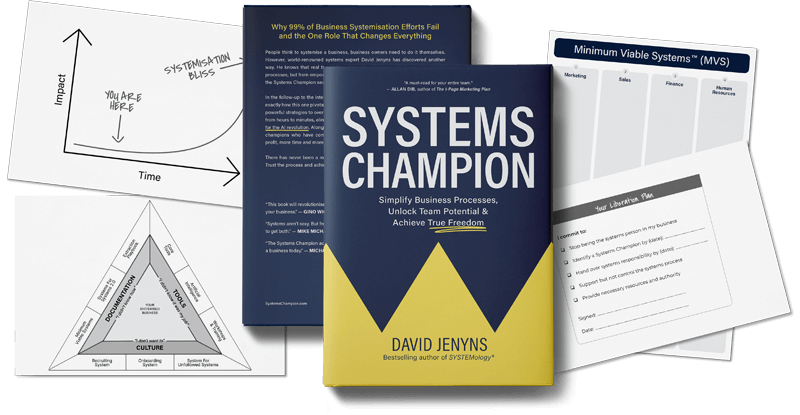
A Systems Champion is a dedicated team member who takes ownership of documenting, organising, and driving the systemisation of your business. They are the person who makes systems happen while the business owner focuses on vision and growth. They are not the owner. That distinction is the most important thing in this entire article.
If you've ever tried to document your business processes and stalled, the reason is almost certainly that you tried to do it yourself.
Why Is the Business Owner the Wrong Person to Lead Systemisation?
This sounds counterintuitive. The owner cares more about the business than anyone. They know how everything works. They're the most motivated person in the room. So why shouldn't they lead the documentation effort?
Because it's not what they're built for.
Business owners are visionaries. They see opportunities, think in possibilities, and are built to spot the next big move. Asking them to sit down and write step-by-step procedures is like asking a sprinter to run a marathon. They can do it, but it's not their strength and they won't sustain it.
According to a Gallup study, only 18% of managers demonstrate high talent for detail-oriented execution. Most business owners fall into the other 82%. That's not a weakness. It's a feature. Your business needs your visionary energy. What it doesn't need is for you to get bogged down in process documentation.
This is why most systemisation attempts fail. The owner starts strong, gets pulled into daily operations, and the documentation project stalls. The SOPs gather digital dust. The standards get ignored. Sound familiar?
The fix is simple: assign someone else to lead it.
What Does a Systems Champion Actually Do?
The Systems Champion is responsible for the entire systemisation lifecycle. Here's what that looks like in practice:
Define what to document. Working with the business owner and team leaders, the Systems Champion identifies which processes to systemise first using the Critical Client Flow framework. This focuses on the 10 to 15 most critical processes rather than trying to document everything.
Assign knowledgeable workers. The Systems Champion identifies who on the team does each process best. These are the "knowledgeable workers" whose expertise gets captured and documented.
Extract the knowledge. The Systems Champion records the knowledgeable worker doing the task. Video, screen capture, or interview. Then they convert that recording into a written, step-by-step procedure.
Organise and store. All systems get centralised in one place (like systemHUB) so they're accessible at the point of need. No more scattered Google Docs.
Drive adoption. Documentation is only half the job. The Systems Champion builds a systems-thinking culture, trains the team, and makes sure processes actually get followed.
Maintain and improve. Systems are living documents. The Systems Champion keeps them current, identifies gaps, and continuously improves how work gets done.
In short, they do the work that the business owner knows needs to happen but never gets around to doing.
Who Makes a Good Systems Champion?
You don't need to hire someone new. In most cases, the right person is already on your team. Here's what to look for:
Detail-oriented and organised. They naturally create structure. They're the person who keeps lists, follows through on tasks, and notices when something is out of place.
Good communicator. They'll be interviewing team members, writing procedures, and training people on new systems. They need to be comfortable talking to everyone in the business.
Follow-through. The Systems Champion role requires consistent, sustained effort. Not a burst of enthusiasm that fades after two weeks. Look for someone who finishes what they start.
Not necessarily a manager. Some of the best Systems Champions are operations coordinators, executive assistants, or junior team members with the right mindset. The role is about drive and organisation, not seniority.
Willing to learn. The Systems Champion doesn't need to know everything about every process. They need to be skilled at extracting knowledge from the people who do.
A common job title that aligns well: operations coordinator, office manager, executive assistant, or project manager. But the title matters less than the traits.
How Eryn Stannard Became a Systems Champion at 18
The most compelling Systems Champion story I know comes from Stannard Homes, a construction firm run by Ryan Stannard.
Ryan was a classic tradie-turned-owner. He was the expert, and the business was stuck in the owner's trap. Every question, every decision ran through him.
The breakthrough was appointing his daughter Eryn as the Systems Champion. She was 18 with no construction industry experience. But she had the right mindset: organised, detail-oriented, and willing to learn.
Eryn started by mapping the Critical Client Flow and documenting core processes in systemHUB. When the interior designer quit, Eryn stepped in, rewrote the systems for that role, and was successfully running it within months. She progressively took over more areas of the business, including HR and accounts, systemising each one as she went.
Today, Eryn is the assistant manager of a $15M company at 21. Ryan takes 7-week holidays knowing the business runs on the systems Eryn built. They're even planning to launch a new business arm by copying and pasting their existing systems.
That's the power of the Systems Champion role. It doesn't require industry expertise. It requires the right person with the right traits and the authority to drive the project forward.
What About AI? Does a Systems Champion Still Matter?
More than ever. AI makes documentation faster, but someone still needs to lead the effort.
AI can transcribe a video recording into an SOP in minutes. AI can reformat messy documentation into clean, consistent procedures. AI can generate training materials from your documented processes.
But AI can't decide which processes to document first. AI can't build a systems culture in your team. AI can't interview a knowledgeable worker and ask the follow-up questions that capture the nuance of how things really get done.
The Systems Champion of 2026 is really a Systems and AI Champion. They harness both the human skills (interviewing, organising, driving adoption) and the AI tools (transcription, formatting, training generation) to systemise your business faster than either could alone.
This is the approach I cover in my book The Systems Champion and in my keynote, The AI-Systems Playbook. The principle is simple: process first, then AI.
How to Appoint Your Systems Champion This Week
Here's the practical plan:
1. Identify the person.
Look at your team through the lens of the traits above. Who is detail-oriented, organised, and finishes what they start? You probably already know who it is.
2. Have the conversation.
Explain the role, the time commitment (typically 5 to 10 hours per week), and the impact it will have on the business. Frame it as a career opportunity, not an extra task.
3. Give them the tools.
Start with the Critical Client Flow to identify the first 10 to 15 processes. Give them access to a central platform like systemHUB. And give them a copy of The Systems Champion book as their playbook.
4. Set the boundaries.
The owner sets the vision and the priorities. The Systems Champion executes. Resist the urge to micromanage or take back control. Your job is to support, not to do.
5. Review weekly.
A short weekly check-in (15 to 20 minutes) to review progress, remove blockers, and celebrate wins. This keeps momentum without the owner getting dragged into the details.
The Bottom Line
The Systems Champion is the most important hire (or promotion) you'll make in your systemisation journey. Not because they have the most expertise, but because they have the drive, the organisation, and the authority to make systems happen while you focus on growing the business.
Every business that has successfully systemised, from dog daycares to $15M construction firms, has had a dedicated person driving the process. The businesses that stall are the ones where the owner tries to do it themselves. If you want to reduce owner dependency, this is where it starts.
Find your Systems Champion. Give them the playbook. Get out of the way.