Every single hour of operational work in a small business contains improvement opportunities.
The team running that hour sees most of them, they feel the friction, notice the redundancy, spot the handoff that almost failed, recognise the customer question that shouldn't have needed asking. What they rarely have is a mechanism for capturing those observations and turning them into actual improvements. The observation happens, the hour ends, and the opportunity evaporates.
The cost of evaporated opportunities, compounded over a year across an entire team, is enormous. It's usually the single largest untapped source of operational improvement in any given small business, larger than process consultants, larger than software upgrades, larger than almost any external intervention. The team already knows what would make the business work better. They just don't have the system that lets their knowledge become operational change.
This article is about that system. What it looks like, how to install it, and why most small businesses leave this value entirely on the table.
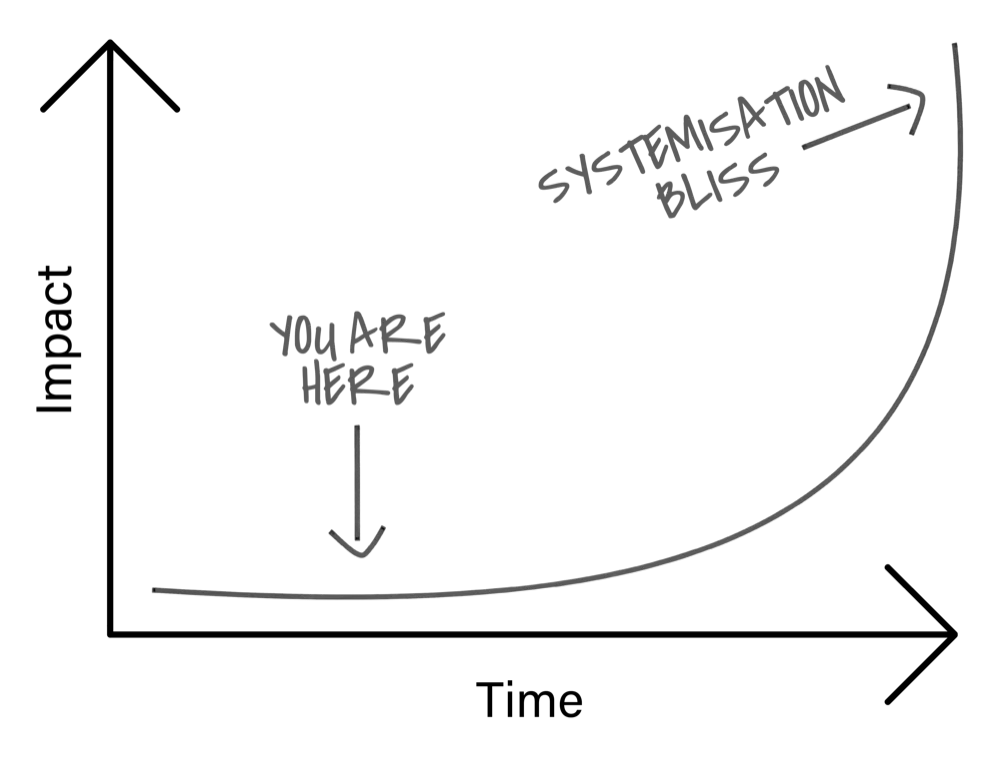
Why opportunities evaporate in most small businesses
Four structural reasons, each fixable with design.
There's no capture mechanism. The team notices something and has nowhere to put it. They mention it to a colleague in passing, it gets a sympathetic nod, and nothing happens. Without a specific place and moment where observations become tracked items, they stay as shared mutterings that fade within days.
There's no triage rhythm. Even when observations get captured, without a regular review cadence they accumulate and overwhelm. A backlog of 200 unreviewed suggestions feels useless to everyone, which guarantees new suggestions stop coming because contributors learn the suggestions go nowhere.
There's no action authority. Observations that surface structural issues the team can't fix alone need leadership attention. Without a clear path from observation to owner attention, structural issues get flagged, ignored, and eventually stop being flagged because the cost-benefit on the contributor is negative.
There's no closed loop. When improvements do get made, the team that flagged them often doesn't hear about the result. The contribution feels anonymous, which reduces future contributions. Without visible acknowledgement of which observations drove which improvements, the innovation system starves itself of input.
Fixing all four is what turns the team's continuous observational capacity into an actual innovation engine. None of the four requires software or budget. All of them require design.
The 5-part opportunity capture system
1. The capture channel. One specific place, a shared doc, a Slack channel, a form, a regular asynchronous thread, where anyone on the team can log an observation in under 60 seconds. Low friction is load-bearing; any more than a minute of overhead and most observations won't be logged.
2. The weekly triage. The Systems Champion spends 30 minutes a week reviewing the week's captures. Each one gets categorised: immediate fix (someone owns it this week), systemic issue (someone owns it this quarter), thanks-but-not-this (acknowledged, not actioned). Without the triage, the channel becomes a graveyard.
3. The owner escalation path. Systemic issues that need leadership authority to fix get brought to the owner monthly in a structured 30-minute review. Not every observation; the surfaced structural ones. This is where the team's operational knowledge reaches the level where it can drive strategic change.
4. The action commitment. Every "immediate fix" and "systemic issue" gets a named owner, a specific fix, and a commitment date. "We'll think about it" is not an action. Actions that don't get committed with owner + date don't ship, which over time teaches the team that contributions don't matter.
5. The closed-loop update. Monthly, the Systems Champion publishes a short digest to the team: this month we fixed X, Y, Z, surfaced by A, B, C. The update takes 15 minutes to write and is one of the highest-leverage culture signals an operation sends. It tells the team their observations shape the business, which is what sustains the flow of observations.
Five components. None of them require more than a standard operational toolkit. Together they convert the team's latent observational capacity into a reliable flow of operational improvements. Most small businesses are missing three or four of the five and wonder why their team "doesn't surface issues."
Jose Carrera and All-Inclusive Care: opportunity capture in field services
Jose Carrera runs All-Inclusive Care, a US facility services and cleaning operation that's grown from a single-operator to a multi-crew business serving commercial and residential clients across multiple locations. Field services is an especially interesting innovation-capture case because the team is dispersed geographically, working on-site at customer locations, with limited synchronous time to discuss observations.
Jose's operation has systematised the capture-and-triage rhythm despite that dispersion. Crews log observations digitally after each shift, friction points, recurring issues, suggestions from clients, near-miss incidents. The operational lead runs weekly triage. Systemic issues escalate to Jose in a structured monthly review. Every fix that lands gets credited back to the crew that raised it. The system works asynchronously, which is what makes it possible to run at all in a distributed field operation.
The result, over years, is a facility services business with retention and operational consistency that competitors in the category struggle to match. Part of the reason is that the people closest to the work, the cleaners on-site, the crew leads coordinating logistics, are genuinely participating in running the business rather than just executing instructions. Their observations drive improvements. The improvements compound. The team stays because the work gets better.
What gets surfaced when the capture system runs
Four categories dominate, in roughly this order of frequency.
Handoff failures. Work moving from one person or team to another produces the most common observations because that's where ambiguity lives. Better briefs, clearer formats, defined acceptance criteria, all surfaced through the capture system faster than any external consultant would find them.
Customer friction the team notices but doesn't own. The team hears things from customers that never reach the owner. "Clients keep asking us why they have to fill out this form twice." "The invoice format is confusing to our largest account." Without capture, this intelligence stays in the field. With capture, it drives product and process design.
Wasted recurring time. "I spend 30 minutes every Friday on X and I'm not sure why we still do it." Reviewed through a systemic lens, these observations usually trace to a workflow that made sense earlier and hasn't been updated. Deletion candidates surface continuously when the team has a place to name them.
Near-miss incidents. Things that almost went wrong but didn't. Near-misses are predictive of future real incidents and are usually invisible to leadership without a capture system. The team that logs near-misses produces a much smaller tail of actual incidents over time, because the structural gaps get closed before they produce customer-visible damage. (Related: how to solve business problems treats near-miss analysis as a specific diagnostic discipline.)
These four categories account for most of the value the capture system produces. The value is not in the individual observations; it's in the compounding effect of reliably surfacing them week after week for years.
Getting started
Installing the system takes under a week of setup time. Week one: create the capture channel, brief the team on the five-component rhythm, appoint the Systems Champion (or delegate) to own the triage. Week two: run the first triage. Week three: run the first monthly escalation to the owner. Month one: run the first closed-loop update to the team.
Within 30 days the system is live. Within 90 days the team has learned that contributions lead to actions and the flow of observations is genuinely useful. Within a year the capture system is one of the most valuable operational disciplines in the business, producing dozens of small improvements that compound into operational advantage.
The cost is measured in minutes per week, not hours. The return is measured in percent-of-revenue operational capacity recovered. It's one of the best-ROI operational moves a small business can make, and almost no small business has installed it, which is why the opportunities genuinely are endless, at least for the businesses willing to capture them.
Ready to see what your team already knows? Run the Owner Time Audit to see how much of your week is going to fire-fighting issues the team would have surfaced earlier if they had a capture channel. For a broader operational diagnostic, try the Systems Strength Test. Then house the capture-and-triage rhythm in a systemHUB free trial.