The Hiring Trap
Here's what most business owners do when they hit a growth ceiling: they hire.
Revenue is growing. The team is stretched. Deadlines are slipping. So the natural response is to add another person. Then another. And another.
But here's what usually happens next. Costs go up. Complexity goes up. The owner spends more time managing people than doing the work that grew the business in the first place. And somehow, despite having a bigger team, things don't feel any easier.
This is what I call the hiring trap. The belief that growth requires more people.
It doesn't. Not always.
After building, systemising, and exiting three businesses, I've learned that the real bottleneck is rarely a lack of staff. It's a lack of documented systems.
The Real Bottleneck
Think about the last time a new hire started at your company. How much of their onboarding was structured? How much was "shadow Sarah for a week and figure it out"?
When knowledge lives in people's heads instead of documented processes, every new hire is starting from scratch. They're learning by osmosis, making mistakes that have already been solved, and asking questions that should have been answered in a system.
The result? You need more people to get the same amount done. Your team is busy, but not efficient.
The real question isn't "who should I hire next?" It's "what should I document next?"
The SYSTEMology Approach
When I built Melbourne SEO Services, I hit this exact wall. I had a great team, but every decision still ran through me. I was working 60+ hours a week and the business couldn't grow beyond my personal capacity.
So instead of hiring more people, I did something different. I documented the 10 to 15 most critical processes in the business. I used a framework I now call the Critical Client Flow, which maps how your business delivers value from the moment a prospect finds you through to repeat business.
Here's the key: I didn't do the documenting myself. I assigned a Systems Champion, a detail-oriented team member, to lead the effort. She recorded our best performers doing the work, then turned those recordings into step-by-step procedures.
Within months, the business was running without me in the middle of everything. I hired a CEO, stepped away, and the business kept growing. Not because I added more people, but because the people I had could finally operate without needing me.
Proof It Works: Stannard Homes
I see this pattern repeated across the businesses I've coached.
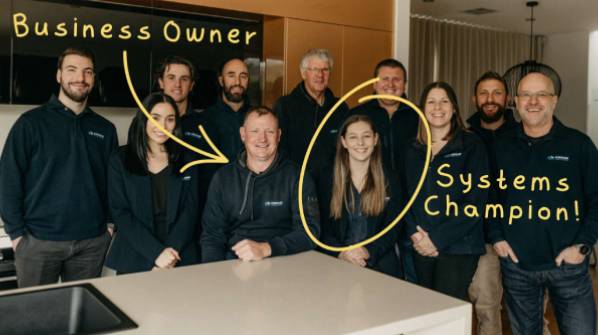
Ryan and Eryn Stannard run a construction firm. When they started implementing systems, they had 7 staff and Ryan was involved in every project. He couldn't take a day off without his phone ringing.
After documenting their critical processes, they doubled their headcount to 15 staff, but here's the part that matters: Ryan now takes extended holidays. Eryn is ready to run operations independently. The systems made scaling possible without the chaos that usually comes with it.
They didn't just hire more people. They built the systems first, then hired into a structure that could absorb new team members without breaking.
Five Systems to Document Before You Hire
If you're feeling the pressure to hire, pause. Document these five systems first:
1. Client onboarding
How does a new client go from signed proposal to fully set up? If this process lives in someone's head, every new client is a reinvention. Document it once and every future onboarding runs the same way.
2. Service delivery
What are the steps to deliver your core offering? Whether you're a tradie, a consultant, or a digital agency, there's a repeatable process behind what you do. Capture it from your best performer.
3. New employee onboarding
Before you hire, make sure you have a system for getting new hires productive fast. If onboarding takes 3 months because there's no documentation, that's 3 months of salary before they're contributing.
4. Sales process
How does a lead become a client? Document the steps, the scripts, the follow-up cadence. A documented sales process means you can delegate sales without losing conversion rates.
5. Quality control
How do you check that the work meets your standard? Without a quality system, the owner becomes the bottleneck again, reviewing everything before it goes out the door.
These five systems alone can free up 10 to 20 hours a week for most business owners. That's time you can reinvest in growth rather than spending it on another salary.
How AI Changes the Equation
Here's where things get really interesting. Once your processes are documented, AI can accelerate them dramatically.
But there's a catch. You have to document first. I say it all the time: automating chaos produces faster chaos.
AI can't improve a process that doesn't exist on paper. But once it's documented, AI can help with:
- Converting video recordings into written SOPs automatically. Record your best performer once and AI generates the step-by-step documentation.
- Onboarding new hires faster. AI-powered training materials adapt to each new team member's questions.
- Spotting bottlenecks. AI can analyse your documented processes and identify where time is being wasted.
The sequence matters. Process first, then AI. This is the approach I cover in my keynote "The AI-Systems Playbook", and it's the biggest shift I'm seeing in businesses right now.
The Bottom Line
Growth doesn't require more people. It requires better systems.
Document what your best people already do. Get it out of their heads and into a repeatable process. Then use those systems to make your existing team more effective, onboard new hires faster, and eventually layer in AI to multiply the output.
The businesses that scale without burning out all have one thing in common: they built the systems before they built the headcount.