You reduce owner dependency by documenting what your best people already do, assigning someone other than yourself to lead the effort, and building repeatable systems that let the business operate without you in the middle of everything. It's not complicated. But most business owners get it backwards.
They try to do the documenting themselves. They try to document everything at once. And they burn out before any of it sticks.
I know because I was that owner. I built Melbourne SEO Services into one of Australia's most trusted digital agencies, and I was completely trapped by it. Every decision, every client issue, every new hire needed my input. I was working 60+ hours a week and the business couldn't grow past me.
It took a framework, a mindset shift, and one critical hire to change everything.
Are You the Bottleneck? Five Signs of Owner Dependency
Before we get into the solution, here's a quick diagnostic. If three or more of these are true, your business is owner-dependent:
- You can't take two weeks off without things falling apart or your phone ringing constantly.
- New hires shadow you (or a senior team member) for weeks because nothing is written down.
- Clients ask for you by name. Not your business. You.
- Your team escalates decisions that should be routine. They're not incompetent. They just don't have a system to follow.
- You've tried to document processes before and it stalled because you ran out of time or didn't know where to start.
According to a study by the Exit Planning Institute, over 80% of businesses that go to market don't sell. The number one reason? The business is too dependent on the owner. It has no transferable value.
Why Does Owner Dependency Matter?
This isn't just about lifestyle. Owner dependency affects four critical areas of your business:
Valuation. A business that depends on its owner is worth less. Buyers and investors want transferable systems, not a business that collapses when the founder leaves. Documented systems directly increase what your business is worth.
Burnout. Working 60+ hours a week is not sustainable. Research from Gallup shows that business owners who work more than 50 hours per week report significantly lower wellbeing scores. The grind catches up with everyone.
Growth ceiling. If everything runs through you, the business can only grow as fast as you can personally handle. You become the constraint. Systems remove that constraint.
Lifestyle. Missing family events, skipping holidays, checking your phone at dinner. Owner dependency doesn't just affect your business. It affects everything around it.
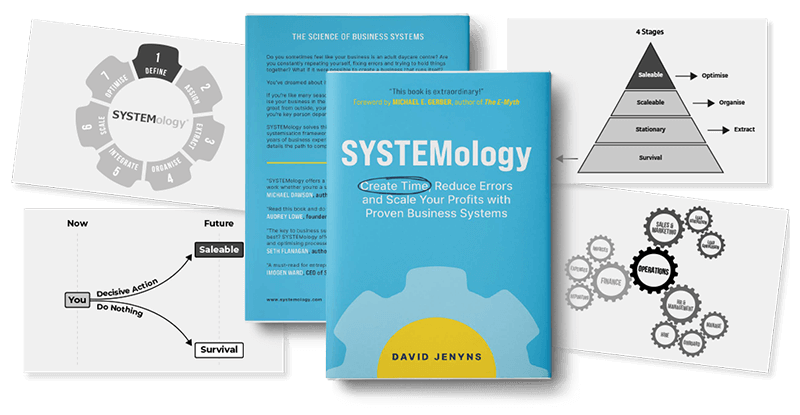
The SYSTEMology Framework: Seven Steps From Trapped to Free
When I finally escaped the daily operations of Melbourne SEO Services, I didn't do it by working harder. I followed a structured process that I've since refined into the SYSTEMology framework.
Here's the overview:
Step 1: Define
Identify the 10 to 15 most critical processes in your business using the Critical Client Flow. This maps how your business delivers value from first contact through to repeat business. It tells you exactly what to document first, so you're not trying to boil the ocean.
Step 2: Assign
This is the step most people skip, and it's the most important. Assign a Systems Champion to lead the documentation effort. Not you. A detail-oriented team member who can drive the project forward while you stay focused on the business.
Step 3: Extract
Your Systems Champion records your best performers doing the work. Video, screen capture, or interview. The knowledge comes out of people's heads and into a structured format.
Step 4: Organise
Store everything centrally in a platform like systemHUB so it's accessible at the point of need. No more scattered Google Docs or folders nobody can find.
Step 5: Integrate
Get the team on board. Build a systems-thinking culture where documentation is how things get done, not an extra task on top of real work.
Step 6: Scale
Expand beyond the Critical Client Flow to all departments. The Minimum Viable Systems framework targets roughly 42 systems across six departments.
Step 7: Optimise
Build dashboards, track performance, and continuously improve. Systems are living documents, not set-and-forget.
The full framework is covered in my book SYSTEMology and in the keynote I deliver at business conferences around the world.
How Jeanette Sold Her Business to PETstock
Jeanette Farren ran DiggiddyDoggyDaycare for 13 years. She served over 2,000 dogs and had built a profitable operation. But she was exhausted. She was working long hours in the business and her systems were, in her words, "all over the place."
After attending a SYSTEMology workshop, Jeanette got clarity on where to start. She documented her Critical Client Flow, centralised her systems in systemHUB, and built a team that could operate independently.
The result? She stepped out of daily operations completely. The business became so well-systemised that it attracted a corporate buyer. In 2019, DiggiddyDoggyDaycare was sold to PETstock for a high multiple of profit.
That sale doesn't happen without documented, transferable systems. The systems were the asset that made the business worth buying.

The Three-Month Phone Call
Here's my own version of that story.
In 2016, I had systemised Melbourne SEO Services to the point where I'd hired a CEO and stepped away from daily operations. Then Michael E. Gerber, the author of The E-Myth Revisited, called and asked me to drop everything for three months to help launch his final book.
Three months away from my business. No daily check-ins. No putting out fires.
The business didn't just survive. It kept growing. Because the systems held.
That experience proved to me that owner dependency is a choice, not an inevitability. If you build the right systems and put the right people in place, the business doesn't need you for every decision.
How Does AI Fit Into Reducing Owner Dependency?
AI accelerates everything I've described above. But only if you've documented your processes first.
I say it constantly: automating chaos produces faster chaos. AI can't improve a process that doesn't exist on paper.
Once your systems are documented, AI can help with:
- Converting video recordings into written SOPs. Record your best performer once and AI generates the step-by-step documentation.
- Onboarding new hires faster. AI-powered training adapts to each team member's questions and learning pace.
- Identifying bottlenecks. AI can analyse your documented processes and flag where time is being wasted.
The approach is always process first, then AI. I cover this in depth in my keynote, The AI-Systems Playbook.
Three Things You Can Do This Week
If you're feeling the weight of owner dependency, here's where to start:
1. Map your Critical Client Flow
Draw out the journey a client takes from first contact through to repeat business. Identify the 10 to 15 processes that matter most. Don't try to document everything. Just define what's critical.
2. Identify your Systems Champion
Look at your team. Who is detail-oriented, organised, and motivated to improve how things work? That person leads the documentation effort. Not you.
3. Record one process this week
Pick the process that causes the most headaches or takes the most of your time. Have your best performer do it while your Systems Champion records and documents it. One system documented is one less thing that depends on you.
The Bottom Line
Owner dependency is not a badge of honour. It's a business risk.
The businesses that scale, sell, and give their owners freedom all have one thing in common: documented systems that let the business run without any single person.
You don't need to document everything. You don't need to do it yourself. And you don't need to do it all at once. Start with the Critical Client Flow, assign a Systems Champion, and build from there. If you want to see how other business owners have done it, read about how to scale without hiring more staff using the same framework.