The Process Improvement Manager is the role most small businesses never hire.
They hire the sales person. They hire the delivery person. They hire the admin person. They hire the technical specialist. And then they spend years complaining that nothing in the business seems to actually improve, while sitting on the role that would fix exactly that.
The Process Improvement Manager is whose job it is to make sure the business gets better every week, not just bigger. In SYSTEMology we usually call the role a Systems Champion. Same function, different name. This article is about why that role exists, what it does, and why every growing small business needs one sooner than they think.
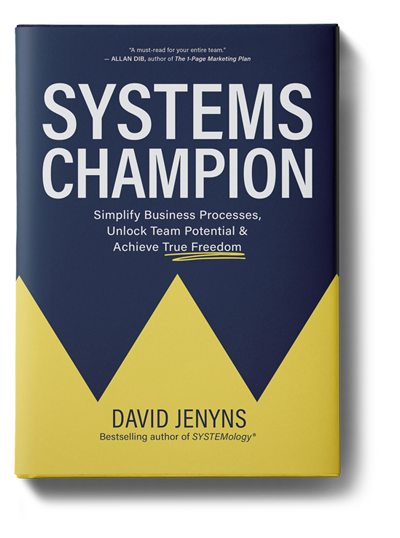
Learn more →
Why this role is missing in most small businesses
Three reasons.
First, the owner assumes it's their job. Systems improvement feels like strategic work, and strategic work lives with the owner. So the owner puts it on their list and never gets to it, because they're also doing sales, delivery, admin, hiring, and fire-fighting. The list keeps the item on it; the item never gets done.
Second, the role doesn't generate obvious short-term output. The sales person closes deals. The delivery person ships work. The Process Improvement Manager's output is a business that runs cleaner next quarter, which is harder to evaluate and easier to defer.
Third, most small businesses haven't seen a good version of the role in action, so they don't know what they're missing. When a business has one, the difference is obvious within six months. When they don't, they assume the friction is normal.
What a Process Improvement Manager actually does
Six responsibilities, none of which are "doing the work."
1. Owns the system library. Every documented process in the business has them as the ultimate custodian. They don't write every system (the practitioners do), but they make sure the library exists, is current, and is actually used.
2. Runs the quarterly review cycle. Fifteen minutes per system, four times a year. Still accurate? Still owned by the right person? Still delivering the intended result? This single habit keeps an entire library alive for decades.
3. Facilitates new system creation. When something in the business changes or a new process is needed, they convene the relevant people, facilitate the documentation, and make sure the new system enters the library with an owner and a review cadence.
4. Hunts system busters. Every quarter they walk the Critical Client Flow looking for the drag the team has adapted to, redundant approvals, broken handoffs, orphaned processes, meetings that don't decide. They surface these; the owner helps decide which to fix.
5. Runs training against the systems. New hires are trained against the documented systems, not by shadowing. When training reveals gaps, the Process Improvement Manager updates the system the same day.
6. Reports improvement to the owner. Monthly dashboard: systems updated, systems retired, busters fixed, training throughput. The owner sees measurable improvement without having to drive it personally.
Haley Santos and the DTC company that hired the role full-time
Haley Santos joined BiOptimizers, a direct-to-consumer supplement company, as their first dedicated Systems Champion. Not a part-time addition to an existing role. A full-time hire whose entire job was process improvement.
The decision to hire the role full-time is unusual for a small business. Most companies wait until they're well past 50 staff before creating the position, by which point the accumulated operational debt has compounded. BiOptimizers did it earlier, and their subsequent scale from 40 to 150 people is the evidence that earlier is better.
Haley's work was exactly the six responsibilities above. She owned the library. She ran the review cycle. She facilitated new systems as the team grew. She hunted busters across customer experience, content production, and internal operations. She built the training-against-systems culture that let new hires ramp in days rather than weeks. And she reported improvement monthly to the founder, who could see the operational machine getting better without having to drive it himself.
The result wasn't a flashier business. It was a business that scaled cleanly through headcount ranges most companies can't navigate without losing their customer experience. That's the payoff of the role, and it's almost impossible to get without someone dedicated to it.
Who to hire, or promote from inside
The best Process Improvement Managers are often already in your business.
Look for these traits:
- Meticulous about detail but not paralysed by it. Can see the small things that matter without getting stuck on perfection.
- Natural facilitator. Can sit with a practitioner and extract their process without taking over the work.
- Systems thinker. Sees the business as interconnected processes, not isolated tasks.
- Comfortable with documentation. Not as a chore, as a creative act.
- Authority through expertise, not title. The role works best when the person is respected by the team independently of the hierarchy.
Internal promotion usually beats external hire. The person who already understands your business, knows the team, and has earned trust will move faster than an external expert who has to learn all that from scratch. The exception is if you need the role full-time and no internal candidate can do it without abandoning their current function, in which case an external hire with systemisation experience is the right call.
The trap: asking the owner to do it
The most common failure is the owner deciding to be the Process Improvement Manager themselves.
They intend well. They book time each week to improve the business. They last about six weeks. Then the urgent work pushes the improvement work off the calendar, and the systems stop improving, and the owner blames themselves for lack of discipline.
It's not a discipline problem. It's a role problem. The owner's job is to run the business. The Process Improvement Manager's job is to improve it. Those are different jobs, done best by different people, at different rhythms. Owners who try to do both usually do neither well, and usually give up on the improvement role before anything compounds.
Hire it or promote it. Don't keep it in your own job description if you can possibly avoid it.
Who to hire this month
If you have 10+ staff and you're feeling the friction of accumulated operational debt, the role is overdue.
Start part-time if you can't justify full-time yet. One day a week, dedicated, protected. Find the internal candidate whose temperament fits and negotiate the time carve-out. Give them the SYSTEMology book, the Systems Champion role description, and three months to prove the pattern.
Within a quarter you'll have evidence either way. Either the business is measurably improving (fewer busters, tighter workflows, cleaner handoffs) or the role isn't working for some reason worth diagnosing. Both outcomes are useful. What doesn't work is leaving the role unfilled and hoping improvement happens anyway.
Want to give your new Systems Champion a home for every process they document? Try systemHUB free, the platform is built for exactly this role, with library visibility, review cadence, and usage tracking baked in. And for the full role definition, see what is a Systems Champion.