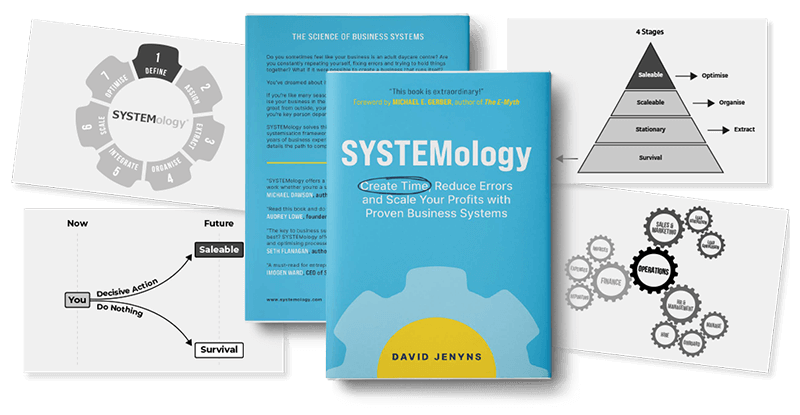
The single most important thing you can do to prepare your business for sale is to make it run without you. Buyers don't want to purchase a job. They want to purchase an asset. And an asset is a business with documented systems, trained teams, and operations that don't depend on any single person.
Over 80% of businesses that go to market don't sell. The number one reason, according to the Exit Planning Institute, is that the business is too dependent on its owner.
Why Do Most Businesses Fail to Sell?
When a buyer looks at your business, they're not just looking at revenue and profit. They're asking one critical question: "Will this business keep running when the current owner leaves?"
If the answer is no, the business is worth significantly less. In many cases, it's unsellable.
Here's what makes a business owner-dependent:
Key relationships live with the owner. If clients only trust the owner, those relationships walk out the door at settlement.
Critical knowledge is undocumented. If the owner is the only person who knows how the business operates, the buyer is purchasing a mystery, not a system.
Decisions funnel through one person. If nothing happens without the owner's approval, the business has no operational independence.
No second-tier leadership. If there's nobody who can run the business in the owner's absence, there's no business to sell.
According to a BizBuySell Insight Report, businesses with documented processes and management teams in place sell for 2 to 3 times higher multiples than owner-dependent businesses of the same revenue.
What Makes a Business Sellable?
Joanna Oakey, an M&A lawyer who hosts the Buy, Grow, Exit podcast, puts it simply: systems turn a business from a job into a transferable, valuable asset.
A sellable business has four things:
1. Documented processes
Every critical operation is written down, accessible, and followed by the team. A buyer can review these systems and see exactly how the business delivers value.
2. A team that can operate independently
The business has people in key roles who make decisions, manage clients, and deliver work without the owner's constant involvement.
3. Consistent, repeatable results
Revenue isn't driven by the owner's personal network or heroic effort. It's driven by systems that produce predictable outcomes.
4. Transferable intellectual property
The business's knowledge, methods, and competitive advantages are documented and owned by the business, not trapped in the owner's head.
These four elements increase both the valuation and the likelihood of a successful sale. They're also exactly what the SYSTEMology framework is designed to build.
How I Made Melbourne SEO Services Sellable
Let me share my own experience.
I built Melbourne SEO Services into one of Australia's most trusted digital agencies. But for years, the business was completely dependent on me. Every client issue, every strategic decision, every new hire needed my input.
If I'd tried to sell at that point, no buyer would have touched it. They would have been buying a business that collapses the moment I leave.
So I systemised. I mapped the Critical Client Flow. I assigned a Systems Champion to lead the documentation. I extracted knowledge from my best performers and centralised everything in a central platform. I hired a CEO and stepped away from daily operations.
Then Michael E. Gerber called and asked me to drop everything for three months. My business survived. It kept running. It kept growing. Because the systems held.
That's the moment I knew the business was sellable. Not because I wanted to sell it immediately, but because it could survive without me. That's what buyers pay a premium for.
How DiggiddyDoggyDaycare Sold to PETstock
Jeanette Farren ran DiggiddyDoggyDaycare for 13 years. She served over 2,000 dogs and had built a profitable operation. But she was exhausted and her systems were, in her words, "all over the place."
After attending a SYSTEMology workshop, Jeanette documented her Critical Client Flow. She centralised her processes in systemHUB and built a team that could operate independently.
The result? The business became so well-systemised that it attracted a corporate buyer. In 2019, DiggiddyDoggyDaycare was sold to PETstock for a high multiple of profit earnings.
Without documented systems, that sale doesn't happen. The systems were the asset that made the business worth buying. PETstock wasn't buying Jeanette's expertise. They were buying a machine that runs without her.
Five Steps to Make Your Business Sale-Ready
Even if you're not planning to sell tomorrow, building a sellable business gives you options. Here's where to start:
1. Map your Critical Client Flow
Identify the 10 to 15 most critical processes in your business. These are the systems a buyer would need to see to feel confident the business can operate without you.
2. Assign a Systems Champion
You need someone other than yourself driving the documentation effort. This role is essential for both systemisation and for showing buyers that the business has operational leadership beyond the owner. What is a Systems Champion?
3. Document and centralise
Get your processes out of people's heads and into a central platform like systemHUB. A buyer wants to see a single source of truth, not scattered Google Docs and tribal knowledge.
4. Build a management layer
Every sellable business has at least one person who can run operations in the owner's absence. If you don't have this person, developing a Systems Champion is often the first step toward building that layer.
5. Remove yourself from daily operations
Start stepping back. If you can take a month off and the business runs smoothly, you have a sellable business. If you can't, that's where the work needs to happen.
How Does AI Help With Exit Readiness?
AI accelerates every step of the preparation process.
Documented processes can be created faster using AI-powered transcription and formatting. Training materials can be generated automatically from your documented systems. Quality checks can be automated so the business maintains standards without the owner reviewing everything.
But the principle remains: process first, then AI. A buyer doesn't care about your AI tools. They care about the documented, repeatable systems underneath them. AI is the accelerator, not the foundation.
The businesses that are most attractive to buyers in 2026 are the ones that have documented systems enhanced by AI. That combination signals operational maturity and future scalability.
The Bottom Line
Preparing your business for sale isn't something you do in the final six months before listing. It's something you build over time by systemising your operations, developing your team, and reducing your personal involvement.
The businesses that sell for premium multiples all have one thing in common: they run without the owner. Documented systems, trained teams, and operational independence.
Whether you plan to sell next year or in a decade, building a sellable business gives you the ultimate freedom. The freedom to choose. Sell if you want to. Stay if you want to. Take a three-month holiday if you want to. The systems hold either way.
Start with the Critical Client Flow. Assign a Systems Champion. Get yourself out of the middle. The rest follows from there.