Business owners ask me one question more than any other.
"Is systemising my business actually worth the effort?"
It is a fair question. Documenting processes is not what most founders got into business to do. It is not glamorous. It does not feel urgent. It sits somewhere between filing your tax return and tidying the shed, on the list of things you know you should do but keep avoiding.
So before we talk about how to systemise your business, you need to know what systemising actually gets you. Not the vague stuff like "efficiency" or "scalability". The concrete, measurable outcomes that change what it feels like to run the business.
After working with thousands of business owners through SYSTEMology, I can tell you the outcomes are remarkably consistent. Seven of them, to be exact. Every one of them starts showing up once your team stops depending on you for every decision and starts following documented systems.
Why "should I systemise?" is the wrong question
Here is the reframe that tends to land with business owners.
You are already paying the cost of NOT having systems. Every day. In ways you have probably stopped seeing.
Missed deadlines. Duplicate work. New hires who take six months to get productive. Work that only you can do, which means work that stops when you take a holiday. Customer service that varies depending on who picks up the phone. Errors that somehow keep recurring even though "we talked about that."
None of this is free. All of it is eating into your time, your margins, and your sanity.
Before we go any further, see what your current cost of chaos looks like in real dollars.
That number is real. It is being subtracted from your profit every single month. And the only way to take it back is to systemise.
The compounding principle
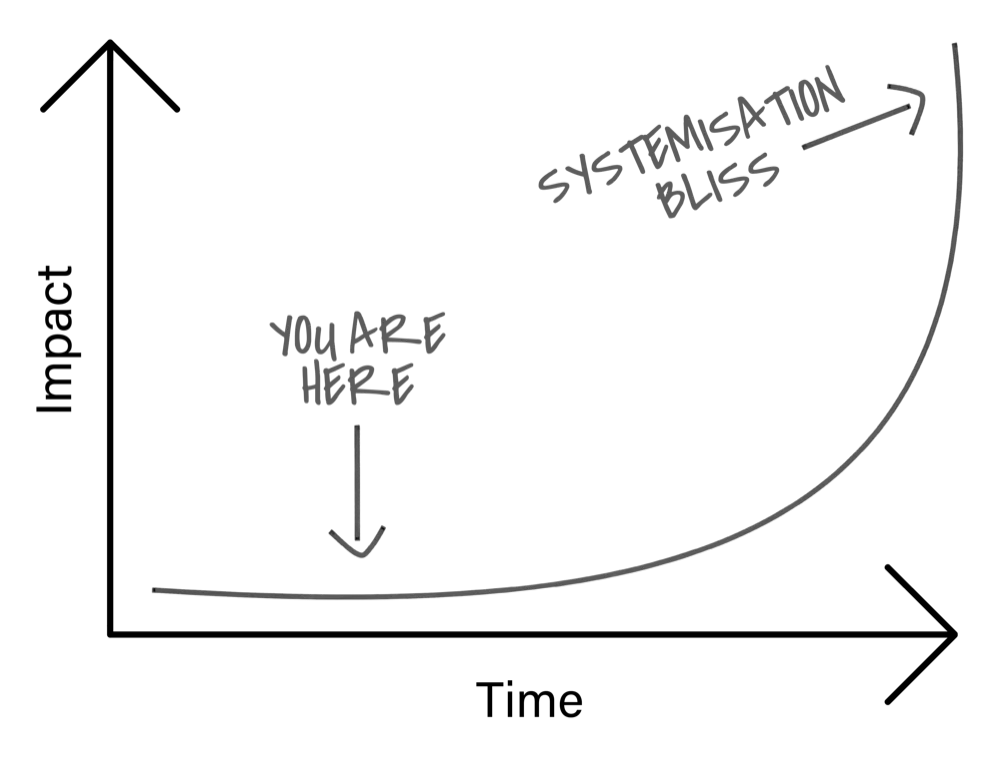
Here is the part most business owners miss: the outcomes of systemisation compound.
Einstein is supposed to have called compounding the eighth wonder of the world. Whether he actually said it or not, it applies beautifully to business systems.
One documented system on its own saves a little time. Maybe 10 minutes here, an hour there. Small. Easy to overlook. Easy to dismiss.
But systems do not work alone.
That onboarding system is feeding your welcome sequence, which is feeding your service delivery, which is feeding your feedback loop. Each one makes the others stronger. Ten good systems saving five minutes each is not 50 minutes saved. It is a business that runs 10x faster, because the systems multiply each other's impact.
This is why business owners who systemise properly do not just see a slightly better business. They see a completely different business. The kind that can be run in 10 hours a week, or sold for a real multiple, or handed to a manager while the owner launches the next thing.
Seven outcomes, all compounding. Here is what they actually look like.
1. Scale without hiring
The first outcome most owners notice is that their team starts producing more, without growing the headcount.
This sounds counterintuitive. "Scale without hiring" feels like a contradiction. It is not.
Every business has a gap between what the team is capable of producing and what the team actually produces. That gap is filled by friction — things that slow people down. Unclear instructions. Interrupted work. Meetings about work that should have been documented. Rework. Duplicate tasks.
Systems close that gap. Same team, same hours, significantly more output.
The businesses I watch scale fastest are not the ones hiring aggressively. They are the ones where the existing team's output keeps rising because the systems keep improving. Hiring happens when it is genuinely needed, not as a band-aid for undocumented chaos.
Read the full breakdown in How to scale without hiring more staff.
2. Reduce your dependency on the owner
The owner is the bottleneck in almost every small business.
If the owner goes on holiday, sales slow. Decisions wait. Problems pile up. The business runs on the owner's tacit knowledge, and when the owner is not there, that knowledge is not.
Systemisation is how you break this pattern.
Documented systems capture the owner's thinking and make it usable by the team. The team starts making the calls the owner used to make, because they know how. New hires ramp up in weeks instead of months. Problems get handled without reaching the owner's desk.
A systemised business is one where the owner can disappear for two weeks and come back to a business that hasn't missed a beat.
That is the kind of freedom you systemise for.
For the full framework, see How to reduce owner dependency in your business.
3. Increase profit
Systems lift profit in ways most owners do not expect.
Yes, they cut waste. Yes, they reduce errors. Both of those hit the bottom line. But the bigger profit story is what happens when your team can focus on higher-value work because the routine work is running itself.
When your best people are not bogged down in low-value tasks, they do the work that actually moves the business forward. Sales. Client relationships. Strategic decisions. Creative problem solving. The work that humans do best.
That work is what drives profit, not the endless cycle of putting out fires and checking whether routine tasks got done.
For the 10 concrete ways systems increase profit, see How business systems directly increase profit.
4. Cut costs without hurting the customer
Most cost-cutting initiatives hurt the customer. Lower-quality materials. Slower response times. Less experienced staff. Fewer people.
System-driven cost reduction is different.
It takes the cost out of the business without the customer ever noticing. Duplicate steps get removed. Error rates drop. Rework disappears. Tasks that used to eat an hour a week now take fifteen minutes, without sacrificing anything the customer cares about.
The best businesses I work with cut costs and improve customer experience at the same time, because both live in the same systems. Fix the system, and both improve.
Full breakdown at How to cut business costs with better business systems.
5. Move faster than your competitors
Speed is an underrated competitive advantage.
Not working longer hours. Not rushing people. Operational speed — the time from prospect enquiry to delivered value, from customer question to resolved answer, from opportunity spotted to opportunity captured.
Systemised businesses move faster because the team does not waste time figuring out what to do. The process is documented. The handoffs are clean. The decisions that need to happen at each stage happen automatically.
In my digital agency days, when we rolled out systems for client onboarding, our lead-to-first-deliverable time dropped by over 60 percent. Same quality. Fewer back-and-forth emails. Clients noticed. So did the referrals.
More at How to increase business speed and efficiency.
6. Solve problems at the root
Most business problems are the same problems, over and over.
The same complaints from clients. The same mistakes from the team. The same fires you are putting out this month that you put out last month and the month before.
In a chaotic business, these problems look like people problems. Someone messed up. Someone dropped the ball. Someone needs to do better.
In a systemised business, they look like what they actually are — system problems. The process that produced the problem needs improving. Once you see it this way, you can actually fix it.
The recurring fires stop recurring. Not because your team is miraculously more careful, but because the system no longer lets the problem happen.
See How to solve business problems and how systems reduce business problems for the full playbook.
7. Build a business that is actually sellable
This is the outcome most business owners think about too late.
If your business depends on you to run, you do not own a business. You own a job.
Jobs are not sellable. Or more precisely, they are sellable for a fraction of what a real business would be worth. Buyers pay for businesses that can run without the previous owner. They discount heavily for businesses where the owner's knowledge is the actual asset.
Systemisation is what turns your job into a business.
The documented processes become the operating manual for the new owner. The team becomes capable of running without you. The business becomes independent of any single person. And the valuation multiple rises.
Consider Jeanette Farren. She built DiggiddyDoggyDaycare from a tiny suburban operation into a business serving over 2,000 dogs. After 13 years of running it hands-on, she wanted out.
Because she had systemised — documented how the care was delivered, how the team operated, how the business ran end to end — she was able to exit cleanly. PETstock acquired the business in 2019. Jeanette got her freedom, and the operation kept running for the new owner.
That exit does not happen without systems.
For the full exit playbook, see How to prepare your business for sale.
Three case studies, three outcomes
Let me anchor these outcomes in real businesses.
Lime Therapy — reduce owner dependency. Renee Kelly built an allied health practice from a solo operation on her farm to 40 team members serving thousands of clients. For years, she was the bottleneck. She appointed Kaleb, a young occupational therapist, as her Systems Champion. The team documented the Critical Client Flow, rolled it out, and the transformation was immediate. Invoicing time dropped 10x. Renee stopped being the only person who could make key decisions. Her whole team started talking in the language of systems.
DiggiddyDoggyDaycare — build a sellable asset. Jeanette Farren spent 13 years building a dog daycare business in Melbourne. Because she systemised the operation end to end — how clients were onboarded, how dogs were cared for, how staff were trained, how the books were run — she was able to exit in 2019. PETstock bought the business. The systems ran under new ownership. Jeanette walked free.
Stannard Homes — scale without hiring. Ryan Stannard built a $15-20 million custom home construction business in regional Victoria. Systems let his team handle growing project volume without hiring proportionally. Eryn, a team member who started in interior design, became the company's Systems Champion and is now positioned to run the whole operation while Ryan launches his next venture.
Three different businesses. Three different outcomes. All driven by the same underlying principle: document what matters, get the team following it, keep improving.
More tools to measure where you are
The three calculators in this article are a start. For the full toolkit — Owner Time Audit, Employee Turnover calculator, System Strength Test, and more — all the free resources live at systemology.com/free-resources. Worth a look if you want to quantify more of what your current operation is costing you.
The bottom line
The outcomes of systemisation are not magic.
They are math.
Documented processes compound over time. Each one is small. Together they transform the business. The seven outcomes — scale without hiring, reduced owner dependency, higher profit, lower cost, faster execution, fewer problems, sellability — are what math looks like in a real business over 12 months.
The businesses that get this right stop wondering if systemising is "worth it". They can see the outcomes in their numbers. They can feel them in their calendar.
If you want the step-by-step plan for actually building the systems that produce these outcomes, start with the Three Pillars framework and then work through the 90-day systemisation plan. Everything else follows from there.
Ready to stop paying the cost of chaos? systemHUB gives you a single home for all your business systems, loaded with 100+ SYSTEMology templates to get you producing outcomes fast. Try it free.