You are not supposed to be the person who documents every system in your business.
If you try, you'll fail. You'll fail because the practitioners know their work better than you do. You'll fail because the library will become a monument to your availability rather than an asset your team can actually use. And you'll fail because the time you spend documenting is time you're not spending on the six specific responsibilities that only the owner can do, the ones that determine whether the systemisation effort produces remarkable systems or mediocre ones.
This article is about those six responsibilities. Not "how to document a system" (which isn't your job), but what the owner actually has to own for the systemisation effort to produce a genuinely different business. Skip any of them and the effort produces adequate outcomes at best. Do all six consistently over time and you get the kind of operation that buyers pay a premium for and competitors can't easily copy.
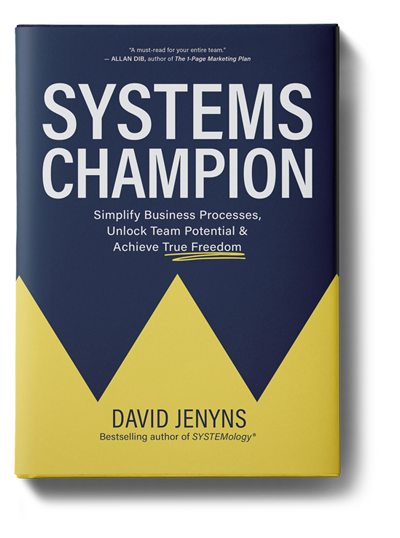
Learn more →
The six responsibilities only the owner can fulfil
1. Name the outcome the systemisation is aiming at. Not "get more systemised", a specific, measurable state of the business. "A business that can run for 90 days without my daily input, delivering X outcomes for customers, with the team confident in their ability to handle Y range of situations without escalation." This outcome is the north star every systemisation investment is oriented toward, and only the owner can define it. Systems Champions can execute against it; consultants can help articulate it; but only the owner can commit to it.
2. Appoint and protect the Systems Champion. The Systems Champion is the operator who owns the day-to-day of systemisation. Only the owner can create the role, hire or promote into it, give it authority, and protect its time from the gravitational pull of urgent operational work. Without the Champion, systemisation is a part-time effort that collapses into the first urgent fire. With the Champion, it becomes a reliable discipline. The appointment is one of the single highest-leverage decisions an owner makes.
3. Enforce the cadence that the team won't enforce themselves. Weekly Systems Champion meetings. Quarterly systems audits. Annual operating reviews. The team will not enforce these when urgent work is louder. The owner has to. Protecting the improvement cadence against the pull of daily urgency is a specific kind of discipline that only the owner's authority can sustain in most small businesses.
4. Model the behaviour you want documented. If the systemisation effort is aimed at making decisions data-driven, the owner reviews the data weekly and references it in decisions. If the effort is aimed at empowering the team, the owner stops making decisions the team should be making. The library documents what the leader practices. When leader behaviour contradicts documented standards, the team follows the behaviour and ignores the documents.
5. Fund the effort with attention, not just budget. Budget is trivial, the cheap stack covers most businesses (the little secret for building business systems cheaply). Attention is scarce. The owner's ongoing engagement in the systemisation effort, asking about it, celebrating its wins, taking its findings seriously, tracking its progress, is the ingredient that makes or breaks the programme. Teams read the owner's attention as a priority signal. Where the owner's attention is absent, the work quietly dies.
6. Decide what gets retired. Systems accumulate without explicit decisions to retire them. Only the owner has the authority to sunset a process that's no longer serving the business, to kill a legacy workflow that's survived its usefulness, to reallocate attention away from things that were important two years ago and aren't anymore. Without this discipline, the library grows heavier indefinitely, and the team eventually opts out of a system that's become burdensome. Retirement is as much the owner's responsibility as creation.
Six responsibilities. All of them judgement calls. None of them delegable. Each one the specific place where the owner's role is irreplaceable and where most small businesses leave value uncaptured.
Callie Saulsburry and the owner-Champion relationship at Crow Estate Planning
Callie Saulsburry is the Systems Champion at Crow Estate Planning, a US boutique law firm specialising in estate planning and probate, headquartered in Tennessee, with staff across three locations in the Southeast. The firm's founder, John Crow, had read The E-Myth and then SYSTEMology, and deliberately appointed Callie into the full-time Systems Champion role to lead the systemisation effort.
What makes Crow a useful case study for owner role is the visible split between John's role and Callie's role. Callie owns the execution of systemisation, the documentation, the library, the team training, the ongoing improvements. John owns the six responsibilities above: naming the outcome the firm is aiming at, protecting Callie's time and authority, enforcing the cadence, modelling the systemised-decision-making he wants the team to practice, sustaining attention on the effort across the multi-year timeline, and making the harder retire/reprioritise calls that only the owner can make.
The result, after several years of this partnership, is a law firm with systemised operations unusual for its size and category, on a clear path to scale across the Southeast without the founder trapped as the bottleneck. The systemisation couldn't have happened without Callie doing the work. It also couldn't have happened without John doing his six owner-specific responsibilities consistently. Neither role substitutes for the other. Both are load-bearing.
Common ways owners get this wrong
Four patterns I see repeatedly in small businesses whose systemisation efforts underdeliver.
Owners who try to do the documenting themselves. They know the work and assume documenting it will be efficient. It isn't, documentation is a craft, practitioners know the work better than owners do, and owner-documented libraries age poorly because practitioners didn't participate in writing them. Owner time is better spent on the six responsibilities.
Owners who appoint a Champion then don't protect the role. The Champion gets operational fires dumped on them. Their improvement time evaporates. The documentation work slides. Within six months the Champion is effectively a line-operations role with "Systems Champion" in the title. The effort dies quietly. The owner's failure to protect the role is almost always the root cause.
Owners who delegate without staying engaged. The inverse mistake. The owner hires a Champion or brings in a consultant and then stops thinking about systemisation. Without ongoing owner attention, the effort becomes an orphan project with no internal sponsor, no priority signalling to the team, and no authority to make hard calls. Delegation without sustained engagement is abdication.
Owners who model the opposite of what they're systemising. The most subtle failure. The owner says the business is becoming data-driven then makes gut-feel overrides on key calls. The team learns that the "system" is rhetorical and real decisions happen elsewhere. The entire library loses credibility in weeks. Consistency between documented standards and leader behaviour is non-negotiable.
Each of these is a specific failure of the owner role, not of the Systems Champion or the methodology or the tools. The owner is the one variable that matters most, and when systemisation fails, it's usually one of these four patterns at the root.
The part you can't skip
If you want to understand the owner's role in one sentence: you are responsible for the conditions that make remarkable systemisation possible, not for the work itself.
The conditions include: a clear target, a capable Champion with protected time, an enforced cadence, consistent behaviour modelling, sustained attention, and disciplined retirement of what's no longer serving. The work itself, the actual documentation, training, measurement, is someone else's job. The conditions are yours.
Most owners try to reverse this split. They want to do the visible work (documenting) and skip the harder invisible work (creating the conditions). The split matters enormously in outcome. Reverse it, and the systemisation effort produces mediocre output no matter how well-intentioned. Honour it, and the effort produces compounding operational value year after year.
The conditions are what you can't skip. Everything else you can delegate, outsource, or skip without meaningful cost. The conditions are the owner's specific work. They are small in time commitment and huge in leverage.
Ready to diagnose your owner-role gap? The Owner Dependency Score measures how much of the business still routes through you daily, usually a signal that one or more of the six responsibilities isn't being fulfilled. Pair it with the Systems Champion Position Description to see what the other half of the partnership looks like. Then install the cadence with a systemHUB free trial.