Most small business owners spend their energy chasing answers.
Sharper ones spend it designing better questions. The difference is enormous. A precise diagnostic question usually dissolves a problem that a week of reactive problem-solving couldn't touch, because the question forces you past the symptom to the structural cause underneath.
Chet Holmes, who built more sales machines than almost anyone, used to say that asking better questions is the highest-leverage skill in small business. Not because questions are magical, but because most problems that feel unsolvable are really problems that were never diagnosed correctly. The question changed the problem. The problem got solvable.
This article walks through the five types of diagnostic questions every small business owner should have in rotation, the Chet Holmes angle on why most problems are interview problems in disguise, and how to install a questioning rhythm so your team starts diagnosing before reacting.
Why most small businesses ask bad questions
Three patterns dominate.
First, they ask "who did this" before "why is this possible in our system." Personal questions produce defensive answers. Structural questions produce improvement. The same incident investigated with "who dropped the ball" and "which handoff allowed this to drop" produces two entirely different outcomes. One creates a quiet performance review. The other creates a durable system fix. (See how good systems reduce business problems, almost every "people problem" has a structural question hiding behind it.)
Second, they ask "what should we do" before "what's actually happening." The rush to action skips the diagnosis, which means the action addresses a symptom instead of a cause. Three months later the same symptom is back with a slightly different costume.
Third, they ask the owner every question. Small businesses route diagnosis through one brain, which doesn't scale and produces a team that's perfectly calibrated to escalate instead of think. The team that can ask its own questions produces ten times the improvement velocity of a team that can only bring answers to the owner for approval.
Fixing all three is a questioning habit, not a technique. The habit is installed by making structured diagnostic questions part of the weekly operating rhythm.
The 5 types of diagnostic questions every small business needs
1. Structural questions. "Where in our system was it possible for this to happen?" Not "who did it." Structural questions point at the machine that permitted the outcome. Incident review, customer complaint, missed deadline, every one of these is an invitation to find the upstream design gap. Structural questions are the opposite of blame, which is why teams relax into them and start surfacing real information.
2. Sequence questions. "What happened right before this?" Problems rarely start where they surface. A late deliverable on Tuesday traces to a brief handed over late on Monday, which traces to a client sign-off request that wasn't flagged as blocking on Friday. Sequence questions walk backwards through the chain until you find the step where the cascade started. (The 5-Whys is a formalised version of this, five why-steps typically traces most incidents to a structural root cause.)
3. Counterfactual questions. "What would have to be true for this not to have happened?" This is the Chet Holmes signature question, phrased for operations instead of sales. The answer almost always points at a specific structural change: a new check, a new template, a new handoff format, a new approval threshold. Counterfactual questions produce action plans instead of lessons.
4. Compounding questions. "If this happens ten more times this year, what will it cost us?" Small frictions feel minor in isolation and ruinous in aggregate. Compounding questions make the aggregate visible, which changes the priority of the fix. A 15-minute weekly friction is 13 hours a year. A $500 rework quarterly is $2,000 + the client-experience damage. Compounding questions convert "nice to fix someday" into "fix this week."
5. Meta questions. "What question should we be asking that we're not?" Reserved for the quarterly strategic review. Meta questions surface the blind spots, the topic nobody's named, the metric nobody's tracking, the decision that's been drifting without an owner. Most strategic surprises in small business are just meta questions that were asked too late.
Five types. Four operational (for weekly rhythm), one strategic (for quarterly). Together they cover almost every diagnostic moment a small business will face.
Callie Saulsburry and the questioning craft at Crow Estate Planning
Callie Saulsburry is the Systems Champion at Crow Estate Planning, a US boutique law firm specialising in estate planning and probate, headquartered in Tennessee, with staff across three locations in the Southeast.
Law firms are the purest case study of questioning-as-craft. The entire product of the firm is structured diagnostic questioning, the lawyer asks a client the right questions to surface the right estate plan, in the right sequence, with the right completeness. Lawyers who can't ask good questions can't practice the craft. Lawyers who can ask excellent ones produce disproportionate outcomes for their clients and referrals for their firm.
What makes Crow Estate Planning interesting is that the same questioning discipline that drives their client work also drives their operational work. When something goes wrong internally, a document delayed, a handoff failed, a recurring friction with a third-party, the firm doesn't leap to an action. It runs a structured diagnostic. Structural questions first. Sequence questions next. Counterfactual questions to nominate the fix. Then action.
The outcome over years is a firm that's much better at eliminating whole classes of recurring problem than peers who treat each incident as a one-off. They scale without the complaint pattern scaling linearly with them. Callie's role is partly to design the business systems, but just as importantly, to be the person in the room whose job is to ask the question the team didn't know to ask yet.

The Chet Holmes angle: the one question that dissolves most problems
Chet Holmes had a favourite diagnostic move when a business owner brought him a complicated growth problem. Before touching the problem, he'd ask a single question: "If a new competitor opened next door tomorrow, cheaper, faster, and hungrier, what would you have to change about your business to stay in the game?"
The owner would answer. The answer almost always included the exact thing they'd been avoiding for months. The problem the owner had brought wasn't the problem; the problem was whatever they just named in response to the competitor question.
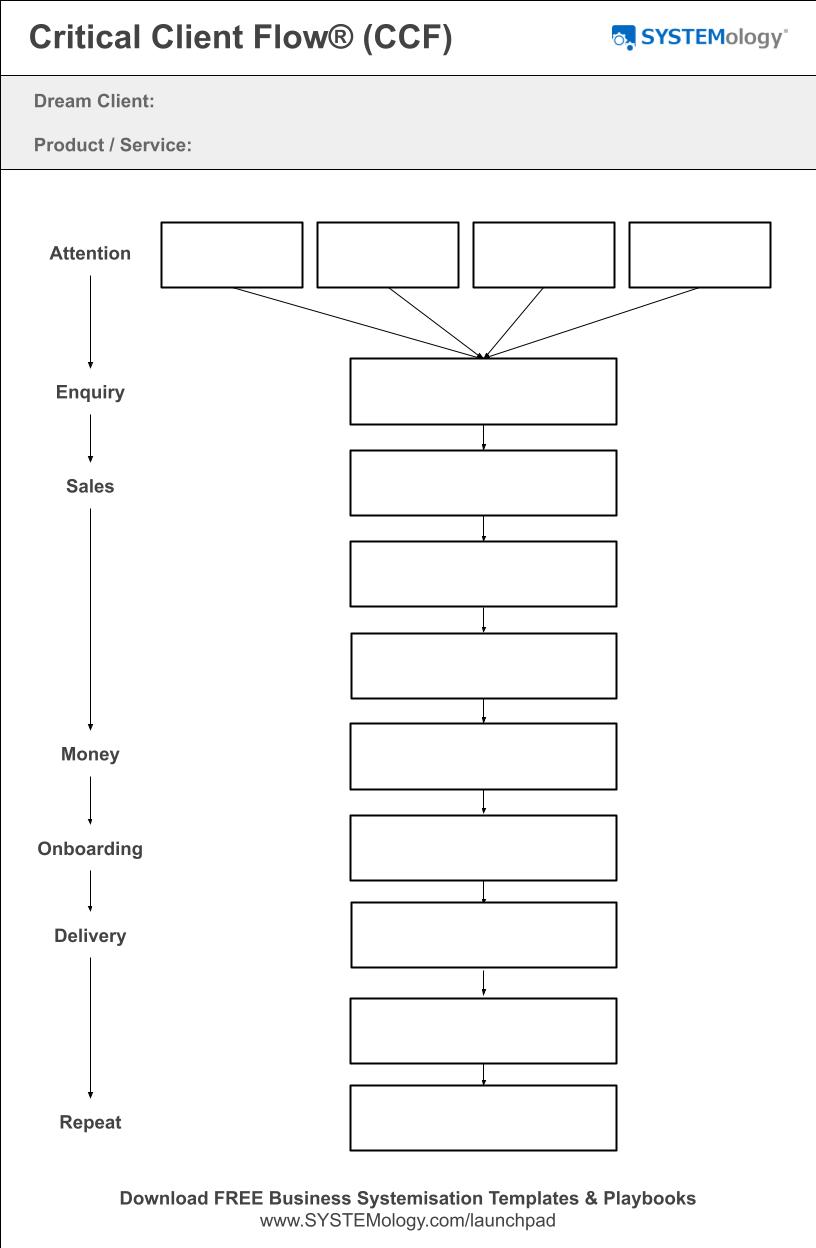
The move is a counterfactual dressed up as a stress test. It bypasses the owner's attachment to the current state and forces them into what's structurally missing. Chet used it for sales diagnostics; it works identically well for operational ones. "If our best competitor copied our Critical Client Flow tomorrow, what's the one step they'd do better than us?" The answer is probably the step you should fix first.
The underlying principle is that most small business problems are problems of self-interrogation, not information. The owner already knows what's wrong. They just haven't been asked the right question by someone patient enough to wait for the honest answer. A good Systems Champion, or a good advisor, or a good spouse who understands the business, is often just a well-placed question away from unlocking a year of improvement.
How to install a questioning rhythm
This doesn't scale through memory. It scales through rhythm.
Weekly team huddle (30 min). The Systems Champion brings one incident or friction from the week. The team walks through it with structural → sequence → counterfactual questions. They end with one specific system-level fix, an owner, and a date. No "we'll think about it." A named fix by a named date.
Monthly customer review (45 min). All customer feedback from the month in one place. The team asks compounding questions of the three biggest themes: "if this customer pattern continues, what does it cost us in a year?" Then picks the top one or two to address structurally next month.
Quarterly owner review (2 hours). This is the meta-question slot. What question should we be asking that we haven't? What are we measuring that's lagging? Where is the business drifting without a decision? Set the strategic cadence by naming the blind spots before they produce surprises.
Annual offsite (1 day). Same meta questions at the year level. Plus: "if we were starting this business today, knowing what we know now, what would we build differently?" That answer is usually the product of the next year.
Four rhythms, four cadences, four different kinds of questions. Together they cover the full diagnostic footprint of a small business from daily friction to strategic drift. Most small businesses run one of these (maybe) and wonder why the same problems keep resurfacing. All four, run consistently for a year, produce a business that's genuinely better at learning than its competitors. Which is, eventually, the only sustainable advantage.
What to try this week
Pick one friction your team is currently complaining about. A recurring customer complaint, a handoff that keeps failing, a system that's been "almost documented" for three months.
Block 30 minutes. Bring the team closest to the friction into the room. Ask the three questions in order: structural ("where in our system was this possible"), sequence ("what happened right before this"), counterfactual ("what would have to be true for this not to have happened").
End the 30 minutes with one concrete system-level fix, one named owner, and one calendar date. No "we'll revisit this." The discipline of the named fix is the whole point.
Run this one session. Watch what happens. You'll almost certainly surface something structural the team has been working around for months without naming. That's the pattern. That's why the question matters more than any specific answer it produces.
Ready to turn questions into improvements? Start with the Systems Strength Test, nine dimensions of your business, diagnosed through nine structured questions. For a deeper self-audit, grade your business systems against the 7-part framework. Then put the weekly questioning rhythm on rails with a systemHUB free trial.