Most efficiency advice is aspirational. Become more organised. Manage your time better. Optimise your workflow. These sound useful and are useless, because they tell you what to be without telling you what to do.
This article does the opposite. Three specific, concrete moves you can make this week, not next quarter, not after a consultant engagement, this week, that collectively recover 5-15% of operational capacity in most small businesses. No hiring required. No firing required. No new software required. Just three design changes to how the work already flows.
The three moves aren't theoretical. They're drawn from the patterns that show up in the first week of almost every small business systemisation engagement. Almost every 10-50 person business benefits from applying all three, and most see visible impact within 30 days of installing them.
Why most small businesses are less efficient than they should be
Three structural reasons.
First, the business grew faster than the design. Systems that worked at five people don't work at fifteen, but the team keeps running the five-person version because nobody has the bandwidth to redesign. The gap between current operating reality and current operating design is where efficiency leaks live.
Second, approvals were designed under earlier risk conditions and never updated. The approval that made sense when the business was doing $500k revenue still exists at $5M, still takes the same time, and still adds the same friction, with none of the original risk it was designed to catch.
Third, handoffs between roles were never formalised. Work moves from one person to another through informal conversation, which is fast when everyone's in the same room and devastatingly slow across asynchronous distributed teams. Most small businesses have never actually designed their handoffs, they've just evolved them.
The three moves below each target one of these structural efficiency killers. Install all three and you'll recover significant capacity without changing your team size or toolstack.
The 3 moves
Move 1: Raise your approval thresholds. Every approval in your business was designed at a specific risk level. If the business has grown, those thresholds are probably stale. Find every approval in your workflow and ask: "what specifically is this approval catching that the person requesting the approval couldn't catch themselves?" If the answer is "nothing specific, it's just the habit," raise the threshold or remove the step entirely. In most small businesses I've seen, approval thresholds can be raised significantly without any increase in error rate, and the time savings are substantial. Days of cycle time, not hours. (See how to cut business costs with systems for the broader pattern, approvals are one of the quiet cost centres most owners haven't looked at in years.)
Move 2: Define your three most-used handoffs. Pick the three handoffs in your business where work moves between roles most frequently, usually sales-to-ops, ops-to-finance, and client-facing-to-internal-execution. For each one, document: what triggers the handoff, what format the handoff takes, what the receiving person needs to accept the handoff, and what the owner of each side is. Write it down. Share it with the team. Run it for 30 days. The team will immediately surface the friction points, and you'll surface where the cycle time was hiding.
Move 3: Identify one recurring "just checking" email and kill it. Every small business has emails that get sent repeatedly just to check on status, chase commitments, or confirm things that should have been automatic. Pick the single most frequent "just checking" email thread in your business. Design it out. That usually means installing a status update that fires automatically when a stage completes, a shared dashboard the requester can check without asking, or a scheduled check-in that makes the ad-hoc email unnecessary. One such email killed is usually worth 30-60 minutes per week across the team. Four killed is worth a full day. Twenty killed is worth a role.
Three moves. Each one implementable in under a week. Collectively they recover the 5-15% capacity that most small businesses carry as operational drag without realising it.
Gary McMahon and Ecosystem Solutions: efficiency through workflow design
Gary McMahon founded Ecosystem Solutions, an Australian environmental consultancy doing bushfire management, ecological surveys, and land restoration. The business has grown from a single operator to a multi-million-dollar firm with dozens of technical staff across multiple states.
Environmental consulting is a brutal efficiency test. Every project is different. Every regulatory regime has different sign-off requirements. Every site has different constraints. There's no way to templatise the work the way you'd templatise a retail transaction, which means efficiency can't come from standardising the output. It has to come from standardising the workflow around variable outputs.
Gary's operation has done exactly that, and the three moves above are visible in the business. Approval thresholds have been raised so senior technical staff can make field decisions without waiting for project-manager sign-off. Handoffs between field teams and report writers are explicitly designed with formats and trigger events. Status updates fire automatically so clients and internal teams don't chase. The firm can throughput more projects per person than typical peers because the workflow around variable technical work has been systematised. (The broader business workflow design principles this draws from are worth the separate read.)
The quarterly efficiency audit
Once the three initial moves are installed, install the maintenance rhythm.
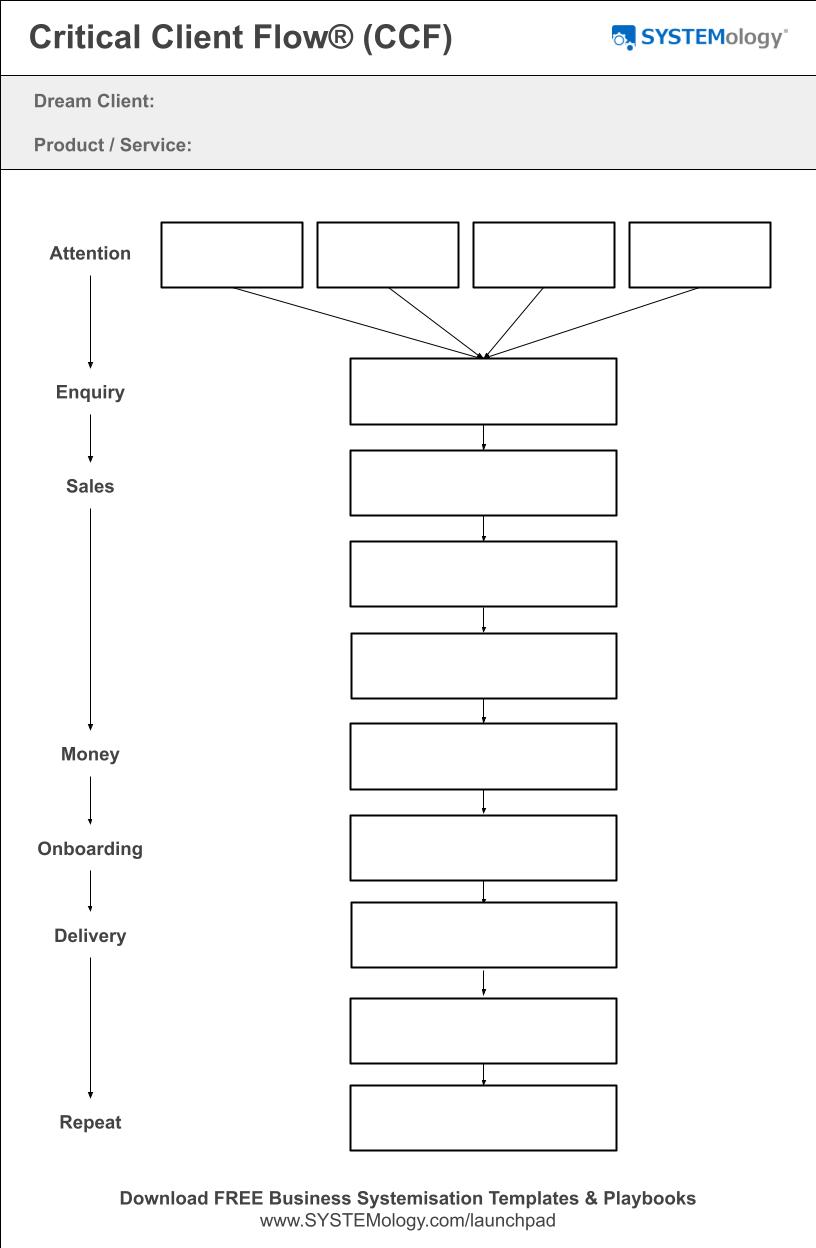
Quarterly efficiency audit (90 minutes per quarter). The Systems Champion walks through the Critical Client Flow with three questions: (1) where is cycle time longer than it needs to be; (2) where have approval thresholds drifted out of sync with risk; (3) where are "just checking" communications happening repeatedly.
The audit produces a list of 5-15 candidate moves. The Champion and owner pick the top three. Those three get fixed next quarter. At the next audit, the next three. Twelve moves a year, compounded across a Critical Client Flow, transforms a small business's operational tempo over a two-to-three year horizon.
Most small businesses never run this audit. They make one-off efficiency moves when a problem gets painful enough to notice, then revert. The quarterly rhythm is what keeps the business efficient without crisis as the trigger.
Try this today
Pick Move 1 or Move 3, whichever feels most achievable in your specific business this week. Block 60 minutes. Find three approval thresholds to raise OR one recurring "just checking" email to kill. Make the change. Email the team to confirm the new standard.
That's the whole test. One move, one hour, one week. By next Monday you'll know whether the change produced the expected capacity gain. If it did, install Move 2 next week. If it didn't (rare), diagnose why with a quick 5-Whys and adjust. (The 5-Whys tool is the fastest way to diagnose implementation issues without overthinking them.)
Efficiency isn't an abstract goal. It's a set of specific design decisions that can be made in specific hours by specific owners. This article gave you three of those decisions. The decision to make them is yours.
Ready to find where the drag is worst? Run the Owner Time Audit to see exactly where your hours are going, the audit usually surfaces one or two of the three move candidates automatically. For a broader diagnostic, try the Systems Strength Test. Then systemise the efficiency wins with a systemHUB free trial.