You Didn't Start a Business to Work 60 Hours a Week
The data is clear. The pattern is consistent. The businesses that scale, sell, and give their owners freedom all share one thing: documented, repeatable systems.
The Problem
39%
of small business owners work 60+ hours a week
Source: SCORE
63%
of entrepreneurs report feeling burnt out
Source: ZipDo
67%
check in to work every day while on vacation
Source: SCORE
You started your business for freedom. Autonomy, flexibility, the chance to build something of your own. But somewhere between the first customer and the fiftieth, freedom flipped into its opposite.
Now you're the answer to every question. The fixer of every problem. The only person who truly knows how things work. You arrive early, get pulled into fires, work late, and check your phone on the one holiday you managed to take.
This is a problem as old as business itself. The owner starts with a vision of freedom and ends up more trapped than any employee. You're not imagining it. And you're not alone.
It's not a character flaw. It's a structural problem. And it has a structural solution.
The Risk
Everything your business has learned about how to do what it does — the workarounds, the client preferences, the "we tried that and it didn't work" lessons — lives in the heads of you and a handful of key people.
This isn't a quirk of your business. According to Gartner, 42% of all institutional knowledge lives solely with individual employees. When they leave, nearly half of what they knew becomes inaccessible.
This creates three compounding problems:
You can't grow beyond those people.
New hires take months to get up to speed because there's nothing written down. Research shows that documented onboarding SOPs reduce new-hire ramp-up time by up to 50%.
You can't step away.
The moment you do, things break. According to McKinsey, employees spend 1.8 hours every day — nearly 25% of the working day — searching for information that should be obvious. That's the equivalent of hiring five people and only getting the output of four.
You're one bad day from catastrophe.
A resignation, an illness, a key person moving on. Replacing them costs 50 to 200% of their annual salary, and the knowledge they take with them is gone forever.
Most business owners only discover this when it's too late. The seasoned entrepreneur learns it through trial and error — through the gut-punch of losing a key team member or hitting a growth ceiling that won't budge.
The Evidence
Every entrepreneur who breaks through — who builds something that doesn't require them to be there every day — eventually arrives at the same conclusion. Systems and processes become the backbone of their business. Not because someone told them to, but because they lived through what happens without them.
"What Michael Gerber started, David Jenyns completed."
— Jack Daly, author of Hyper Sales Growth
The data backs this up:
30%
more likely to scale with documented processes
Source: Comprose/Whale
25%
higher growth in companies with operational excellence
Source: Harvard Business Review
10–50%
key person discount applied to owner-dependent businesses at sale
Renee and Matt Kelly built Lime Therapy into a 40-person allied health service in rural Australia. But the business had hit a ceiling. Policies sat in folders unused. Processes lived in people's heads. After committing to SYSTEMology, they identified a Systems Champion within the team, started documenting their Critical Client Flow, and saw immediate wins. Today, systemisation is part of their culture. Team members proactively look for processes to improve. Renee and Matt have stepped back from daily operations, trusting the systems and the team to run the business.
The good news? You don't have to learn this the hard way. There's a shortcut.
The Consensus
The World's Best Business Minds All Say the Same Thing
From Andrew Carnegie in the 1880s to Jeff Bezos today, every generation of business builder arrives at the same conclusion. Systems are the infrastructure that separates businesses that last from businesses that don't. Yet for most business owners, it remains an afterthought - the thing they'll get to "when things calm down." Things never calm down.
"I try to buy stock in businesses that are so wonderful that an idiot can run them. Because sooner or later, one will."
Warren Buffett — Chairman, Berkshire Hathaway
"Effective process is not bureaucracy. Bureaucracy is senseless process."
Jeff Bezos — Founder, Amazon
"You do not rise to the level of your goals. You fall to the level of your systems."
James Clear — Author, Atomic Habits
"The company must be set up so it can continue without me."
Richard Branson — Founder, Virgin Group
"Create great decision-making machines by thinking through the criteria you are using to make decisions while you are making them."
Ray Dalio — Founder, Bridgewater Associates
Franchises with documented systems succeed at a rate of 75-95%. Independent businesses without them? Roughly 20%. The evidence has been clear for decades. The gap isn't knowledge - it's execution.
Three Things That Surprise Every Business Owner We Work With
1
You're the worst person to document your own processes.
Business owners skip steps, overcomplicate things, and frankly, they'll never finish. The best person to document a process is the team member who does it every day. And the best person to drive the whole project isn't you either — it's a Systems Champion inside your team. Someone detail-oriented and organised who can keep the momentum going while you stay focused on the business.
2
You don't need a 40-page corporate manual.
Stuffy SOPs that nobody reads aren't systems — they're shelf decoration. The most effective systems are simple, visual, and built to be used, not filed. If your team won't actually open it, it doesn't exist.
3
You don't need to document everything.
Start with your Critical Client Flow — the handful of processes that directly touch your customer's experience. That's usually 10 to 15 processes. Get those right first. You can always expand later. Trying to document everything at once is the reason most businesses never start.
67% of well-formulated strategies fail due to poor execution (Harvard Business Review). The fix isn't a better strategy. It's getting the critical few things documented and followed.
The Urgency
The Gap Is Widening
Two forces are converging that make this the most important time to act.
It has never been easier to build systems. AI tools have collapsed the effort required. What used to take months of painful documentation can now happen in weeks. Record your best performer once, and AI generates the step-by-step documentation. The barrier to getting started has never been lower.
It has never been more important. The businesses winning with AI aren't the ones with the fanciest tools. They're the ones who are crystal clear on their processes. Because process becomes the programming for the machines. It tells the AI: "This is how we do things. Now do it faster, cheaper, and better."
Without documented processes, you can't leverage AI effectively. You're trying to automate chaos.
"Process is the programming for the machines."
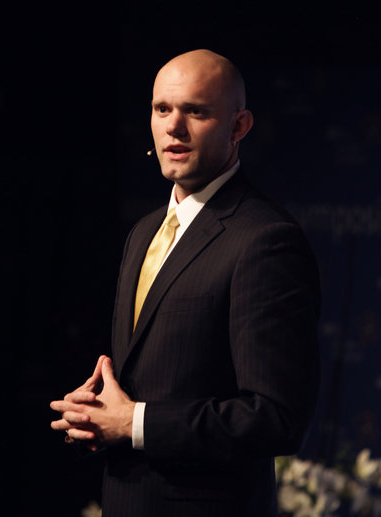
— David Jenyns
Every month, the gap between systemised businesses and those without documented processes gets wider. And it's accelerating.
The Vision
What It Looks Like When It Works
Your team handles operations because everything is documented and accessible. New hires get up to speed in days, not months. You focus on strategy, growth, and the parts of the business you actually enjoy. You take a holiday and your phone doesn't buzz.
Your business becomes an asset — something that has value independent of your personal involvement. Something a buyer would want. Something your team can run. Something that gives you back the freedom you started with.
"Every business owner deserves to build something that works without them."
Shannon was working 70-hour weeks running an award-winning accounting firm. Critical knowledge was stuck in her head, and the business was entirely dependent on her. After implementing SYSTEMology, she identified a Systems Champion, mapped her Critical Client Flow, and centralised everything in systemHUB. She removed herself from day-to-day operations, took her first long holiday in years, and the firm continued to grow without her.
Next Steps
Three Ways to Start
Read the Book
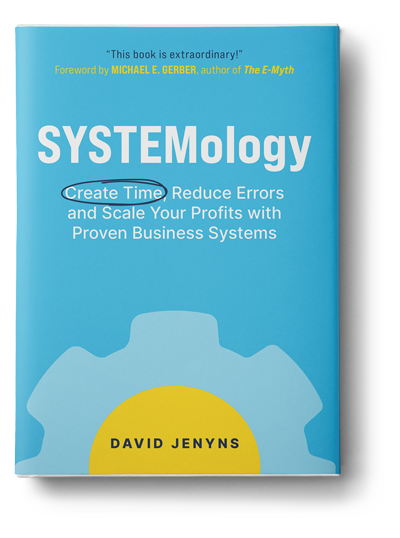
SYSTEMology lays out the complete 7-stage framework. Step by step. No fluff. Endorsed by Michael E. Gerber and Gino Wickman.
If you want to scale, sell, or simply stop being the bottleneck, yes. Documented systems are what separate businesses that grow from businesses that stall. They reduce owner dependency, cut onboarding time in half, and make your business a transferable asset.
Start by mapping your Critical Client Flow — the 10 to 15 processes that directly touch your customer experience. Then assign a Systems Champion (not you) to lead the documentation. The SYSTEMology framework gives you the exact steps.
Most business owners see meaningful change within 90 days of starting. The first few documented systems create immediate relief. Full operational independence typically takes 6 to 12 months.
Yes, but only if you document your processes first. AI can convert recordings into written SOPs, accelerate onboarding, and identify bottlenecks — but it can't improve a process that doesn't exist on paper. Process first, then AI.

 — Jack Daly, author of Hyper Sales Growth






 — David Jenyns