About 40% of businesses that sign up for systemHUB shouldn't have, yet.
Not because the platform is wrong for them. Because they haven't fixed the prerequisites that make any system-aware platform actually land: no named Systems Champion, no allocated documentation time, no leadership alignment on whether systems are a current priority. Those businesses subscribe, use the platform poorly, cancel within 90 days, and often blame the platform for their own preconditions. I'd rather tell you honestly whether you're in the 60% who'll get value from systemHUB or the 40% who should fix the prerequisites first.
Someone asked me recently whether systemHUB was the right tool for their 4-person services business. My honest answer was "probably not yet, but almost certainly in 6-12 months." That answer doesn't sell a subscription today. It does build trust and it saves the owner from paying for a platform they'd use poorly. Rather than pitch the platform generically, here's the honest diagnostic: when does it fit, when doesn't it, and what operational conditions predict whether you'll get value from it or regret the subscription.
What systemHUB is actually designed for
systemHUB is a system-aware documentation platform. The design assumption is that a business has (or wants to have) structured, documented operating systems that need to be stored, maintained, and referenced by a team.
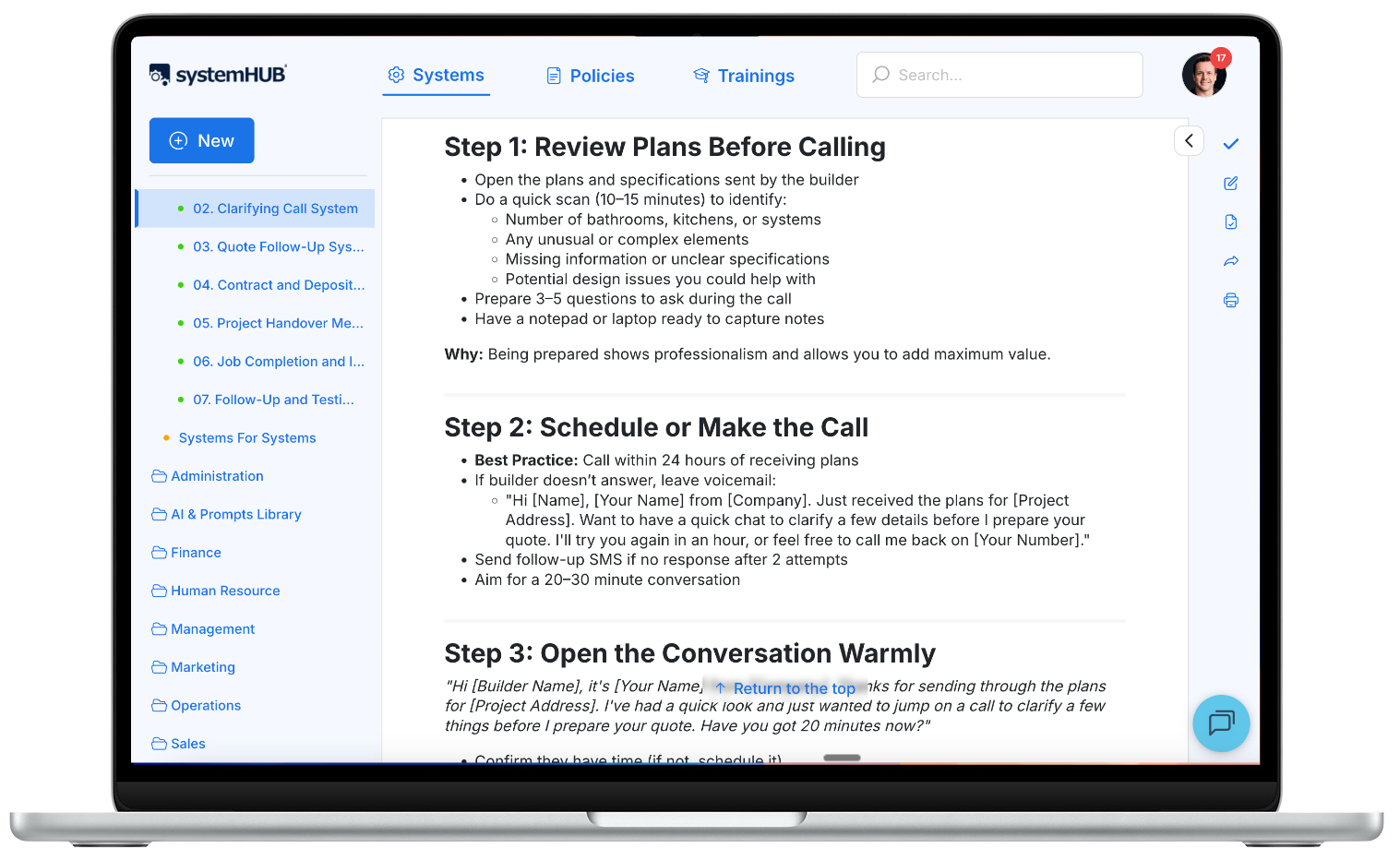
The "system-aware" part is what differentiates it from general notes tools. Every document in systemHUB has metadata specific to operational systems: owners, edit cadences, status, version. The platform exposes that metadata as primary navigation, which means you can see at a glance which systems are current, which need review, who owns what, and where the gaps are.
For a business managing 20-200 documented systems across a team of 5-50 people, that structure produces operational clarity a general notes tool can't match. For smaller or larger businesses, or for businesses that aren't yet running structured documentation, the differentiation matters less.
How systemHUB compares to SweetProcess and other SOP tools
The most common question I get alongside "is systemHUB right for me?" is "how is it different from SweetProcess?" Fair question. Here's the honest comparison, because the two platforms sit in genuinely different categories even though they look similar at first glance.
SweetProcess is SOP software. Its primary job is storing and sharing standard operating procedures. It does that job competently. If all you want is "somewhere to put SOPs," SweetProcess works and the pricing ($99/month) is in the same range as systemHUB Starter ($95/month).
systemHUB is a systemisation platform built on a methodology. Beyond document storage, systemHUB ships with the SYSTEMology framework baked in, 100+ pre-built templates for common small business systems, AI tools for drafting and refining documents, and implementation support at the Champion tier including live 90-day sprints. The platform assumes you want to systemise a business, not just store SOPs.
The practical difference shows up in what you're trying to accomplish. If you already have documented systems and just need a home for them, SOP software is sufficient. If you're trying to actually systemise an operation (identify what to document first, document it, get the team using it, and build a review rhythm), the methodology-plus-platform combination earns its price. The $4/month pricing gap isn't the story. The outcome gap is.
For the full comparison, see systemHUB vs SweetProcess: Why Software Alone Won't Systemise Your Business.
When systemHUB fits
Four operational conditions predict good fit.
1. You have at least 5-10 people on the team.
Below about 5 people, the coordination overhead systemHUB is designed to solve is often manageable with simpler tools. Team members can keep systems in a shared Google Drive folder and Slack. As the team scales toward 10+ and especially as it scales toward 30-50, the coordination friction compounds and system-aware tooling earns its keep.
2. You're actively documenting systems (or ready to).
systemHUB is a tool for businesses that have decided to build documented operating systems. If documentation isn't a current priority, the platform is premature. Fix the priority first; then the platform makes sense. A signed-up-and-unused systemHUB subscription is a sign that the systemisation commitment wasn't there yet.
3. You have (or plan to have) a Systems Champion.
The platform works best when one person in the business owns the systemisation effort. Without a Champion, systems get documented inconsistently, reviews get skipped, and the library slowly drifts toward chaos regardless of what platform holds it. The Champion role is more load-bearing than the platform choice. Appoint the Champion first; the platform becomes useful around them.
4. You're scaling beyond the founder's direct operational presence.
The core operational problem systemHUB solves is making the business run when the founder isn't the bottleneck anymore. If you're happy for the founder to remain the centre of every operation (some businesses genuinely are), the platform's structure is extra overhead. If you want operational capacity to exist independent of the founder, the platform earns its keep.
When systemHUB doesn't fit
Four conditions where something else (or nothing) is the better choice.
1. Solo operator or 2-3 person business.
At this scale, Google Docs + a shared drive + a task tool will handle the documentation need. The structured metadata systemHUB provides is overkill. Revisit in 12 months when the team has grown and the informal approach is breaking down.
2. Enterprise complexity requiring custom workflows.
If you need custom approval flows, complex role-based permissions, regulated-industry compliance features, or deep integrations with enterprise systems, systemHUB won't be enough. You'll be better served by enterprise platforms like Nintex, Process Street enterprise tier, or custom-built solutions. systemHUB sits in the small-business-to-mid-market range by design.
3. You just want a wiki.
Notion, Confluence, or even a well-organised Google Drive will do the wiki job cheaper and with more general flexibility. systemHUB's structure is specifically for business systems, not for general team knowledge. If your primary need is "shared team knowledge base," pick a wiki tool; don't over-specify.
4. You haven't decided to systemise yet.
This is the most honest disqualifier. If the business isn't committed to documented systems with owners, cadences, and review rhythms, no platform will land. Fix the commitment first. Read the SYSTEMology book, appoint a Champion, decide on the operational approach. Then evaluate platforms.
Questions to ask before subscribing
Five questions that predict whether systemHUB (or any system-aware platform) will work for you.
- Do you have a named Systems Champion? (If no, fix first.)
- Is the leadership team aligned that documented systems are a current priority? (If no, alignment is the first move.)
- Can you name three business systems you'd document in the first month? (If no, start with a smaller documentation exercise before the platform.)
- Who will do the documenting? (If "the owner in spare time," results will be limited. Someone needs meaningful allocated time.)
- What does success look like in 90 days? (If you can't articulate this, slow down before subscribing.)
If you can answer all five clearly, systemHUB (or a similar platform) will probably earn its keep. If several answers are fuzzy, the platform isn't the first move.
What a good 90-day trial actually looks like
Assuming the fit is there, a successful 90-day trial has specific markers.
Week 1. Platform installed. Top-level system framework built (6-10 parent categories). One document migrated from existing storage.
Month 1. Five-to-eight systems documented under the new structure. Team members know how to find and edit documents. Edit cadences set for first three priority systems.
Month 2. Library growing to 15-25 systems. Team referencing documentation voluntarily during work. Founder's operational load measurably lower.
Month 3. Library structure stable. Weekly rhythm around documentation updates. Next 6-month documentation roadmap defined.
If month 1 produces less than 5 documented systems, something's wrong, usually a Champion issue or an allocation issue, not a platform issue. If month 3 is still chaotic, the business likely wasn't ready for the platform yet. The markers are diagnostic; they tell you whether the investment is landing or not.
The broader point about tool fit
Most small businesses evaluate tools by comparing features. Does Tool A have this? Does Tool B have that? That's the wrong question. The right question is: what operational conditions does this tool work best under, and do we have those conditions?
Features matter, but much less than fit. A feature-rich platform used by a business not ready for it underperforms a simpler platform used by a business that is ready. When you're evaluating systemHUB or any business systems platform, spend more energy on fit diagnostics than feature comparisons.
The 5-minute qualifier: answer the five questions above honestly. Count your yesses. If you got 4-5 yesses, you're in the 60% who'll get value from systemHUB, start the free trial today and run the 90-day markers. If you got 2-3 yesses, you're borderline, fix the gap (usually the Champion appointment or the leadership alignment) and revisit in 30 days. If you got 0-1 yesses, you're in the 40% who shouldn't subscribe yet, work the Owner Dependency Score to surface where your real bottleneck is, and come back to platform evaluation once the prerequisite is addressed. That's honest. I'd rather lose the subscription today than have you blame the platform 90 days from now.