Small business owners face specific constraints that most business-systems advice ignores.
Time is scarce and interrupted. Budget for consultants, platforms, and dedicated hires is limited. The team is small and multi-hat. The daily operation has to keep running while systemisation work happens. Generic "best practice" systemisation advice, written for companies with chief operating officers and dedicated transformation budgets, doesn't translate cleanly.
This is the owner-specific version. Six principles tuned to the actual conditions a small business owner operates under. Each one accounts for limited time, tight budget, small team, and the need to keep the lights on while building. The goal isn't systems that look good on a slide deck; it's systems that get used, improve results, and compound over the years the owner stays involved.
Why owners specifically need a different playbook
Three structural reasons generic systemisation advice under-serves small business owners.
Owners run multiple functions simultaneously. The owner isn't the head of operations running a systemisation programme, they're also the salesperson, the product designer, the hiring manager, and the customer escalation point. Advice that assumes dedicated systemisation time collapses on contact with the owner's actual week.
Owner attention is the scarcest resource in the business. A large company has dozens of managers who can own different initiatives. A small business has one or two people whose attention determines whether anything gets prioritised. Systemisation that demands continuous owner attention competes with every other priority and usually loses.
The owner's presence is load-bearing in ways leadership's isn't at larger scale. When a corporate leader is out for a week, the business continues. When a small business owner is out for a week, things usually stop or wobble. Systems advice for small business has to account for this, the whole point of the work is often to reduce that exact dependency, which is a different problem than "run this programme alongside your other responsibilities."
The 6 principles for owner-led systemisation
1. Trade money for time when the trade is available. Owners often try to DIY every part of systemisation, documenting, training, reviewing. When budget allows, buy the time back. An AI assistant at $20/month can draft documents the owner would otherwise spend hours writing. A part-time Systems Champion can run reviews the owner would otherwise postpone. Every hour of owner time reclaimed is hours that can go to higher-leverage work, or simply home at a reasonable time.
2. Start with the systems that reduce YOUR workload first. Not the ones a consultant would prioritise. The ones that specifically take work off the owner's plate. Weekly invoicing you do manually. Client onboarding that routes every decision through you. Vendor coordination that lives in your inbox. Systemise those first because they pay back in owner hours immediately, which funds the patience for slower-payback systemisation work later.
3. One system at a time, finished to running. Parallel systemisation kills owner-led efforts faster than any other mistake. Running three half-documented systems feels productive and produces nothing. Pick one. Finish it. Then the next. (Focus-finish is its own discipline.)
4. Appoint a Champion before you need one. The temptation is to wait until the business "needs" a Systems Champion (usually around 15-20 staff). By then, the owner has been doing systemisation solo for years and built bad habits. Promote or hire the Systems Champion earlier than feels justified. Part-time is fine. The role's authority and time protection matter more than full-time headcount.
5. Document for the person who comes next, not for yourself. Owner-written documentation often reads as memory-aid, notes to self. The person who'll actually read it in 2 years won't have your context. Write each system for a competent newcomer, with explicit context, clear triggers, defined owner, measurable outcome. A document that works for a new hire works for you too; the reverse isn't true.
6. Protect the cadence against your own urgency. The single most common way owner-led systemisation stalls: the owner commits to a weekly systemisation rhythm, then cancels repeatedly under operational pressure. The team reads cancellation as "this isn't really a priority." Protect the cadence even when it's inconvenient. Especially when it's inconvenient. That's when the signal is strongest.
Six principles. All tuned to owner-specific constraints. Collectively they produce systemisation that actually lands in small businesses where the owner is the operational centre of gravity.
Alison Rogers and Vocal Manoeuvres Academy: owner-led systemisation in a founder-dependent practice
Alison Rogers runs Vocal Manoeuvres Academy, an Australian vocal coaching practice that's trained thousands of singers over decades. Vocal coaching is a founder-dependent category by default. The founder's skill, taste, and teaching approach are what customers are buying. Scaling the academy without losing what made it valuable is a textbook owner-led systemisation challenge.
Alison's approach applies every one of the six principles in some form. She's systemised the methodology itself, so other instructors can deliver to her standards, not by scripting them, but by documenting the scaffolding that preserves the teaching craft. She started with the systems that reduced her workload first (administrative coordination, student progression tracking, instructor onboarding). She worked on one system at a time, finishing each before starting the next. She built the scaffolding for other instructors early, before the business "needed" it. She wrote everything for the person who comes next, not for her own reference. And she protected the systemisation cadence against the competing urgency of her client-facing teaching work.
The result is an academy that's outlasted most vocal coaching businesses in her category, with consistent quality across multiple instructors, and a founder who still teaches but isn't the entire product anymore. That's what owner-led systemisation done well looks like. Not dramatic. Not glamorous. Just a multi-year discipline that produces a business capable of existing beyond the founder's direct daily involvement.
The owner's first 90 days
If you're just starting this work, here's the rhythm that compresses the most learning into the shortest time:
Days 1-30. Audit your week. Where does your time actually go? What percentage of your hours would disappear if three specific processes were systemised? Usually 20-40%. Those three are your starting candidates. Pick one.
Days 31-60. Document that one. Record yourself doing the work, narrating as you go. Convert the recording into a one-page document. Share it with the team, get their edits. Run it for a week with the document in hand.
Days 61-90. Train one other person against the document. Hand them the system for a week. Fix whatever they flag as unclear or missing. At the end of the 90 days, the system is running without you, or you've learned what specifically blocks that transition and can address it before the next system.
90 days, one system converted. Feels slow. Produces the owner-hours-reclaimed that makes the next system cheaper and faster.
What compounds over years
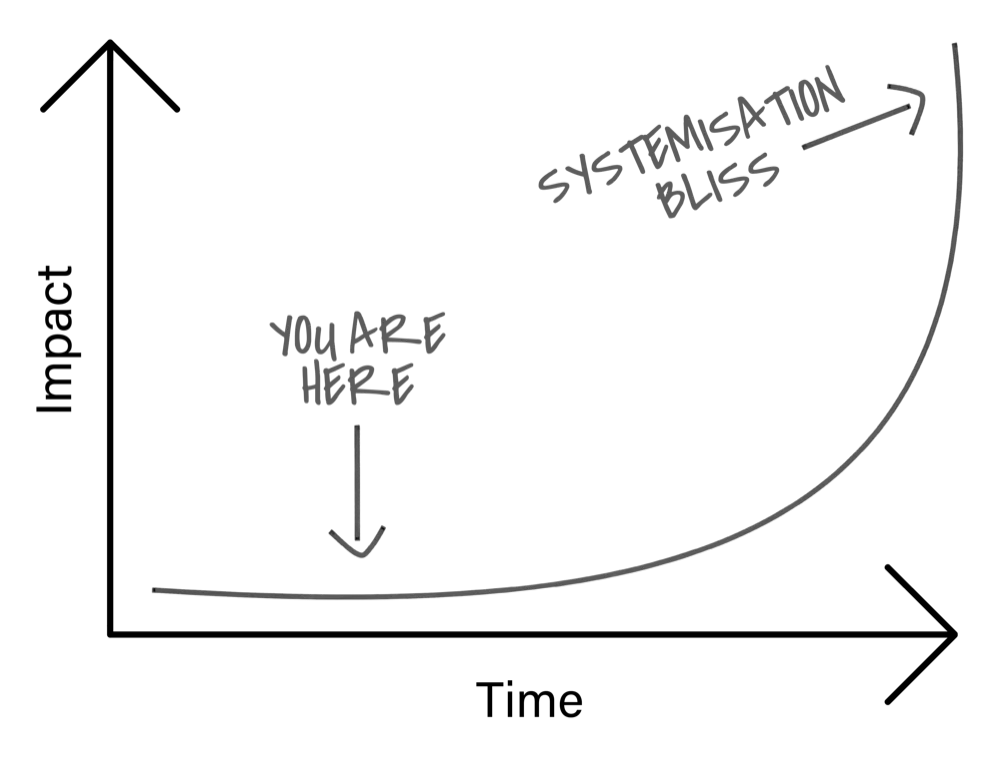
Owner-led systemisation compounds in a specific way most owners don't expect.
Year one, you get one or two systems running. Feels modest. Maybe 5-10 hours a week of owner time reclaimed.
Year two, you have 4-6 systems running. The reclaimed time is now enough to fund a Systems Champion part-time or a VA full-time. The rate of conversion accelerates.
Year three, the library has 10-15 systems. The owner's daily presence is genuinely less necessary. Decisions route through the team. Holidays get taken. The business feels different.
Year five, the library has 25-40 systems. The owner can step back, sell, franchise, or redirect to a completely different focus. The operational foundation has become an asset that exists independently.
None of this requires extraordinary talent or budget. It requires the six principles, sustained over time, protected against owner urgency. The owners who do this end up with businesses that look qualitatively different from the owners who kept meaning to start but didn't.
Ready to start your owner-led systemisation? Run the Owner Dependency Score to see the current state of owner-workload concentration, usually it's worse than the owner realises and the number itself creates useful urgency. Then pick one system and commit to 90 days. Start with a systemHUB free trial to house the documentation.