If no one in your business can articulate how the work actually gets done, you can't move to AI-first. Full stop.
That's the line nobody is drawing in the AI conversation, and it's the line that's about to sort businesses into winners and losers. The bottleneck isn't tech budget. It isn't talent. It isn't being early. It's documentation.
The maturity curve nobody asked for
Dave Ebbelaar laid out a three-stage AI maturity model in a recent video. He's right about the curve. But he's missing the layer underneath, and that layer is the whole game.
The three stages, briefly.
AI-enabled. Your team uses ChatGPT and a few AI features inside the tools they already have. Nothing structural changes. The org chart looks the same. The processes look the same. Some people are 20% faster at writing emails. That's the level most businesses are at right now.
AI-first. The business gets re-engineered around agents as the primary operational layer. Roles change. Workflows change. Decisions about what to do next get handed off to systems that don't sleep. Humans review, approve, and step in for judgment calls. They don't push paper.
AI-native. Built ground up assuming an agent does the work. There's no human-version of the workflow to compare against. The business simply couldn't run the way it runs without agents at the centre of it.
Ebbelaar's call is that every business gets forced along this spectrum. Not because owners want to. Because AI-native upstarts will out-execute incumbents on speed, cost, and consistency, and customers will follow. He's right. That's the curve.
But here's what he doesn't say loudly enough.
The unspoken bottleneck
You can't hand a workflow to an agent if no one can articulate the workflow.
Read that twice.
This sounds obvious when you read it. It is anything but obvious in practice. Most businesses, even good ones, run on tribal knowledge. The "how we do it here" lives in three people's heads. The order of operations, the edge cases, the unwritten rules about which client gets the white-glove treatment and which doesn't. None of it is on paper. None of it is in a system. It works because Sarah's been there for eleven years and just knows.
That business cannot become AI-first.
Not "it'll be hard." Not "it'll take longer." It cannot be done.
You cannot brief an agent on a process that no one has written down. You cannot have a meaningful conversation with an AI tool about a workflow that exists only as a vibe. The agent will hallucinate, the team will lose faith, the project will get shelved, and the owner will conclude that AI is overhyped.
The AI is not overhyped. The documentation is just missing.
I've been saying for over a decade that systems are how businesses scale, exit, and survive. That argument used to be about freedom and predictability. Important, but soft. The AI shift turns it into something harder. The documentation that used to be a "should" is now the literal precondition for participating in the next era. Your team can't hand work to an agent if your team can't explain the work. So step one is always the same. Document the work. SOPs are the audit output. Agents are the build output. Skip step one and the agents fail.
Where the agent opportunities actually live
Once a business is documented, the next question is: of the hundred things we do, where do agents go first?
The lean manufacturing world has had a useful answer for fifty years. They call it Type 2 waste. Activity that adds no value but the system requires it anyway. Not the obvious waste like sitting around. The hidden waste. The kind nobody thinks to question because it's just "how it works."
Three signals tell you where Type 2 waste is hiding in your business.
Duplicate steps. The same piece of information gets entered into three different tools. The lead's name goes into the CRM, the project tracker, the invoicing system, and a spreadsheet someone's maintaining on the side. Every time it's typed, there's a chance it's typed wrong. Every typo costs someone half an hour to fix later.
Manual data shuffling between systems. Your operations person spends Tuesday mornings copying numbers from one report into another report. Your bookkeeper exports a CSV from one tool and imports it into the next. Nothing about the data changes. It just moves. Slowly. By hand.
People moving things by hand that the system should know. A client signs the contract, and now someone has to go tell the onboarding team, the finance team, and the project lead. None of those handoffs are doing real work. They're just delivery vans for information that the contract already contains.
That's where agents go first. Not the creative work. Not the relationship work. Not the judgment calls. The duplicate, shuffling, hand-carrying work. The work that is invisible because it's so normal nobody questions it.
If you can spot Type 2 waste, you can spot agent opportunities. They're the same thing.
The most valuable skill of the next decade isn't prompt engineering
There's a lot of noise about prompt engineering being the skill of the future. It isn't. Prompt engineering is a skill. It's not the skill.
The skill is process auditing.
The ability to walk into a business, sit with the people who actually do the work, and reverse-engineer what they're really doing. Not what the org chart says they do. Not what the procedure manual claims happens. What actually happens, on a Tuesday afternoon, when the client calls and something's gone slightly sideways. The audit captures that. The documentation makes it transferable. The agent then takes the documented version and runs it.
Most of the engineers Ebbelaar describes have to learn the auditing skill from scratch. They know how to build agents. They don't know how to interview a 40-year-old construction owner and figure out which 3 of his 47 daily decisions could be handed to a system without anything blowing up. That interview skill, that empathy plus pattern recognition plus systems thinking, takes years to develop. You can't shortcut it with a model upgrade.
This is the part nobody is pricing in.
The people who've been doing process audit work for a decade, the SYSTEMologists, the operations consultants, the lean coaches, the people who've sat through hundreds of "but we've always done it this way" conversations and gently pulled the actual workflow out, have a head start that the engineers can't buy.
Your team has been doing it the whole time. You just didn't know it was about to be the most leveraged role of the next ten years.
Why systems thinkers were always going to win this round
I've spent the last decade telling business owners that documenting their systems is worth the effort. The argument used to be about freedom. Document the work, train the team, take the three-month phone call, and your business runs without you. That's still true. Always will be.
But the AI shift adds a second argument that's harder to ignore.
A business with a fully documented critical client flow is not just a business that can run without the owner. It's a business that's pre-loaded for the agent layer. Every documented process is a brief. Every brief is an instruction set. Every instruction set is a candidate for automation. The asset is the same. The use case multiplied.
Look at what's already happening with the businesses I work with.
Shannon Smit runs a specialist accounting firm doing complex international transfer pricing work. Two years ago, she was working 70-hour weeks and the entire business lived in her head. She and her Systems Champion documented the critical client flow, centralised it, and got the team running on the documented systems. Shannon stepped out of daily operations. That was the freedom outcome. The AI outcome is that her firm now has the substrate to start layering agents over the top, automating research, streamlining reporting, accelerating documentation of new procedures. She's two steps ahead of every competitor who's still trying to figure out where to start.
Ryan and Eryn Stannard run a $15-20M construction business. Same arc. They documented the work, got the team running on the systems, and Ryan got his time back. The business is now in a position that 95% of construction firms aren't, which is that there's a written record of how the work actually flows. When the agents arrive, they'll have something to read.
Renee Kelly built Lime Therapy into a 40-staff allied health practice, hired Kaleb as a Systems Champion with two years of OT experience and zero systems background, and watched her invoicing time drop ten-fold. The systems were the win. The agents are next. The agents work because Kaleb already wrote the manual.
None of these owners set out to become AI-first. They set out to get their lives back. The AI-first capability is a free upgrade that fell into their lap because they did the documentation work for the old reason.
That's the SYSTEMology decade in one sentence. Quiet, unglamorous documentation work, done patiently for ten years, has just turned into the most strategic asset a business can hold today.
Compounding on compounding
There's a graph I've been showing audiences for years. Two lines on it. The flat one is what most businesses look like. Busy. Working. Growing slowly. Gaining a bit and losing a bit. Mostly running in place. The steep one is what happens when systems take hold. Documentation accumulates. Each documented process improves the next one. The team gets faster at documenting, better at improving, more consistent at executing. The line doesn't go up linearly. It bends.
That's the compounding effect of systems. It's been true for a long time. It's how a business goes from grinding to gliding.
AI has its own compounding curve. Models get better. Tools get cheaper. The work an agent can do today is more than it could do six months ago, and dramatically more than it could do two years ago. A business that gets fluent with agents earns leverage that grows year on year, almost regardless of what the business itself is doing.
Most owners are looking at one curve or the other. The systems crowd talks about systems compounding. The AI crowd talks about AI compounding. The interesting move sits in the overlap.
When you stack them, you don't add the curves. You multiply them.
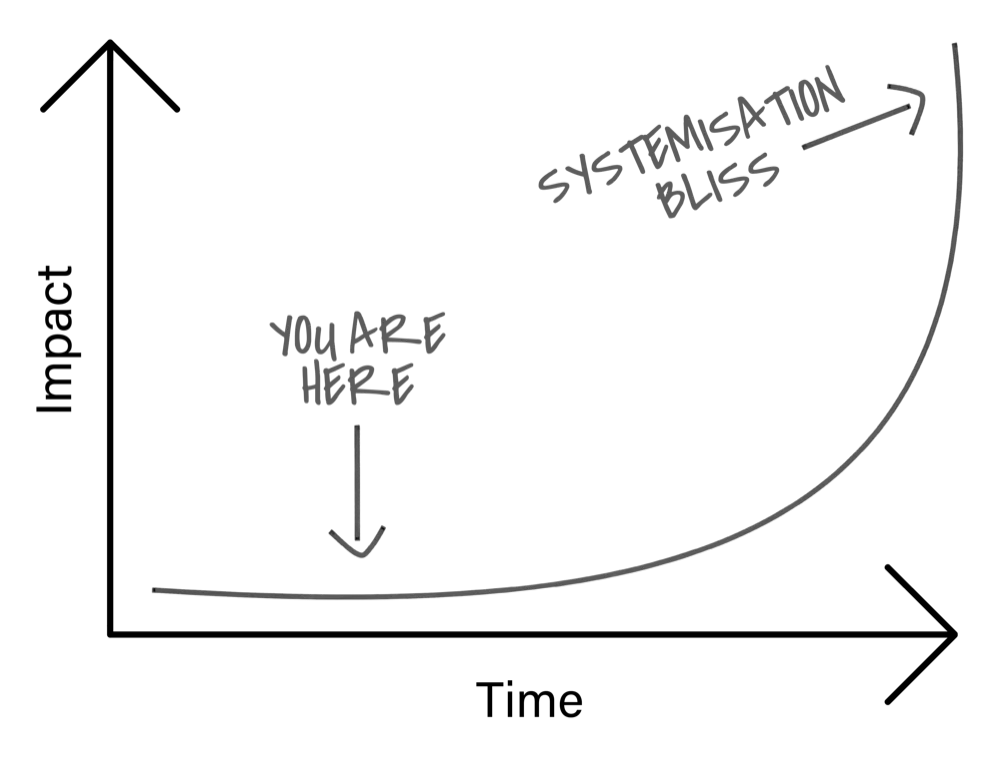
A documented business that adopts agents isn't getting a 10% lift on its systems work plus a 10% lift on its AI work. It's getting both compounding effects working on the same operational substrate. Each documented process becomes a candidate for an agent. Each agent's output becomes input for refining the next process. Each refinement makes the next agent easier to brief. The systems compound. The AI compounds. And then they compound on each other.
This is why the gap between leaders and laggards is about to widen faster than most owners expect. Not because the leaders are smarter. Because they're stacking two exponential curves where most businesses are stuck on one, or neither.
The AI Roadmap is the natural next deliverable
Once a business has its critical client flow documented and its core systems centralised, a new question shows up.
Of the things we've documented, which of them should we hand to agents first?
This is the next deliverable. Call it an AI Roadmap. The output is a ranked list. Take each documented system, score it on Type 2 waste density, frequency of execution, and the cost of getting it wrong, and you get an order of operations. The top of the list is where you start. The bottom of the list is where humans stay involved for the foreseeable future.
You can't build that roadmap without the documentation underneath. Anyone trying to build an AI strategy without the systems work first is just guessing about what their business actually does. That's not a strategy. That's a wishlist.
This is the work I see happening in advanced businesses right now. The audit comes first. The roadmap comes second. The build comes third. The order matters more than any individual decision in it.
Where to start
If your processes aren't documented, that's the work. Yesterday was the right answer. Today is the second-best answer. There is no shortcut. You cannot AI your way past this step. The shortcut is to start now and accept that the first six to twelve months will look like documentation, not transformation. That's fine. Documentation is transformation, just in a form most owners don't recognise as exciting. Start with the critical client flow. Pick the one process that's causing the most pain. Document it. Then the next.
If your processes are documented, the work is the audit. Walk through your library with fresh eyes. Look for the duplicate steps, the shuffling, the hand-carried information. Build your AI Roadmap. Pick the top one or two systems and run small experiments with agents that handle them. Learn what works. Learn what doesn't. The companies pulling this off in 2026 are not the ones with the biggest AI budget. They're the ones with the cleanest source material.
For the practical sequence on how to get from documented system to working agent, I've laid the steps out in Process First, Then AI. For the role most businesses will need to hire or appoint to drive this work, I've covered it in What Is an AI Champion?. If you're still earlier than that, the systemisation pillar is the place to start.
The maturity curve is real. The forced march up it is real. The piece nobody's talking about is that the climb starts with a notebook and an interview, not a model and a prompt. The most valuable skill of the next decade is not prompt engineering. It's the ability to walk into a business, find the work that's hidden in someone's head, and get it on paper clearly enough that something else can run it.
The audit muscle has always been the work. Now it's the moat too.